
Tag: cognición y arte
-

The machine removes our easy answers
Cada vez que una máquina aprende a hacer algo que creíamos nuestro, alguien se apresura a decir que eso, en realidad, nunca fue lo importante. Cuando calcularon mejor que nosotros, dijimos que calcular era mecánico. Cuando ganaron al ajedrez, que el ajedrez era solo cálculo con reglas. Cuando empezaron a escribir párrafos correctos, que redactar…
-
Eight arcminutes
A comienzos del siglo XVII, Johannes Kepler pasó unos cinco años peleándose con el planeta Marte. Tenía en las manos las mejores observaciones astronómicas jamás tomadas hasta entonces, las de Tycho Brahe, un danés que había medido las posiciones de los planetas a simple vista, sin telescopio, con instrumentos enormes y una obstinación sin igual,…
-

Six tactile paintings
In 2015 the Prado Museum mounted a small and unusual exhibition. It was called Today it is the Prado's turn and consisted of six paintings from the collection reproduced in relief, with textures and volumes of up to six millimetres, so that they could be traversed with the hands: a Velázquez, a Goya, a Greco, a Correggio, a still life…
-
Twenty-seven seconds
There is a figure that circulates through museum outreach texts with the authority of the obvious: the average visitor looks at the Mona Lisa for fifteen seconds. It is repeated in articles, talks and guides, always to say the same thing, that we no longer know how to look, that contemplation is dead, that we pass before works as before…
-

The empty chair
On 7 July, The New York Times published a report with a headline that sounds like retribution: the revenge of the philosophy graduates. Artificial intelligence laboratories are hiring philosophers. Not as an ornamental gesture: Google DeepMind and Anthropic each have at least half a dozen, there is a constitution of twenty-three thousand…
-
How a world chooses what it observes
Introducing a series on regimes of relevance. Over the past few days, I have published a series of five texts in this public notebook without prior announcement. This silence was intentional; I preferred the collection to be complete before presenting it, allowing for the entire trajectory to be offered rather than five separate notifications. Here it is,...
-
The box that does not read itself
On the limits of interpretability and the opacity of the machine regime of relevance. This line of inquiry has maintained a thesis throughout four texts: aesthetic understanding rests upon regimes of relevance, and the regime of relevance of a machine differs from that of a human. I demonstrated that this divergence is measurable (in the...
-
Processes without meaning
On generative art and what humans and machines may share. The first text in this series concluded with an intuition which I marked as an inference, rather than a conclusion. When discussing the work Rain Blooms by Kazuhiro Tanimoto, I suggested that between very distinct entities—a human and a computational system—the common ground...
-
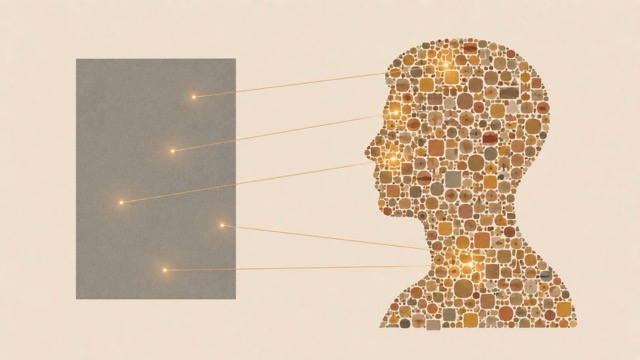
The effect of self
On self-relevance as the core of aesthetic judgement and its machine boundary. In the two previous texts of this series, I maintained two points. First, that aesthetic understanding rests upon regimes of relevance, and that misunderstanding—between cultures, between humans and machines—is a misalignment of those regimes. Second, that the divergence between attention...
-
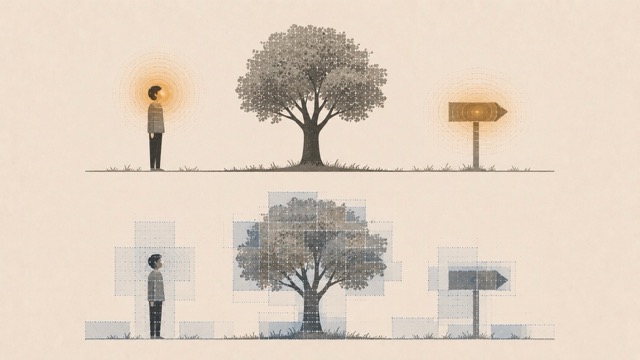
Where the machine looks
On the measurable divergence between human attention and model attention. In the previous text of this series, What Matters and What Is Relevant, I maintained that aesthetic misunderstanding—between human cultures and between humans and machines—can be described as a misalignment of regimes of relevance: distinct hierarchies of what counts...