
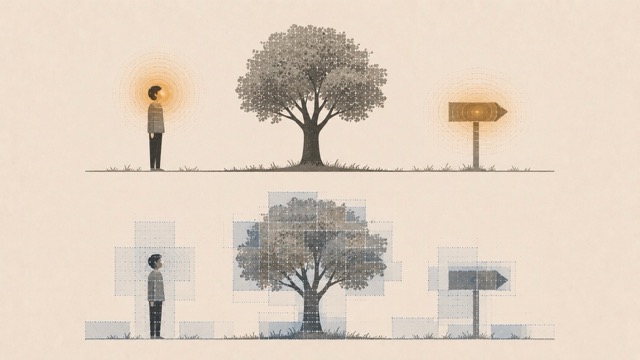
On the measurable divergence between human attention and model attention
In the preceding text, What matters and what is relevant, I argued that aesthetic misunderstanding—between human cultures and between humans and machines—may be described as a misalignment of relevance regimes: distinct hierarchies of what counts as a significant signal. That text operated primarily on a conceptual plane. This one operates on an empirical one, and it does so to answer a specific question: when a human and an artificial intelligence system are confronted with the same image, do they look at the same places?
The answer provided by the available evidence is both clear and nuanced. They do not look at the same places; the divergence is measurable, repeated, and systematic; and it is concentrated precisely where human relevance ceases to be formal and becomes social, semantic, or vital. Yet that divergence is not proof that the machine 'sees worse': it is an effect of the objective for which it was trained. When the objective changes, alignment with the human gaze may increase significantly, without ever becoming identical.
Before proceeding, a clarification that the previous text left imprecise and which is central here. Speaking of 'machine attention' groups together, in a misleading way, at least four distinct things: human ocular fixation measured via eye-tracking, the saliency map of a model trained specifically to predict those fixations, the internal weights of an attention module in a model trained for another task, and Grad-CAM-style explanation maps that attempt to reconstruct what influenced a decision. These are four levels that public discourse conflates and which should be separated, because a good deal of the confusion regarding 'whether AI sees as we do' arises from comparing them as if they were the same.
1. Four things called attention
It is advisable to establish the distinction before utilising the data, as it underpins everything else.
The first level is observed behaviour: where a person's eyes rest when viewing an image, recorded via eye-tracking. It is behavioural data, directly measurable. It is not a hypothesis about anything; it is what occurs.
The second level is the saliency model: a system trained specifically to predict those human fixations. Its stated objective is to imitate the gaze. The DeepGaze family is the reference example. Here, the model performs no other task: its task is to resemble us while looking.
The third level consists of the internal attention weights of a model trained for a different task—classifying, answering questions about images, generating. Those weights indicate, in an approximate manner, which parts of the input the model weighs when operating. They were not designed to resemble the human gaze; they are a byproduct of the architecture.
The fourth level is explanation maps, such as Grad-CAM, which attempt to reconstruct a posteriori which regions influenced a model's decision. These are interpretations of the machine produced by external tools, not the machine's gaze itself.
The distinction matters because the answer to 'do humans and machines look at the same things?' changes radically depending on which of the four levels we discuss. Conflating them produces both naive optimism—'AI already sees as we do'—and easy catastrophism—'the machine sees nothing'. The truth is more subtle and lies in the data.
2. Do they look at the same places? The cleanest case
The study that addresses the question directly is that of Das and collaborators on visual question answering. The authors constructed a dataset of human attention—they asked people to indicate which regions of an image were relevant for answering a question about it—and compared it with the attention maps of the models that solved the same task.
The result is compelling. The best model of the time achieved a mean rank correlation of 0.26 with human maps. The agreement between different humans was 0.623. And in the evaluation corrected for central bias—the tendency to look at the centre of any image—the models fell to correlations of between 0.038 and 0.114. The authors' conclusion was explicit: the attention models for this task do not appear to look at the same regions as humans.
It is worth reading those figures carefully. They do not state that the model fails in its task—many answered the questions correctly. They state that they arrived at the correct answer by looking at something else. Success did not imply coincidence of gaze. This is the first empirical crack: one can solve the problem without sharing the relevance regime with the one who poses it.
A second study, by van Dyck and colleagues, compared human eye-tracking and Grad-CAM maps in object recognition on the same stimuli. Its dual value lies in measuring divergence while simultaneously warning of a methodological trap: human and machine visualisations possess different resolutions, and comparing them without correcting for this distorts the result. Even after correction, the agreement remained low: one architecture coincided with human attention blocks in 17% of cases, another in 12%. The study leaves a lesson worth retaining: the correct question is not 'do they resemble each other?', but 'which architecture, which task, and which comparison metric?'.
3. When the goal is to imitate the gaze
The decisive nuance emerges when the model is specifically trained to predict human fixations. There, the alignment increases significantly. DeepGaze II, built upon features from an object recognition network, manages to explain approximately 87% of the explainable information in human fixations, with very high metrics on benchmark test sets.
However, it does not achieve identity. In direct comparisons, the model falls below the level of agreement between humans. It performs particularly well in predicting that we will look at faces and text—because it has learned that this is where we look—but a low-level, purely physical model outperforms it on around 10% of images. That is to say: even the system designed to resemble our gaze leaves a remainder uncaptured, and that remainder is not random noise; it is the structure of the human gaze that the model fails to reproduce.
There is an even more revealing finding, by Fel and colleagues. When comparing 84 deep networks with human data on which features are diagnostic for recognising objects, they found a systematic trade-off: as models improve their accuracy in the task, many become less aligned with human visual strategies. Greater accuracy, less resemblance to us. This is exactly the opposite of what common sense would expect—'the better the AI, the more like us'—and it is central to the thesis: the machine does not move away from our gaze due to a technical default, but, at times, due to an excess of optimisation. It becomes more effective in its task by separating itself from how a human establishes relevance.
4. Where it breaks down: the social, the semantic, the vital
The divergence is not distributed equally across the image. It is concentrated in specific zones, and those zones are revealing.
Human gaze is not distributed solely by physical salience—contrast, brightness, edges. Cerf and colleagues demonstrated that, in free-viewing conditions, individuals look at faces and text significantly more often than at comparable regions matched for size and position: approximately sixteen times more for faces, eleven times more for text. Furthermore, a purely physical model requires the addition of semantic information regarding faces and text to approach predicting gaze. Social and symbolic elements carry weight for us, even when they do not dominate the visual field in physical terms.
Rösler, End, and Gamer confirmed this with briefly presented naturalistic scenes: initial saccades are oriented towards social features more than would be expected by chance, and social content predicts the direction of the first gaze better than physical salience. The act of looking at social stimuli is, in their terms, reflexive: it occurs prior to any deliberate decision and is directed towards areas that are not those of greatest physical salience. We looked at them for what they signify, not for how they stand out.
On the machine side, the regime is different. Geirhos and colleagues showed that standard convolutional networks trained for classification are heavily biased towards texture, whereas humans prioritise shape. Faced with a conflict between shape and texture—the silhouette of a cat with elephant skin—human and machine reach different conclusions, and for different reasons. Crucially, upon retraining the same architecture with a dataset designed to force attention towards shape, the model adopted a strategy more akin to the human one. The divergence was not a destiny of the machine; it was an effect of the training.
Internal analysis of salience models refines the picture further. He and colleagues found that certain semantic categories—heads, text, symbols, vehicles—are already encoded in pre-trained networks, but that fine-tuning to predict salience causes the model to favour some over others, for instance, heads over text. Moreover, the model learns to trigger on faces with relative independence from whether that face is truly the most relevant region in the context. And although these models dominate in natural scenes, they fail when faced with synthetic pop-out stimuli that classical models resolve with ease. They have learned certain biases of the natural world very well, and other regularities of human attention very poorly.
The picture that emerges is not that the machine is blind. It is more uncomfortable and more interesting: the machine learns some of our invariants—it recognises faces, text—but it weights them differently, thereby producing a cartography of relevance that resembles our own on the surface while diverging in structure.
5. The case of art: a gap that is data
One might expect art to be the field where this comparison has been most studied, given the weight of eye-tracking in aesthetic research. This is not the case, and it is worth stating this precisely.
There is sound evidence regarding how a human views a work of art. Quiroga and colleagues recorded gaze towards figurative and abstract paintings and found that, despite individual variability, common fixation patterns exist: in one work, for example, the attention of all subjects was drawn to the area of greatest sharpness. Massaro and colleagues showed that gaze towards painting results from the interaction between bottom-up and top-down processes, and that correlations between aesthetic assessment and gaze patterns appeared precisely in the areas of the faces. Even in art, the social and the affective retain special weight.
There is also reasonable evidence that part of that gaze can be modelled. Le Meur and colleagues constructed a set of 150 paintings from five movements, found that the deployment of the gaze before paintings resembles that of natural scenes, and demonstrated that a saliency model specifically adjusted to the art domain predicts better than a general one. Art is not excluded from modelling, but generalisation from natural images is limited: it requires retraining.
What I did not find—and it is worth stating this as an honest limitation—is a consolidated line of research that systematically compares the eye-tracking maps of art spectators with the internal attention of general vision models applied to those same works. In art, computational comparison primarily takes the form of a salience model that predicts gaze, rather than an assessment of what a classifier deemed important in the painting. This asymmetry is not a drawback for my approach; it is, in itself, a data point. The territory where the divergence between human and machine relevance would be most significant—art, where vital weight and historical context are at their maximum—is precisely the least studied in these terms. There is a research gap here that the programme I outlined in the previous text—the archive of importance—is designed to begin filling.
6. Why a map is not a reading of what mattered
There remains a level that should be treated with caution, as it is where popularisation most often falters. Even if we possessed the internal attention map of a model, would it tell us what it truly found important?
The research response is no, or at least not reliably. Jain and Wallace, in a paper with the eloquent title 'Attention is not Explanation', showed that a model's attention weights correlate weakly with other measures of feature importance, and that it is possible to construct entirely different attention distributions that produce the same prediction. If two opposing maps yield the same result, the map cannot be the explanation for the result.
In computer vision, the issue recurs. Chefer and colleagues maintain that reducing a transformer to its attention weights is shortsighted: it ignores other operations that participate in the decision, and some methods based solely on attention highlight irrelevant elements or produce maps that do not even distinguish between classes. More recently, Wu and colleagues demonstrated that certain standard metrics for explanation fidelity fail to distinguish effectively between sophisticated methods and purely random attribution.
The consequence for this line of work is significant and should be formulated without exaggeration: even from within, we currently lack fully reliable access to 'what mattered' to the model. We possess approximations, some useful, others misleading. This reinforces, rather than weakens, the thesis of the regime of relevance: not only does the machine's regime differ from the human; that regime is also opaque, and remains so even for those who possess the entire model and its weights. The box does not read itself with transparency.
7. What this demonstrates and what it does not
It is prudent to close the door on three misinterpretations.
It does not demonstrate that the machine perceives less effectively. In many tasks, models perform as well as or better than humans. What the evidence shows is not an inferiority of machine vision, but a difference in criteria: it arrives at often correct results by attending to other regularities. Looking differently is not looking poorly.
It does not demonstrate that the divergence is fixed or essential. The opposite is true. When the training objective is changed—from classifying to predicting fixations, from texture to shape—the alignment with human vision shifts, sometimes significantly. The divergence is an effect of the objective, the architecture, and the data, not a metaphysical property of 'the machine'. This matters because it neutralises both catastrophism and determinism.
It does not yet demonstrate the self-referential part of my thesis. Solid evidence covers divergence in the social and semantic realms—faces, text, shape versus texture. The leap from there to 'the vital weight, that which touches the self' remains, for now, my own interpretive extension, not a closed empirical result. The social aspect is demonstrated; the self-referential is a well-founded but open inference. Marking that distinction is part of the rigour this line demands, and it is also one of the questions that the research programme must address directly.
8. Conclusion
Three conclusions.
The first, empirical: when humans and machines attend to the same stimulus, the coincidence is partial, conditional, and measurable. Studies comparing human and machine attention maps on the same stimuli find low correlations, well below the agreement between humans, except when the model is specifically trained to imitate gaze, and even then, a remainder remains uncaptured.
The second, analytical: the divergence is concentrated where human relevance ceases to be formal and becomes social, semantic, or vital. We look at faces, text, and meaningful content even if they are not the most physically salient; models, depending on their objective, rely on other regularities. And the divergence is not fixed: it depends on the objective, the architecture, and the data, which confirms that we are discussing configurable regimes of relevance, not an essential blindness.
The third, methodological and programmatic: we do not even have reliable access, from within, to what mattered to the model, which renders its regime of relevance doubly distinct from our own—it diverges and it is opaque. And the territory where this divergence would be most significant, art, is precisely the least studied in these terms. That gap is not an obstacle to the line of research I have been tracing: it is its justification.
The machine does not look less. It looks differently, and it looks differently for reasons we can measure, name, and, in part, modify. Knowing where it looks—and where it ceases to coincide with us—is the first empirical step toward understanding what would need to change in its architecture of relevance for its vision to approach comprehension, rather than merely a correct result. That is the distance between solving a problem and sharing a world.
On open conversation
This text is the second in the series on regimes of relevance that I opened with 'What matters and what is relevant', as part of my work in NeuroArt: Cognitive Surplus. If that piece established the thesis on a conceptual level, this one subjects it to empirical evidence regarding comparative attention. The planned next steps address the effect of self-relevance on aesthetic judgement and the limits of model interpretability.
If anyone wishes to intervene from the fields of perception psychology, computer vision, neuroaesthetics, model interpretability, or artistic practice, this notebook remains open.
Sources
Das, A., Agrawal, H., Zitnick, L., Parikh, D., & Batra, D. (2017). Human Attention in Visual Question Answering: Do Humans and Deep Networks Look at the Same Regions? Computer Vision and Image Understanding, 163, 90–100. https://doi.org/10.1016/j.cviu.2017.10.001
van Dyck, L. E., Kwitt, R., Denzler, S. J., & Gruber, W. R. (2021). Comparing Object Recognition in Humans and Deep Convolutional Neural Networks—An Eye Tracking Study. Frontiers in Neuroscience, 15, 750639. https://doi.org/10.3389/fnins.2021.750639
Müller, R., Dürschmidt, M., Ullrich, J., Knoll, C., Weber, S., & Seitz, S. (2024). Do Humans and Convolutional Neural Networks Attend to Similar Areas during Scene Classification: Effects of Task and Image Type. Applied Sciences, 14(6), 2648. https://doi.org/10.3390/app14062648
Kümmerer, M., Wallis, T. S. A., & Bethge, M. (2016). DeepGaze II: Reading fixations from deep features trained on object recognition. arXiv:1610.01563. https://arxiv.org/abs/1610.01563
Fel, T., et al. (2022). Harmonizing the object recognition strategies of deep neural networks with humans. NeurIPS 2022. https://arxiv.org/abs/2211.04533
Cerf, M., Frady, E. P., & Koch, C. (2009). Faces and text attract gaze independent of the task: Experimental data and computer model. Journal of Vision, 9(12):10. https://doi.org/10.1167/9.12.10
Rösler, L., End, A., & Gamer, M. (2017). Orienting towards social features in naturalistic scenes is reflexive. PLoS ONE, 12(7), e0182037. https://doi.org/10.1371/journal.pone.0182037
Geirhos, R., Rubisch, P., Michaelis, C., Bethge, M., Wichmann, F. A., & Brendel, W. (2019). ImageNet-trained CNNs are biased towards texture; increasing shape bias improves accuracy and robustness. ICLR 2019. https://arxiv.org/abs/1811.12231
He, S., et al. (2019). Understanding and Visualizing Deep Visual Saliency Models. CVPR 2019. https://arxiv.org/abs/1903.02501
Quiroga, R. Q., & Pedreira, C. (2011). How Do We See Art: An Eye-Tracker Study. Frontiers in Human Neuroscience, 5, 98. https://doi.org/10.3389/fnhum.2011.00098
Massaro, D., Savazzi, F., Di Dio, C., Freedberg, D., Gallese, V., Gilli, G., & Marchetti, A. (2012). When Art Moves the Eyes: A Behavioral and Eye-Tracking Study. PLoS ONE, 7(5), e37285. https://doi.org/10.1371/journal.pone.0037285
Le Meur, O., Le Pen, T., & Cozot, R. (2020). Can we accurately predict where we look at paintings? PLoS ONE, 15(10), e0239980. https://doi.org/10.1371/journal.pone.0239980
Jain, S., & Wallace, B. C. (2019). Attention is not Explanation. NAACL 2019. https://arxiv.org/abs/1902.10186
Chefer, H., Gur, S., & Wolf, L. (2021). Transformer Interpretability Beyond Attention Visualization. CVPR 2021. https://arxiv.org/abs/2012.09838
Wu, J., et al. (2024). On the Faithfulness of Vision Transformer Explanations (SaCo). CVPR 2024. https://arxiv.org/abs/2404.01415
Esteban Ruiz, J. A. What matters and what is relevant. Public notebook at juanesteban.art, 2026.
Esteban Ruiz, J. A. Art as Structural Surplus: Toward a Relational Ontology Beyond Human Authorship (V2.3). PhilArchive and Zenodo, 2026.