
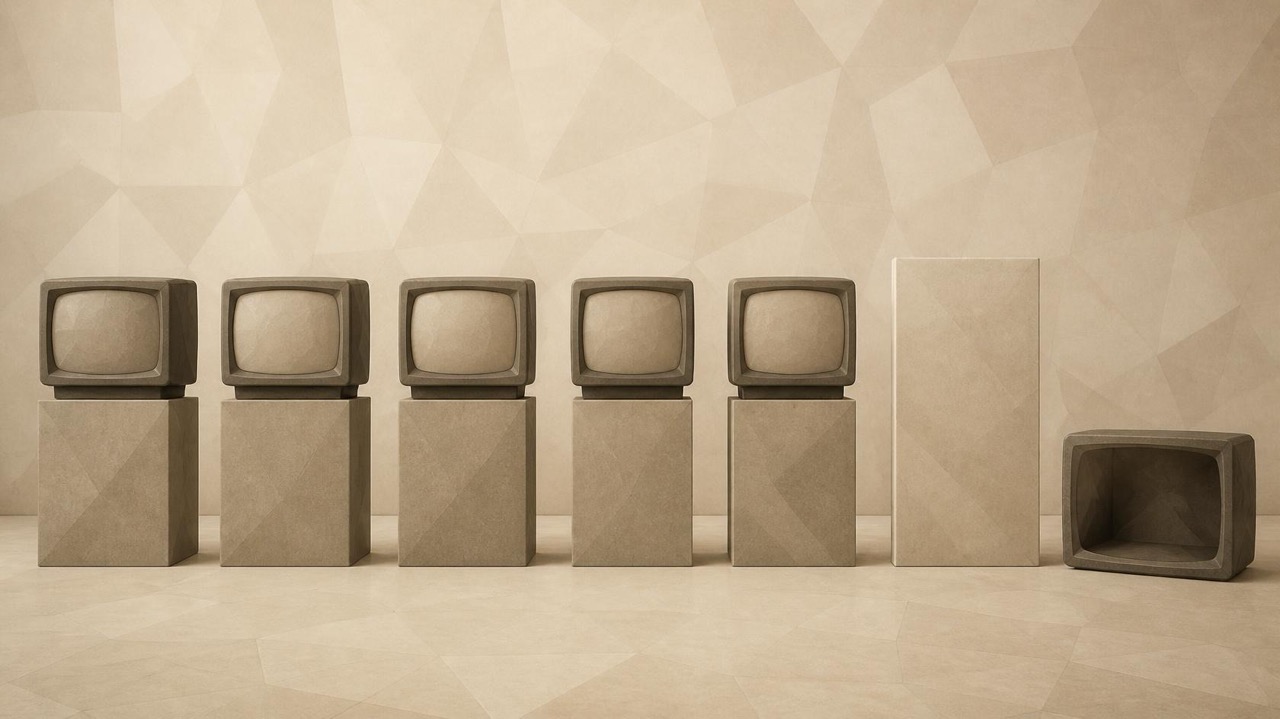
A painting also changes and requires conservation, yet a technological installation introduces a unique difficulty: it only exists fully when it is reinstalled. A technological installation is conserved by reinstalling it: in another room, with different lighting, often with a different screen, because the original is no longer manufactured. Each reinstallation changes it slightly. The question conservators face is uncomfortable: to what extent can it change without ceasing to be the same work?
Monitors that no longer exist
The problem is evident in a specific object: the tube monitor. Many video works from the seventies, eighties, and nineties, such as the installations by Nam June Paik, were created using cathode-ray tube televisions. They are no longer manufactured, and those that remain are prone to failure.
Replacing them with flat screens appears straightforward: the image remains visible. However, the tube was not merely a screen. It possessed depth, a curved surface, a distinct brightness and flicker, a hum, and a furniture-like volume. In many works, it was also sculpture. Changing it may preserve the video while losing the work. Museums have been forced to decide on a case-by-case basis: to store original devices while they remain functional, to preserve the casings with new electronics, or to accept visible substitutes.
Not every component fulfils the same function
Before replacing equipment, it is advisable to distinguish its functional, aesthetic, historical, sculptural, and conceptual value. A monitor may be a mere playback device or the visible volume that organises the space. Two technically equivalent components can produce a different experience due to their scale, latency, brightness, noise, or relationship with the body.
The decision requires a reference: artist documentation, photographs, video, plans, parameters, and records of earlier set-ups. Without this, an installation may remain powered on while having lost the relationship that defined it.
The precedent: deciding what defines the work
The Tate addressed the problem with a method now used by many museums. Pip Laurenson, then head of time-based media conservation, proposed distinguishing between the properties that define the work and the contingent components that can be replaced. A reference case was Between Cinema and a Hard Place by Gary Hill, an installation with dozens of monitors that the Tate documented as a system: what it does, how it behaves, which parameters are essential, and which can be adapted to each room. With that documentation, and with the artist, it was possible to reinstall it.
The Metropolitan Museum added a practical tool: two types of report. The identity report establishes what the work is, what was acquired, and what scope for change it permits. The iteration report records each set-upe, with what equipment, and what decisions were taken. Over the years, iteration reports chronicle the life of the work.
Identity and iterations
The Metropolitan Museum uses identity and iteration reports based on models developed at the Guggenheim. The former describes the identity of the work, the materials acquired, its exhibition history, and the flexibility of presentation. The latter documents each set-up and the decisions that made it possible. These do not replace the contract or the interview with the artist, but they allow for the reconstruction of why a version was considered acceptable.
What it resolved and what it did not
The method resolved an important problem: it replaced the impossible question of whether the work remains the original with one that can be answered: whether it retains what defines it.
Yet it has limitations. It depends on someone having decided what is essential, and that is easier with a living, accessible artist and a museum with the resources to interview them. When the artist has passed away and left no criteria, the decision falls to conservators or heirs. And public museum documentation rarely reveals these decisions: the file remains internal.
A process for deciding on change
A substitution should leave a record of:
- The failure or risk that necessitates intervention.
- The function and significance of the affected component.
- The alternatives considered: storage, repair, substitution, migration, emulation, or reinterpretation.
- The comparative tests conducted.
- The authorisation of the artist or the party with the authority to decide.
- The resulting version and its next review.
Ownership of the equipment is not enough to authorise transformations of the work. Technical conservation, exploitation rights, and respect for integrity are distinct planes that must be coordinated.
What can change
In my view, the Tate method is correct in understanding the work as an event that is updated with each reinstallation, rather thanan as a fixed object. In the framework I proposed in Art as Structural Surplus, what constitutes a work is the difference it introduces into the field where it appears, more than its medium. Viewed in this light, the conservator's question is much the same: what must be maintained for that difference to continue to be produced. A cathode-ray tube monitor may be contingent in one work and essential in another. What it cannot be is a decision taken without due consideration.
Anyone creating a technological installation today can spare their successor this problem: by leaving a written record of what defines it and what may change. I explain this in the guides on installation instructions and obsolescence.
About the open conversation
This text separates data from my interpretation and does not constitute legal advice. If you work in the conservation of time-based media or create installations and wish to clarify a point or discuss this reading, this notebook remains open: write to me.
The author's relationship with the cases
I hold digital work in my collection, the Esteban-Ruiz Collection, but none of the works cited in this text. I have no relationship with the museums or the artists mentioned.
Sources
- Pip Laurenson, 'Authenticity, Change and Loss in the Conservation of Time-Based Media Installations', Tate Papers, no. 6, 2006.
- Pip Laurenson, on the conservation of Between Cinema and a Hard Place, Tate Papers, no. 1.
- The Met, Sample Documentation Templates.
- Juan A. Esteban Ruiz, Art as Structural Surplus, DOI 10.5281/zenodo.20020706.