
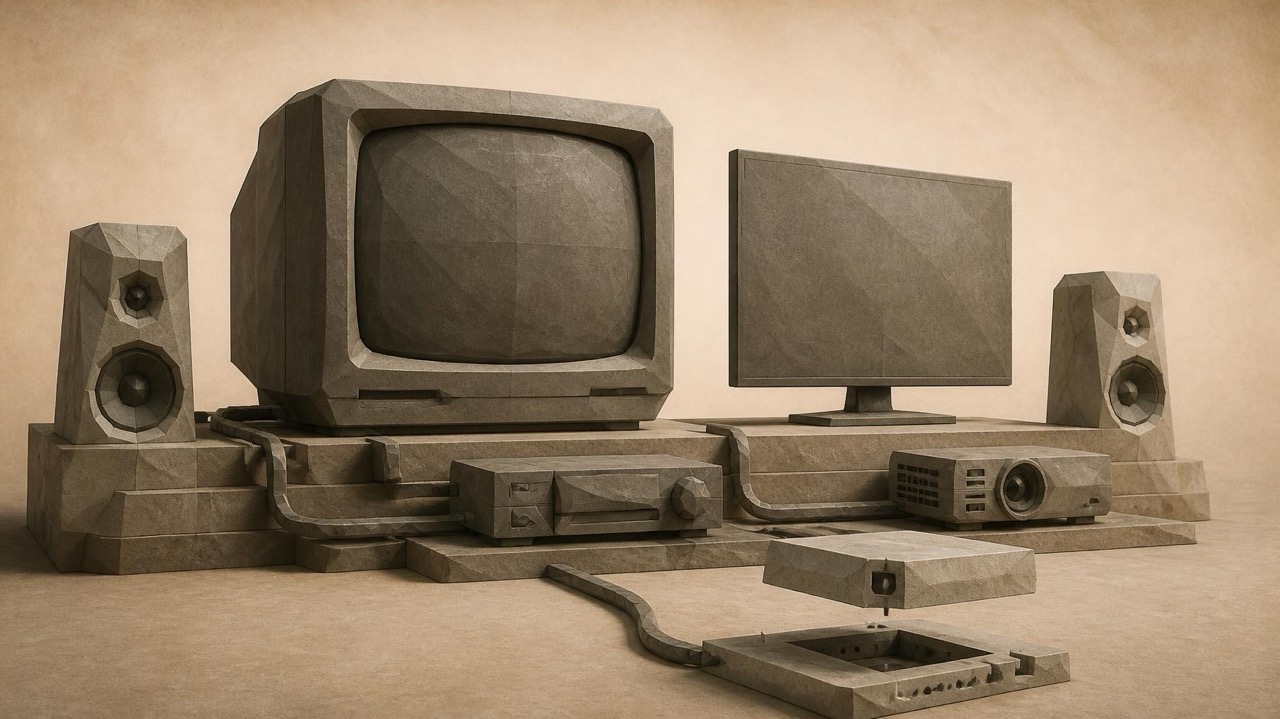
A screen ceases to be manufactured. A computer no longer boots. The system that distributed the sound depends on a part with no replacement. In a technological installation, replacing a component may alter scale, light, latency, sound, spatial layout, and the relationship with the public.
The issue is not deciding whether every old device is untouchable. It is determining what function each element serves and which relationships cannot be lost. I read these cases from the perspective of artistic practice, mediation, and work documentation, not from technical restoration.
A work that emerges upon installation
Traditional conservation often starts from an object that remains even when not exhibited. A technological installation operates differently. Tate notes, when studying Between Cinema and a Hard Place by Gary Hill, that the activated installation is something distinct from the sum of its components: its meaning depends on interrelated technologies that must function together.
In a single work, there may be components with historical or sculptural value, replaceable equipment, consumables, master files, software, libraries, and spatial conditions. Storing all the apparatus without documenting that hierarchy does not guarantee that the work can be presented again. Replacing them all because new technology exists may maintain a signal while destroying the experience.
Gary Hill: vulnerability lies in the system
Between Cinema and a Hard Place (1991) uses twenty-three modified tube monitors, video fragments, sound, and a computer system that controls their distribution. The study by Pip Laurenson for Tate locates the risk in interdependence: an alteration in the control, the image, the monitors, or the layout changes the whole.
The intention and parameters expressed by the artist guide conservation, but they are not an automatic response. It is advisable to contrast materials, technical documentation, historical installations, and statements from those who produced the work.
Nam June Paik: replacing does not mean equating
The exhibition Seeing Double: Emulation in Theory and Practice, held at the Guggenheim from 18 March to 16 May 2004, placed original and recreated versions side by side. Among them was TV Crown (1965), by Nam June Paik. The Fondation Daniel Langlois documents an original version with an RCA television and another from 1998-1999 with a Samsung television and signal amplifiers.
The case does not demonstrate that any screen can replace another. It shows that a substitution can form part of the authorised history of the work and that it must be judged in a specific configuration. Changing a cathode ray tube for a flat screen alters depth, curvature, brightness, proportion, and material presence.
Identity and iteration
The templates developed by the Whitney Museum separate two levels. The identity report describes the work in the long term: concept, experience, history, components, flexibility, metadata, code, and instructions. The exhibition or iteration report records a specific presentation: equipment, space, decisions, issues, and evaluation.
Identity is not a closed recipe; iteration does not automatically become the norm. Each assembly provides evidence, but a solution accepted once may not be appropriate in another space or with different technology.
Documenting who decides as well
A record may list models, connectors, and dimensions without explaining why they were chosen. It is advisable to register who proposed a substitution, what alternatives were compared, who approved it, what properties were evaluated, what tests were performed, and whether the solution is reversible.
Such a record prevents a contingent adaptation from becoming, through repetition, the definition of the work.
When the museum acquires dependencies
The Metropolitan Museum's procedures for software-based works show the breadth of what a collection may require: contract, certificate, instructions, executable, source code, libraries, third-party applications, and an approved computer capable of executing the work. The list is adapted to each case.
Rights matter as much as files. Possessing code does not by itself grant permission to modify it; possessing a monitor does not authorise redefining the work.
The installation as distributed knowledge
An installation often depends on knowledge not contained in any isolated file: how to adjust the light, what latency is acceptable, what error is part of the work, or when a substitution changes the whole. That knowledge is distributed among the artist, assistants, programmers, conservators, technicians, registrars, and previous versions.
The useful documentation connects those layers and declares their disagreements.
What these cases do not authorise us to conclude
These precedents do not establish that the artist's intention resolves every intervention, that equipment can always be replaced by a functionally similar one, that the most recent version is the correct one, or that a universal form exists. Their value lies in the questions they make repeatable.
To take action
The technical specification of a digital or interactive work describes components and requirements; the installation instructions explain how to activate a version; and the guide on obsolescence, migration, emulation, and reinterpretation helps to record changes and authorisations. In the Notebook, what changes when an obsolete work functions again and what must enter the collection when acquiring digital art continue these questions.
About the open conversation
The question of how one determines that a substitution preserves the work remains unresolved. Who participates in that decision: the artist, the technician maintaining the piece, the conservator, or the collection? And which differences between the original component and the new one should remain visible in the record?
The precedents examined reflect decisions made in specific situations. They do not allow for the extraction of a universal criterion of equivalence, nor for the assumption that changing a screen, a computer, or a projector will always, or never, alter the experience of the work.
If you are an artist, technician, conservator, or collection manager and possess a documented case in which replacing a component did or did not change the experience, including the date, the observed difference, and who made the decision, this notebook remains open: write to me.
Sources
- Pip Laurenson, “Developing Strategies for the Conservation of Installations Incorporating Time-Based Media: Gary Hill’s Between Cinema and a Hard Place”, Tate Papers, 2004.
- Whitney Museum of American Art, Documentation Templates.
- The Metropolitan Museum of Art, Sample Documentation and Templates for Time-Based Media Artworks.
- The Metropolitan Museum of Art, Acquisition Procedures for Software-Based Artworks.
- Guggenheim, Seeing Double: Emulation in Theory and Practice.
- Fondation Daniel Langlois, documentation of Seeing Double.