
On 16 November 2026, the Community of Madrid began digitising the Cervantes Birthplace Museum in Alcalá de Henares. Over approximately one month, images and videos of the rooms and pieces were to be captured. The material would be processed in Realidad Infinita, a laboratory developed by the regional government with SperidLabs, to offer a visit via browsers, mobile devices, and virtual reality headsets.
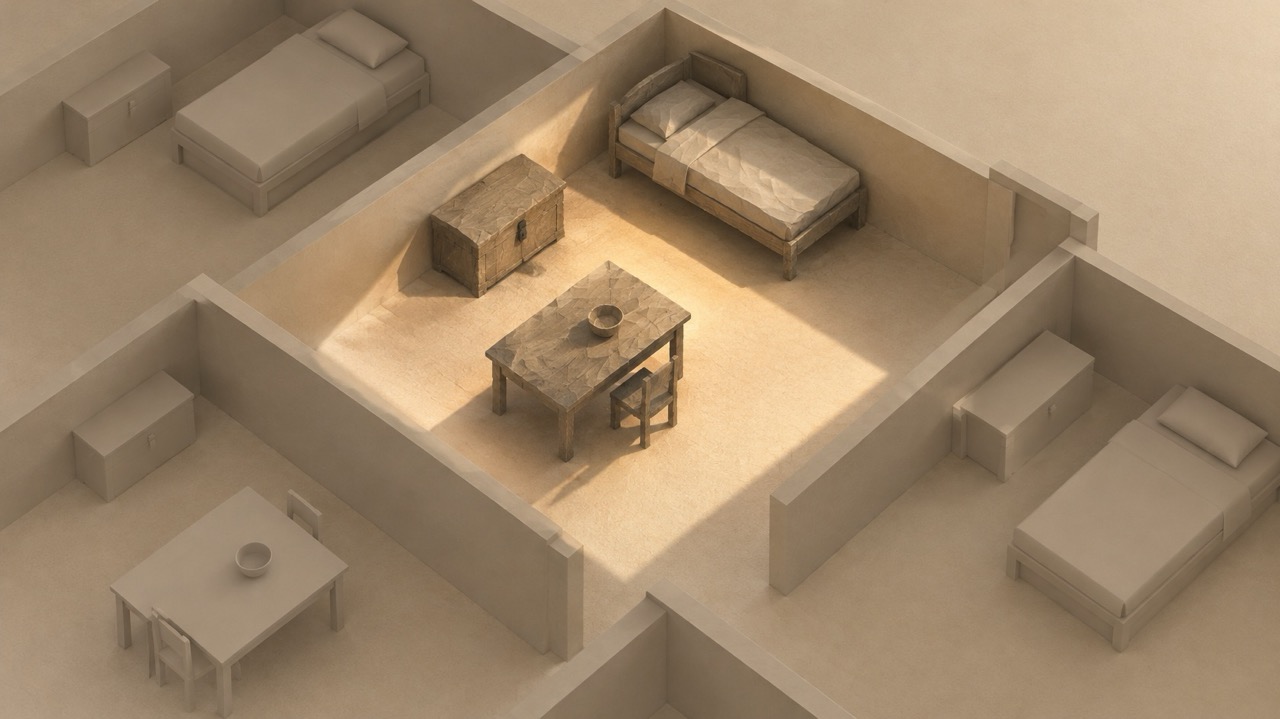
Official notes attribute two distinct operations to the system. They promise high-precision three-dimensional reproductions and state that the technology will recreate areas that the lens cannot capture. One records observed surfaces. The other completes an absence. The interface may present them as a single continuity, but they do not constitute the same class of evidence.
Capture, reconstruction and inference
Photogrammetry estimates geometry and texture from overlapping photographs. It does not produce a neutral copy: the position and calibration of the cameras, the light, the reflections, the resolution, the coverage, the cleanliness of the mesh and the team's decisions all exert an influence. Even so, each surface can be linked to specific captures and subjected to metric control.
A documentary reconstruction uses plans, historical photographs, inventories, material analysis or comparisons. It may represent a missing part, but it must explain the source and the degree of certainty.
Generative inference proposes a plausible continuation based on context and learned regularities. It can complete a corner without an image, smooth out a gap, repeat a piece of furniture or invent a plausible wear pattern. The problem does not lie in using it. It appears when the result is presented as an exact capture or when it is reused as a conservation document without preserving the distinction.
The word 'recreate' does not explain which of these operations is involved. Nor do we know, from the public documentation located, which model Realidad Infinita uses, what data it processes, how it validates the output or how it signals the generated regions.
A house already interpreted
The Cervantes Birthplace Museum is not an intact 16th-century domestic capsule. It is a museographic reconstruction linked to the memory of the writer and the historical interpretation of a dwelling. In a house museum, the pieces matter, but so do their relationships, the scale, the circulation, the light, the material traces and the decisions with which the narrative has been constructed.
The virtual tour adds layers:
- The current building.
- The museography that interprets a historical house.
- The captures made in 2026.
- The reconstructed geometry.
- The manual corrections.
- The areas inferred by a generative system.
- The interface that decides how to navigate it all.
When walking along a continuous surface, the visitor may attribute the same authority to all layers. A measured moulding and an invented one receive the same texture; a photographed corner and a completed one are illuminated in the same way. Visual continuity conceals documentary discontinuity.
The Seville Principles for virtual archaeology demand purpose, scientific transparency, documentation and a distinction between evidence and hypothesis. The London Charter insists on recording sources and decisions. They were born in different heritage visualisation contexts, but their criteria are applicable here: uncertainty must be visible or consultable.
Dissemination and conservation archive
On 22 November, the Community of Madrid stated that the virtual copies would serve to document future reconstructions in the event of deterioration. That purpose raises the requirements. A public experience may simplify to facilitate navigation. An archive used to intervene materially on an asset requires measurements, provenance, version control and a radical separation between observation and hypothesis.
It would be necessary, at the very least, to distinguish three products:
- Capture archive. Original photographs and videos, calibration, camera position, date, light conditions, resolution and metadata.
- Documentary model. Mesh and textures linked to the captures, with a record of cleaning, corrections, and metric precision.
- Public experience. Optimised for navigation, with generative inferences indicated and access to the source for each area where relevant.
If conflated, a visual solution created to fill a void may end up being treated as evidence during a restoration. The error need not be spectacular. An altered proportion, a repeated texture, or a piece placed where it never stood is sufficient.
Contract, data, and dependency
I have not located the budget, the contract with SperidLabs, the models utilised, the software licence, the master formats, or a public validation protocol. Furthermore, there is no record of whether the collection material is used to adjust or train systems, where it is hosted, or what reuse rights the Administration retains.
A public procurement for digital heritage should describe:
- Ownership of photographs, meshes, textures, code, and derivatives.
- Institutional access to master files.
- Open or documented formats.
- Dependencies on external services.
- Portability upon contract termination.
- Copies, preservation, and deletion.
- Use of data for training.
- Version control.
- Procedure for correcting errors.
- Licence for the experience funded by public resources.
Nothing compels the publication of trade secrets. It must, however, be possible to know what the institution preserves and what would be lost should the provider cease to exist.
Access without false equivalences
A remote visit can open spaces to those unable to travel, reduce pressure on fragile rooms, and display closed areas. It does not automatically substitute the accessibility of a physical visit nor resolve all digital barriers. It requires keyboard navigation, compatibility with assistive technology, subtitles, audio description, alternative text, movement control, and a non-immersive alternative.
Furthermore, not everyone can use virtual reality headsets, nor is a three-dimensional interface always the most comprehensible medium. Accessibility must appear as a verifiable requirement, not as a presumed consequence of publishing the museum online.
An evidence layer would also improve educational value. It could distinguish direct capture, geometric reconstruction, manual intervention, and inference through colours or filters. Uncertainty would cease to be a concealed deficiency and would demonstrate how heritage knowledge is constructed.
In Museums and AI without policy, I highlighted the disconnect between technological adoption and institutional explanation. This case situates that disconnect within a historic house: how much can a machine complete, and what must the person traversing the result know?
A replica that invents part of what it displays can be valuable. It must state where it does so.
On the open conversation
This text continues the series of the Notebook on museums, heritage, and AI. It may be read alongside the guide for documenting processes and metadata. If you work in conservation, photogrammetry, or virtual reconstruction and are aware of additional documentation regarding Realidad Infinita, you may write to me.
The author’s relationship to the case
I maintain no relationship with the Community of Madrid, SperidLabs, or the museums cited. I work with generative art, a practice that compels me to differentiate between capture, transformation, and inference.
Sources
- Community of Madrid, commencement of digitisation, 16 November 2026.
- Community of Madrid, virtual copies for conservation, 22 November 2026.
- López-Menchero and Grande, 'Towards an International Charter for Virtual Archaeology. The SEAV Draft' (Seville Principles), Virtual Archaeology Review, 2011.
- London Charter.