
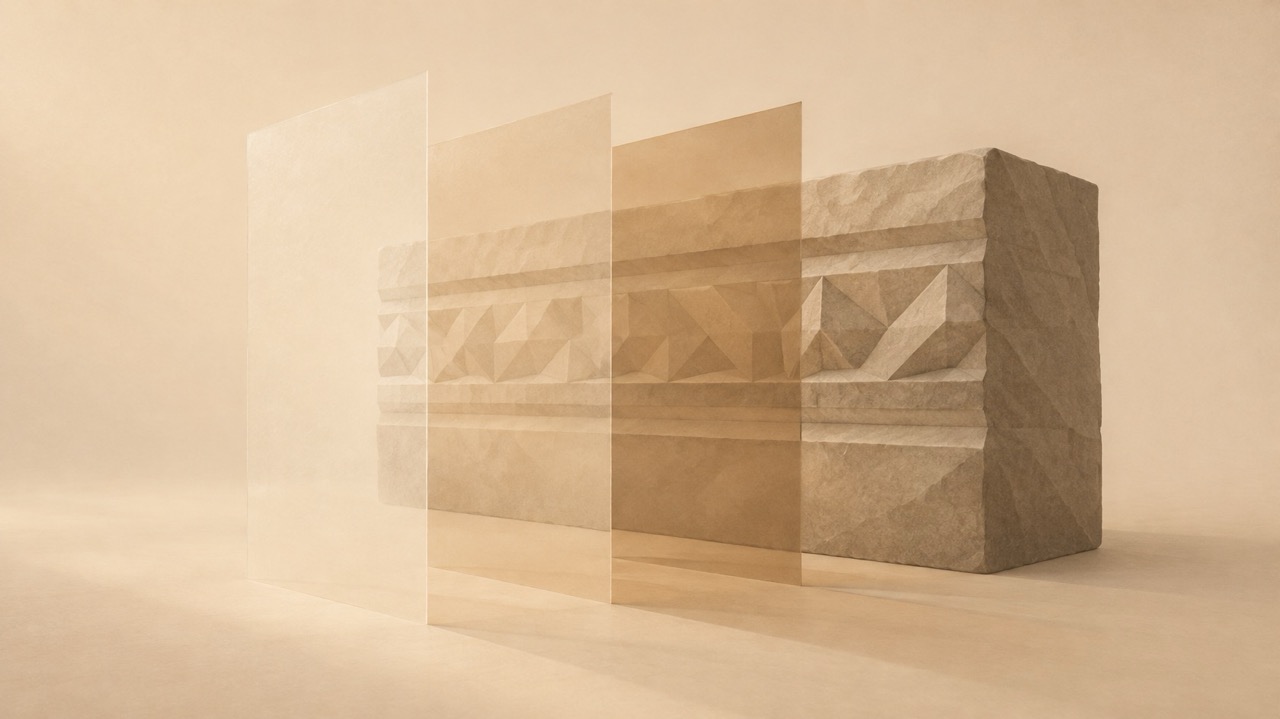
From 13 November 2026, the Taharqa shrine once again displays colour at the Ashmolean Museum in Oxford. The stone is not repainted. A digital projection superimposes blues, reds, and yellows onto its sandstone reliefs. When the light is extinguished, the almost uniform monument that has reached us reappears.
Taharqa, King of Kush and Pharaoh of Egypt, ordered the construction of the shrine within the temple of Amun-Ra at Kawa, north of present-day Sudan. The Ashmolean dates the building to his reign, between 690 and 654 BCE. Excavations directed by Francis Llewellyn Griffith recovered it in the 1930s. The monument arrived in Oxford in 150 crates as a gift from the Sudanese Government to the University of Oxford excavations; Nora Griffith presented it to the museum in 1936, in memory of her husband.
The museum presents it as the only free-standing pharaonic building preserved in Great Britain. The installation commemorates the ninetieth anniversary of its arrival and is accompanied by two films: one traces the material history of the shrine and the scientific research; the other explains the scenes, symbols, attire and offerings of its reliefs.
Institutional communication promises to show what the original decoration would have looked like. This formula conflates two operations that must remain distinct: detecting material remains and completing an image. The project’s interest increases when the visitor can comprehend the trajectory between the two.
From a particle to a painted wall
The research combined microscopic examination of surviving pigments with specialised photographic techniques. The Art Newspaper specifies that hyperspectral imaging was utilised, which combines photographic and spectroscopic information. Analyses located red in crevices and colours no longer distinguishable to the naked eye, including yellow and Egyptian blue.
Egyptian blue is an ancient synthetic pigment whose cuprorivaite emits luminescence in the near-infrared when excited by visible light. This property allows for the mapping of minute particles through visible-induced infrared luminescence photography, known as VIL. The technique reveals presence and distribution; it does not, by itself, determine the complete appearance of a surface.
The Ashmolean indicates that blue appears to have been reserved for specific figures and divine images. The research also identified burn marks associated with the subsequent destruction of the temple. The stone therefore preserves traces of two moments: the polychromy that covered it and the fire that contributed to erasing it.
Detecting pigment confirms that colour existed in an analysed area. It does not automatically reconstruct an entire figure. Between a blue particle and a fully coloured deity lie decisions regarding extent, density, saturation, combination with other pigments, preparation of the substrate and comparison with related monuments.
The blocks were plastered before being painted. The current projection falls upon sandstone that has been eroded and treated throughout its conservation history, not upon that preparatory layer. It restores a chromatic relationship, but not the materiality of the paint: its thickness, opacity, light absorption, irregularity or ageing.
Furthermore, not all methods answer the same question. Microscopy observes remains; hyperspectral imaging differentiates spectral responses; VIL is particularly effective for locating Egyptian blue. A rigorous reconstruction should indicate which technique supports each identification and where analogy begins.
A reversible intervention and an affirmative image
The projection avoids applying new paint to the monument. It can be switched off without removing a layer from the stone and modified if an attribution changes or new evidence emerges. This material reversibility constitutes a clear advantage over permanent reintegration.
The image, however, is not neutral. A full-scale reconstruction, perfectly aligned with the reliefs and endorsed by a museum, possesses an affirmative force superior to a small illustration. The visitor may recall “the shrine was like this” even though the projection combines direct data, comparisons and visual interpretation.
Its authority derives from several layers:
- The authenticity of the monument.
- The geometric precision of the mapping.
- The scientific research that precedes it.
- The immersive scale.
- The visual continuity of a complete decoration.
- The institution presenting the reconstruction.
The better the projection functions, the easier it is to forget that it formulates a hypothesis. Mediation must communicate degrees of certainty without reducing the experience to a technical manual.
The guide to verifying primary sources distinguishes the original document from subsequent explanation. The reconstruction poses a parallel problem: the stone and its pigments are material sources; the projected image is an informed interpretation of them.
Evidence, comparison and hypothesis
The gallery could make the process visible through three states:
- Current state. Stone without projection, with the preserved remains.
- Detected evidence. Areas where analyses identified pigments, differentiated by technique and level of confidence.
- Reconstruction. Complete image, indicating which parts derive from direct detection, comparison or inference.
The sequence changes the reading. If the experience begins with a complete decoration, the scientific evidence may appear as a secondary explanation of a truth already shown. If it begins with the stone and the findings, the final colour appears as the result of a chain of decisions.
It is not necessary to cover every scene with labels. A layer control, an animation or an accessible map could indicate:
- Which pigment was detected.
- Which technique allowed its identification.
- At what point on the relief it appeared.
- Which areas were extrapolated.
- Which monuments or documents were used for comparison.
- Which alternatives were discarded.
- When that version of the reconstruction was approved.
Uncertainty should not always be represented as a fictitious percentage, either. It can be expressed through layers, contours, differences in saturation or a simple legend. The important factor is that the visual continuity of the projection does not erase the discontinuity of the evidence.
Versioning is essential. A digital projection can change without leaving a trace on the monument. The museum should preserve source images, correspondence maps, colour files, projector parameters, software, scientific documentation, curatorial decisions and a record of each version. It must also document the position, intensity and calibration of the equipment: replacing a projector can alter the colour even if the file remains intact.
The guide "Archiving and conserving a work created with artificial intelligence" addresses another digital infrastructure, yet it shares a principle: preserving the result is insufficient. Dependencies, decisions, and versions must be maintained.
Dendur: a distinct evidentiary basis
The MediaLab at the Metropolitan Museum developed Color the Temple in 2015, a projection onto a scene from the temple of Dendur. The team chose the south wall to prevent natural light from cancelling out the projection and created a vector image aligned with the reliefs using openFrameworks and MadMapper.
The precedent is useful because it documented its method in detail. The team examined the temple through direct observation and VIL, yet found no traces of colour in the chosen scene. It relied upon historical reports and comparisons with Philae, Dendera, and other materials from the museum. The reconstruction could alter colours and activate layers, meaning the tool served to investigate and explain, in addition to producing an attractive image.
Taharqa begins from a different basis. It retains pigments within the shrine itself and possesses microscopic and photographic analyses. This closer evidence does not eliminate the gaps. The difference between both projects is one of degree and the provenance of the evidence, not an opposition between certainty and fantasy.
Dendur further demonstrates a risk. A tool designed to compare hypotheses may end up circulating as a single closed image. Public projection should preserve, at least within the mediation, the critical capacity it possessed during the research.
Colour does not return the shrine to Kawa
The shrine was excavated during the Anglo-Egyptian Condominium of Sudan. The formula "gift from the Sudanese Government" describes the recorded mechanism of its transfer, but does not exhaust its context. The colonial administration, the distribution of finds, the British funding of the excavations, and the unequal capacity to decide upon heritage are part of that history.
The monument left Kawa dismantled and arrived in Oxford in 1936. There it was reconstructed, treated, and converted into a centrepiece of the Egypt and Sudan galleries. The projection recovers a lost appearance while the building remains far from the temple of Amun-Ra and the landscape for which it was constructed.
I have not located an extensive explanation of the colonial framework of the excavation and transfer within the public materials of this installation. One of the films covers the journey of the shrine, but its content should not be presumed before viewing it. The new mediation offers an occasion to explain who authorised the departure, how the archaeological distribution functioned, and what relationship the museum maintains today with Sudanese institutions and specialists.
The issue is not resolved by adding a guilt-ridden note nor by asserting a restitution claim without sources. It requires publishing provenance, political context, treatments endured, distribution documentation, and current collaborations. The more vivid the presence of the monument becomes in Oxford, the more necessary it is to explain why it is there.
Colour may also modify the public's geographical imagination. An exhibition tradition that separates "Egypt" from "Africa" has frequently weakened the understanding of the Kushite dynasty. The museum names its galleries "Ancient Egypt and Sudan", and the press release positions Taharqa as ruler of Egypt and Kush. The polychromy must reinforce that history, not convert it into an exclusively Egyptian episode detached from Kawa.
A hypothesis that can be switched off
The projection produces an intense image without fixing it materially to the object. It can be corrected, compared, and removed. This flexibility should extend to the language with which it is presented.
"Original colour" in the singular suggests a closed solution. "Chromatic reconstruction based on detected pigments, documentation, and comparisons" better describes the available knowledge. Precision does not weaken the project. It allows one to see the scientific and curatorial work that the complete image tends to hide.
The stone retains traces. Research interprets them. The projection proposes a totality.
The room should allow for the distinction of the three operations.
On the open conversation
If you work in conservation, archaeology, Egyptology, or digital mediation and can provide technical documentation of the project, you may write to me. I am particularly interested in how degrees of certainty are recorded within a full-scale projection.
Author's relationship to the case
I maintain no economic or professional relationship with the Ashmolean Museum, the Metropolitan Museum, or the cited teams. I have not seen the installation; I write based on the published research and communication.
Sources
- Ashmolean Museum, "Taharqa’s Shrine Illuminated", 4 November 2026.
- The Art Newspaper, "New research reveals original colours of Ancient Egyptian shrine at Oxford museum", 2 November 2026.
- Ashmolean Museum, educational fact sheet on the Taharqa shrine.
- Metropolitan Museum of Art, "Color the Temple".
- digitalEPIGRAPHY, technical description of Color the Temple.
- Germain Wiseman, Stephanie Barnes and Kate Helwig, "Investigation of Egyptian Blue on a Fragmentary Egyptian Head Using ER-FTIR Spectroscopy and VIL Imaging", Heritage, 2023.