
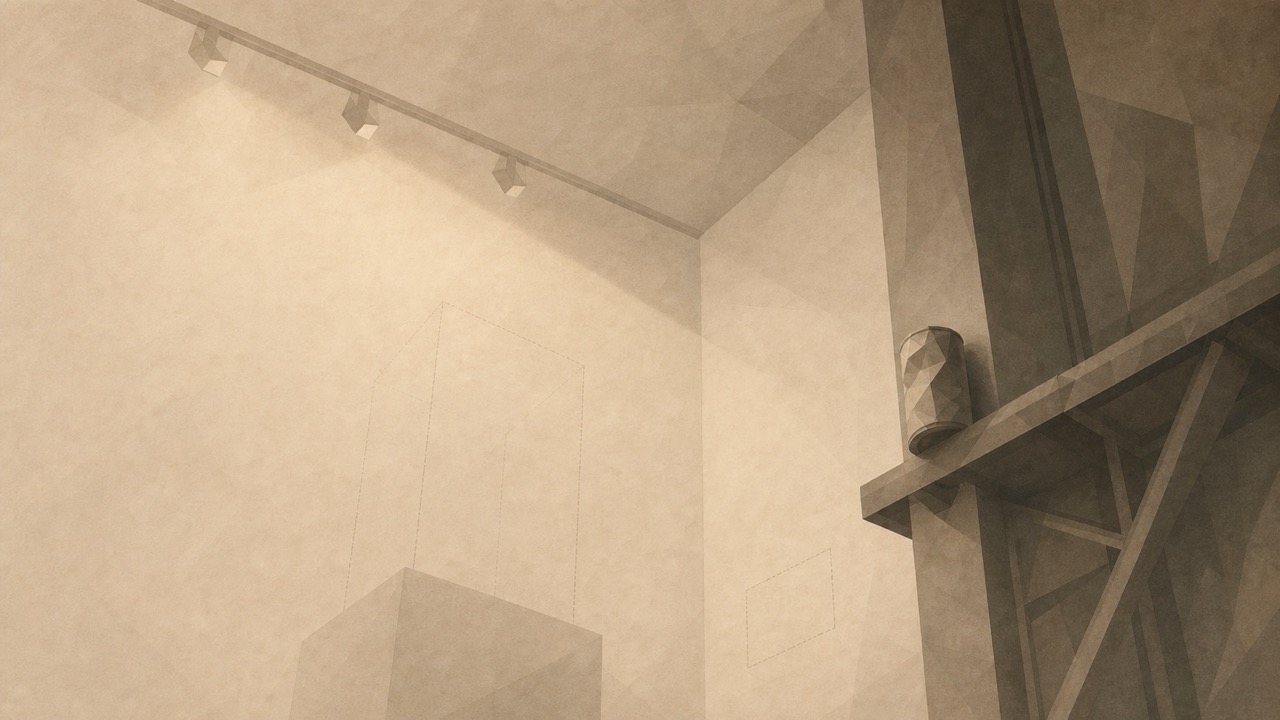
At the end of September 2024, a lift technician entered the LAM museum in Lisse, in the Netherlands, to perform a service. He was a substitute and was unfamiliar with the building. On the roof of the lift cabin, which is made of glass and ascends through a transparent shaft, he found two dented beer cans of the type left behind after construction work. He did what anyone would do: he collected them and placed them in a rubbish bag.
They were a work of art. It is titled All the good times we spent together, signed by the artist Alexandre Lavet in 2016, and they are not cans; almost the entire press reported this incorrectly. Lavet did not take two used cans and exhibit them, but rather fabricated two aluminium pieces and painted them by hand, with acrylic and varnish, until reproducing with precision the design of a Belgian beer brand, the dents, the wear, the grime. They are painting, meticulous work of imitation, not found objects. The artist explained that he chose those cans for their connection to his life in Brussels, because they are present in many moments of friendship and celebration and, at the same time, no one looks at them.
And although it may appear otherwise, what occurred was not a failure to recognise a work of art. It was that the work had been positioned there precisely to remain unrecognised. The museum had deliberately placed it atop the lift cabin, within the glass shaft, so that it appeared as though workmen had left the cans behind after completing their tasks. This is their stated policy: the director of the LAM has explained that they place works in unexpected locations so that visitors might perceive everyday objects in a different manner. The museum purposefully removed all the indicators that typically signify 'this is art': the display case, the pedestal, the label, the gallery, the distance. And without those indicators, to a technician arriving to repair a lift, the work was exactly what it appeared to be.
The museum curator, Elisah van den Bergh, noted their absence, searched for them, and recovered them from the rubbish bag, intact, before they were discarded. They were cleaned and displayed for a few days at the entrance, upon a conventional pedestal, to provide them, as she stated, with their moment of prominence. The museum did not hold the technician at fault: they stated that he had performed his duties in good faith, and added that the episode was, in a certain sense, a testament to the efficacy of Lavet's work.
They are correct in that the technical achievement of those two pieces is that they resemble refuse. A painter spent hours ensuring that an aluminium object appeared as a used can, and succeeded so thoroughly that a reasonable adult discarded it as rubbish. The excellence of the work and its vulnerability are one and the same: the more effectively it imitates, the less it is distinguishable from that which it imitates. Had Lavet painted with less proficiency, the can would have been preserved.
Yet there are two conclusions that appear sound but do not withstand scrutiny. The first is to suggest that the accident completed the work or that it was the artist's intention. There is no evidence for this: Lavet speaks of friendship, of Brussels, of objects that no one observes, not of an experiment involving maintenance staff. Furthermore, the museum placed the cans to surprise visitors, not to set a trap for the technicians. The second is to ridicule the individual who discarded them, which is what half of the internet did. The technician did not err through ignorance: he behaved in a perfectly correct manner when confronted with an object that, in that specific location, was indistinguishable from waste. The error, if there was one, did not lie with his perception.
What this case reveals is what determines whether an object functions as a work of art when its material does not distinguish it from any other. It does not depend on the material, evidently: painted aluminium bears no sign stating what it is. It depends on the frame, on that entire invisible apparatus of display cases, labels, galleries, lighting and protocols that tells the viewer 'this here is art, do not touch it'. That apparatus is so effective that we do not even notice it, and it only becomes visible when it is removed. The museum removed it, and as soon as it was gone, the work ceased to behave as a work of art to the first person who was not there to view art, but to service a lift.
I do not maintain that art is merely the frame, which would be a lazy conclusion. Lavet’s work possesses its own value: the labour of the painting, the choice of an object laden with memories, the concept of observing what no one observes. All of that resides in the pieces and not on the pedestal. But for that value to be activated, it is necessary that someone is looking for it, and the institutional frame is, above all, a signal that there is something to seek. Without the signal, the work remains there, intact, with all its labour within, and yet it may still end up in a rubbish bag without anyone having done anything wrong.
On the open conversation
This text is based on a verified case: in September 2024, a lift technician at the LAM museum in Lisse discarded two pieces by Alexandre Lavet, hand-painted aluminium objects designed to resemble used beer cans, which the museum had deliberately placed on the lift cabin to appear as abandoned debris. They were recovered intact. I distinguish the facts (the material, the location, who removed them, that they were not destroyed) from simplistic interpretations: there is no evidence that the artist or the museum intended to test the staff, nor that the accident completed the work. I am interested in what determines whether an object functions as a work when its material does not distinguish it from waste. If anyone wishes to contribute from the fields of museology, conservation or art theory, this notebook remains open.
Sources
LAM Museum (Lisse), press release of 1 October 2024, 'Lift technician mistakes LAM museum artwork for rubbish and disposes of it': account of the incident, recovery by conservator Elisah van den Bergh and statements by director Sietske van Zanten ('He was just doing his job in good faith'; 'By displaying artworks in unexpected places, we amplify this experience').
Alexandre Lavet, official record for All the good times we spent together (2016): 'Acrylic paint on aluminium, varnish. Variable dimensions.' The pieces are hand-painted aluminium objects, not commercial cans.
Specialised coverage: Hyperallergic (8 October 2024) and ArtReview, which specify the exact location on the glazed lift cabin.
The artist did not comment publicly on the incident. His cited statements refer to the general meaning of the series.
Verified precedents of works removed by external personnel: Goldschmied & Chiari at the Museion in Bolzano (2015), recovered and reinstalled; Martin Kippenberger at the Museum Ostwall in Dortmund (2011), where a painted layer was removed during cleaning.