
On a defence of art that in reality defends two other things
A recent column in El País, by Jordi Labanda, is titled “Against automatic art” and summarises its thesis in one line: an algorithm does not paint because it cannot bear to exist, nor does it exist because it fears death, nor does it compose because someone broke its heart one summer. It is a well-crafted sentence, and for that reason it deserves to be taken seriously: because it condenses, with rhetorical efficacy, two confusions that should be separated. I am not responding to the author, whose position is legitimate and understandable. I am responding to the argument, because the argument says more than it intends.
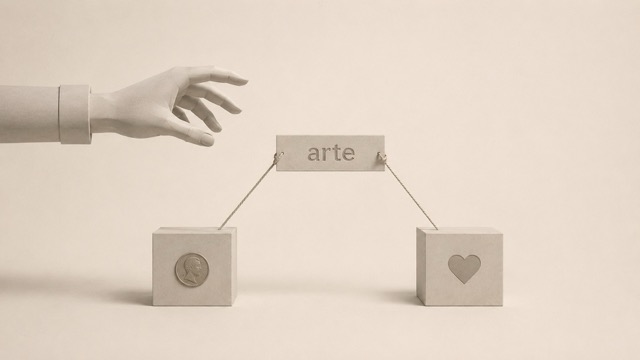
The column presents itself as a defence of art against automation. I maintain that it defends, in reality, two other distinct things: the art market and a romantic theory of art. Neither of these is art. And mixing them—sliding from one to the other without warning—is what gives the column its apparent strength and its real weakness.
1. The first shift: from art to the art market
When one defends “art” against the machine, it is advisable to ask what exactly is being discussed. A significant portion of the anxiety regarding generative art is not for art: it is for the art market and the design market. These are distinct things, subject to distinct rules.
The art market is governed by the rules of the market—scarcity, speculation, price narrative, concentration in an elite. I developed this in another text in this notebook: the high-end art market operates today under financial logic, and that logic mistreats the vast majority of artists, save for a small, privileged minority. Graphic design is governed by even more explicitly commercial rules: those of marketing, not even those of the art market. When the machine threatens that terrain, what is being defended is a position in a value chain, not an ontology.
And here is what is important: that defence is legitimate. That automation makes precarious the livelihoods of illustrators, designers, and artists who lived from a trade is a real, grave problem, and it deserves a response—syndical, legal, regulatory. But it is a problem of labour and of the market, not of art. Confusing them has a consequence: it uses the dignity of the word “art” to shield a market position. The emotion awakened by defending “art against the machine” is transferred, without our noticing, to the defence of an economic sector. It is a rhetorical movement that is effective and conceptually deceptive. The market mistreats artists; using that real mistreatment to define what art is, is using a truth to sustain an error.
2. The second shift: from art to the interiority of the author
The other slippage is deeper, and it is the one that pulses in the phrase about the broken heart.
The column defines art by the suffering of the author: one paints because one cannot bear to exist, one composes because someone broke one's heart. It is an expressive definition of art—art as the discharge of a human interiority—and it has a long romantic tradition behind it. But it is a position, not an obvious fact. And it is debatable.
The issue is not that human emotion is irrelevant to art. It is relevant, and intensely so, in the mode of art that has dominated history. The issue is conflating the historically dominant mode with the necessary condition. That much human art has been born of pain does not mean that pain is what makes something art. There is art without suffering—decorative, conceptual, constructive, playful—and there is suffering without art—the vast majority of human pain produces nothing. Correlation is not definition.
When art is defined by the interiority of the author, a curious thing occurs: the question of the machine is decided in advance and by tautology. 'The machine does not suffer, therefore it does not make art.' But that is not an argument: it is the conclusion inserted into the premise. If you define art as the expression of suffering, of course that which does not suffer does not make art. You have won the debate by defining the words in your favour. And you have left the interesting question unexamined: is it the suffering of the author that constitutes art, or is it merely the path by which we humans have arrived at it?
3. What art is, if it is neither of those two things
I have been maintaining, in my work, that art is defined neither by the market that prices it nor by the interiority of the one who makes it. It is not the price it reaches nor the pain from which it is born. It is something else: an event that reorganises a field of possibilities without being absorbed by the function from which it arises. I call it structural surplus, and I have developed it elsewhere.
From that perspective, the column is read with clarity. Its two shifts are, at heart, the same error with two faces: anchoring art in something that is not the artistic event. The market anchors it in price; romanticism anchors it in the suffering of the subject. Both lose the same thing: that art occurs, or does not occur, independently of who signs it and how much is paid for it. A work can be born of a broken heart and produce no surplus whatsoever—being pure sentimental discharge without reorganising anything. And a configuration can produce surplus without a pained biography behind it.
That is why the question of generative art is not settled by saying 'the machine does not suffer', just as it is not settled by saying 'the machine does not sell'. Both responses change the subject. The serious question is whether in a process—human, mechanical, or mixed—that reorganisation occurs which overflows the function, or if everything remains absorbed by it: by the commission, by the effect, by the market, by the release. That question is answered neither by the biography of the author nor by their invoice. It is answered by the event.
I do not write this against those who fear for their profession. That fear is legitimate and the precariousness that fuels it is real. I write against the confusion that converts a market problem and a romantic aesthetic preference into a definition of art, and that shields both with the word that commands the most respect. Defending artists from the mistreatment of the market is necessary. But art is not defended by defining it by what the market pays or by what the author suffers. Art is what occurs when something, wherever it came from, reorganises what we believed possible. That is not priced by the market nor guaranteed by a broken heart.
This notebook remains open, as always, to anyone who wishes to discuss it.
Sources
Labanda, J. (10 June 2026). Against automatic art. El País, ICON Design. https://elpais.com/icon-design/2026-06-10/contra-el-arte-automatico.html
Esteban Ruiz, J. A. Art as an asset. Public notebook at juanesteban.art, 2026. (On the financialisation of the art market and the structural mistreatment of artists.)
Esteban Ruiz, J. A. Art as Structural Surplus: Toward a Relational Ontology Beyond Human Authorship. PhilArchive and Zenodo, 2026. (On art as surplus, versus expressive and market definitions.)