
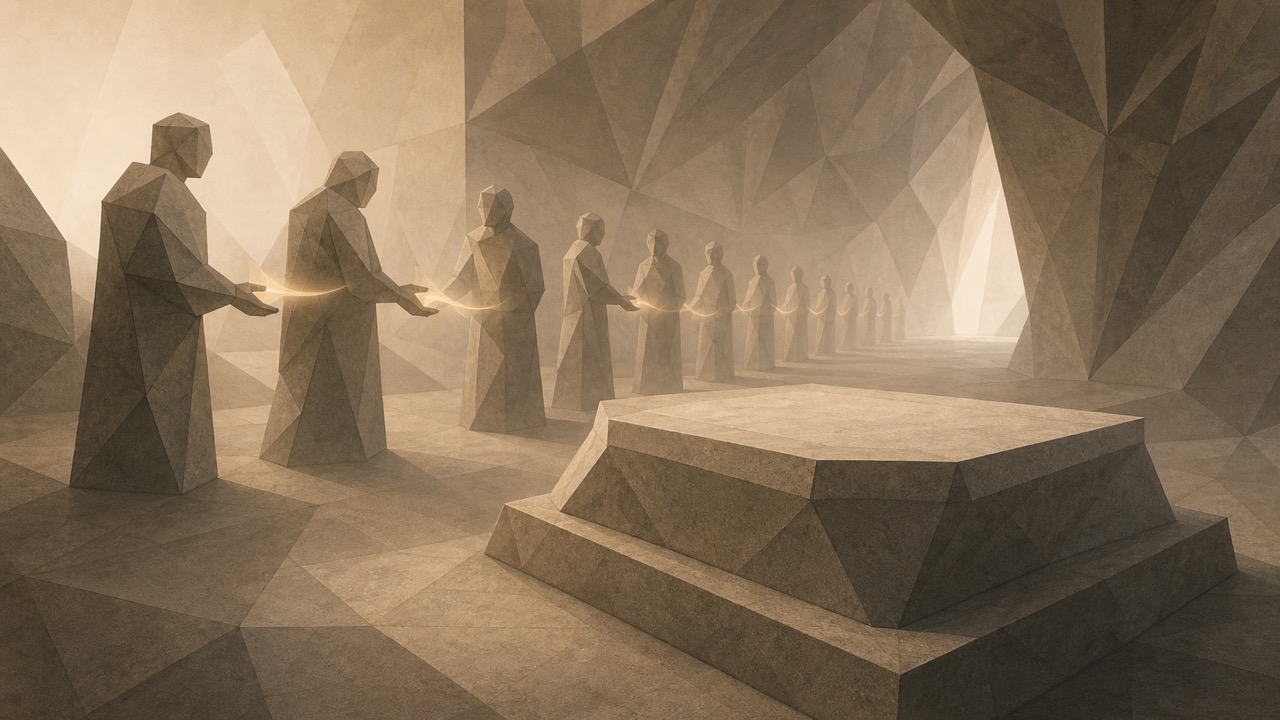
In 2005, the Tate purchased This is propaganda, by Tino Sehgal. The work does not exist as an object: it cannot be photographed, and its instructions are not written down. In a gallery at the museum, there is a woman dressed like the rest of the security staff. When a visitor enters, she turns towards the wall and sings a line, "This is propaganda, you know you know, This is propaganda you know". On the final line, she turns slowly towards the person who has just entered. Upon finishing, she states aloud the title of the work, the name of the artist, the year of execution, and the year the museum purchased it. These are the details that would appear on a label. Afterwards, if the visitor wishes to converse, she speaks. When another person enters, the process begins again.
If one searches for the work in the Tate’s online catalogue, its entry appears with an inventory number, date of acquisition, and a line where the image should be: no image is available. This is not an oversight in the database. Sehgal imposes as a condition for all his live works that they must not be documented or recorded on any material medium. There are no photographs of the piece in operation, no video, no recording of the song. His argument is simple and radical: replacing the work with a photo or a video does not document it; it exchanges it for something else. If you wish to see it, you must be present.
What makes this case unique is not the absence of an object, which no longer surprises anyone in contemporary art. It is the absence of text. The Tate declares, in its own research into the piece, that no formal written record of acquisition exists and that the instructions are not written: they exist only through verbal transmission. There is no score, no manual, no contract describing the work. Sehgal’s sales are conducted in face-to-face meetings, with the gallery and a notary present, and without any paper being exchanged to codify the piece. Regarding the specific act of the Tate’s purchase, there is no public record of who was present or what was said.
And so, how is it conserved? By teaching it. The interpreter learns the work from a person at the Tate trained by Sehgal or from one of his producers. That person learned it from the artist or from someone authorised by him. What is transmitted is not merely the lyrics of the song, which would be easy to recall. One must transmit the tone, the rhythm, the position of the body, the exact moment of the turn towards the wall, the manner of reciting the oral label, the way of responding if someone asks a question. A Tate conservator noted that remembering the words is insufficient; what is passed from one person to another is a know-how, with all the fragility and vitality that entails.
It is not true that the Tate purchased nothing, nor that the transaction left no trace. The work has an inventory number, a date, provenance, and classification. A public museum cannot purchase without accounting for the expenditure. What does not exist is a file containing the work: no document that, when read, allows it to be reproduced.
Nor is it true that it is forbidden to write about it: the Tate itself publishes a fairly detailed description, there are studies, there are interviews with interpreters. What is forbidden is for a material object to replace it.
Neither does it rely on the memory of a single individual, as is sometimes suggested. The work resides in a chain distributed among the artist, his producers, the museum’s trained staff, and the performers who execute it. It is an institutional memory, not a private recollection. It can be renewed, and indeed it is renewed, each time someone new learns to perform it.
Nevertheless, the situation possesses a certain dizzying quality. A museum is, by definition, an institution that preserves objects: it measures them, catalogues them, restores them, monitors their humidity, and determines who may touch them. Its entire machinery is designed to safeguard things. Yet here, it has acquired something it cannot keep in any storage facility, because it is not a thing: it is the capacity to perform an action. What the Tate possesses is not a piece; it is the right and the knowledge to activate it. Its conservation task does not consist of preventing the deterioration of a material, but of ensuring that a teaching is not lost.
This inverts the conventional problem of conservation. A painting degrades if it is not cared for, and is preserved better the less it is handled. This work degrades if it is not performed, and is preserved only if it continues to be performed and taught. Its mode of existence is transmission. The moment the last person who knows how it is done ceases to teach it, not even a ruin will remain. There will remain only an entry in a catalogue, with its inventory number, its date of purchase, and no image available.
On the open conversation
This text begins with a verified case: This is propaganda (2002), by Tino Sehgal, acquired by the Tate in 2005, a work that the artist prohibits from being documented in any material medium and whose instructions, according to the Tate itself, are not written down and exist only through verbal transmission. I am interested in what it signifies for an institution dedicated to conserving objects to safeguard, instead, a know-how. I correct two frequent exaggerations: that the purchase left no trace (there is an entry, an inventory number, and a date) and that the work depends on the memory of a single person (the transmission is distributed among the artist, his producers, the trained staff, and the performers). Furthermore, I make no claim about the widely repeated detail regarding who attended the purchase: the notary is part of the artist’s general method of sale, not the documentation of that specific transaction. Should anyone wish to contribute from the fields of contemporary art conservation, performance, or museology, this notebook remains open.
Sources
Tate, collection entry for This is propaganda (Tino Sehgal, 2002; performance, 1 person; purchased in 2005; no. T12057), no image available.
Tate Research, Acatia Finbow, study on the work: the piece "does not have a formal, written acquisition record"; the instructions "are not written down and only exist through verbal transmission"; the refrain "This is propaganda, you know you know, This is propaganda you know"; and the general condition that Sehgal’s live works "are not documented or recorded in any material form".
On transmission and its difficulty, observations by Pip Laurenson (Time-based Media Conservation at Tate).
On Sehgal’s general method of sale (in-person meetings with gallery, notary, and buyer, without contracts or certificates): Zoë Lescaze, "How Does a Museum Buy an Artwork That Doesn’t Physically Exist?", The New York Times Magazine (2018). It is not recorded who attended the Tate’s acquisition in 2005.