
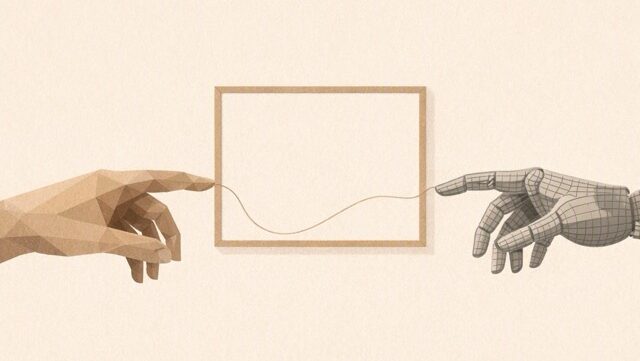
What happens to the value of the handmade when the first question we ask of an image is where it came from
For centuries, the value of a work was debated by observing it. One could disagree on the result, but the inquiry operated upon something present: this is what exists, let us judge it. The era of synthetic generation has introduced a prior question that displaces the former. Before evaluating an image, an increasing number of people wish to know where it originated. And that question—seemingly banal—alters the locus where value is determined.
My thesis is simple to state and less simple to sustain: in the era of AI suspicion, the value of the handmade does not increase because we perceive a formal superiority within it, but because its human origin can be distinguished, narrated, and verified. Value shifts from production to reception. The hand itself is not worth more. The hand that can be believed is worth more.
1. The premium on the handmade predates AI
The preference for the handmade does not originate with generative artificial intelligence; it is a symbolic premium documented long before. Market research into the 'handmade effect' demonstrated that labelling a product as handmade increases its appeal compared to a machine-manufactured alternative, and that the mechanism is not technical but symbolic: the handmade is perceived to 'contain' intention, care, and presence. Further studies confirmed that this perception translates into a greater willingness to pay, particularly in relational contexts—the gift, the object imbued with affective significance—and that the attribution of naturalness and authenticity mediates this effect.
In symbolic objects—art among them—the logic intensifies: they are valued more when perceived as the materialisation of a singular human expression under the control of an agent. AI does not invent this appreciation. What it does is render visible the necessity for signs of human agency, by converting the origin into a problem that did not previously arise.
2. Reception bifurcates
When human art and AI-generated art are compared under blind conditions—without disclosing which is which—some studies find a significant preference for AI-generated images. The visual surface of the synthetic competes, and at times prevails. However, when the origin is made explicit—when it is stated that 'this was created by a machine'—aesthetic appreciation diminishes. Recent reviews of the evidence maintain that a consistent bias exists against AI-generated visual art when its artificial origin is known.
Both things are true simultaneously, and that simultaneity is the core of the matter. The immediate aesthetic potency of an image and the regime of provenance under which that image enters circulation have diverged. The surface no longer explains value on its own. The market is beginning to appraise two distinct things: what the image does when I view it without knowledge, and what it is worth when I know its source.
This carries a consequence that interests me particularly, as it connects with an argument I have been maintaining. The surplus that renders a work significant—that which reorganises the field of what can be seen and thought—does not reside in the capturable surface. It resides in a relationship. And a relationship requires a legible origin to be attributed. When the origin becomes uncertain, the image is not lost: the possibility of attributing the event to someone is lost. The market may capture the surface. It cannot capture the attribution without first resolving where it came from.
3. The market does not substitute: it polarises
The facile narrative suggests that AI is obliterating human art. The data does not support this. What is observed is a polarisation of the criterion of value.
On one hand, there is genuine demand for AI-generated art, particularly among new and younger buyers: the first auction at a major house dedicated to AI art closed above estimates, with significant participation from bidders who had not previously purchased. This is not merely discursive fascination; a market exists. On the other hand, and simultaneously, the demand for explicit distinction is growing: according to the 2024 Hiscox Art and AI Report, conducted with ArtTactic, 82% of collectors demand a clearer distinction between AI-generated works and human-made works, and only 16% of veteran collectors believe that AI art will eventually achieve the valuations of art created by individuals.
This is not a contradiction. It is the form of the market when a single criterion splits in two. One segment purchases techno-aesthetic novelty. Another segment pays for human verifiability, process, and embodied singularity. The more perfect the synthetic capture of the surface, the more distinct the segment that pays for the alternative becomes.
4. What this demands of art theory
The lesson of the Thaler-Europe contrast, for the purpose of contemplating art, is that the question 'who created it?' has ceased to be the decisive one. Not because the author is disappearing—artists, decisions, and responsibility remain—but because the artistic event was never solely located at the origin. It was, and is, in what a work reorganises, and in the infrastructure that permits or prevents that reorganisation from occurring, circulating, and being recognised. A theory of art commensurate with AI is not one that decides whether the machine is an author. It is one that ceases to seek meaning at the starting point and seeks it where it is truly produced: in the field of relations—technical, cultural, economic—where something, regardless of its origin, alters what was previously possible.
The Thaler case will conclude on a false premise as long as the question remains one of origin. Europe, without intending to, is pointing elsewhere: towards the infrastructure. And there, not in the author’s signature, is where it is prudent to look.
This notebook remains open, as always, to anyone who wishes to discuss it.
5. Benjamin, once again, but displaced
The reference is inevitable, and it is prudent to specify in what sense it remains valid. Benjamin linked the authenticity of the work to its unique presence in time and space, and to what he termed aura. He diagnosed its fracture under mechanical reproduction.
The contemporary situation introduces a twist. It is no longer merely a matter of the work being reproducible. It is that the threshold of origin has become uncertain: the question is not only whether the image can be multiplied, but from what type of process it proceeds and with what degree of human agency. If one wished to speak of a contemporary aura of the handmade—and I state this as an interpretation, not a discovery—it would no longer reside in absolute material uniqueness, but in the social credibility of the human origin. The aura becomes, in part, forensic.
6. What this is not
This is not a condemnation of AI-generated art. It exists, it possesses a market, it opens new segments of demand, and for some, it serves as an initial entry point into collecting. I work professionally with these technologies; I do not position myself outside the issue. What I describe is not a judgement on the quality of the synthetic, but rather a shift in the locus where its value is determined.
This is not a guarantee, either. There is no solid foundation yet to assert that this revaluation is structural rather than partially cyclical, nor robust evidence that 'AI-free' labels produce a measurable price premium in the art market. It is a discernible trend, not a law. I state this as it is.
And it is not a nostalgia for the unmediated. Every work has always been mediated by infrastructures. What changes is that the decisive mediation is no longer that of the medium, but that of the proof of provenance.
7. The believable hand
I have read the complete text. Below, I present it corrected and cleared of AI watermarks, maintaining the original content and applying the orthographic and stylistic standards of British English:
What happens to the value of the handmade when the first question we ask upon seeing an image is where it originated?
For centuries, the value of a work was discussed by observing it. One could disagree on the result, but the inquiry operated upon something present: this is what exists, let us judge it. The era of synthetic generation has introduced a prior question that displaces the former. Before evaluating an image, an increasing number of people wish to know where it originated. And that question—seemingly banal—shifts the locus where value is determined.
My thesis is simple to state and less simple to sustain: in the era of AI suspicion, the value of the handmade does not increase because we perceive a formal superiority within it, but because its human origin can be distinguished, narrated, and verified. Value shifts from production to reception. The hand itself is not worth more. The hand that can be believed is worth more.
- The premium of the handmade predates AI
The preference for the handmade does not originate with generative artificial intelligence; it is a symbolic premium documented long before. Market research into the 'handmade effect' demonstrated that labelling a product as handmade increases its appeal compared to a machine-manufactured alternative, and that the mechanism is not technical but symbolic: the handmade is perceived to 'contain' intention, care, and presence. Further studies confirmed that this perception translates into a greater willingness to pay, particularly in relational contexts—the gift, the object imbued with affective significance—and that the attribution of naturalness and authenticity mediates this effect.
In symbolic objects—art among them—the logic intensifies: they are valued more when perceived as the materialisation of a singular human expression under the control of an agent. AI does not invent this appreciation. What it does is render visible the necessity for signs of human agency, by converting the origin into a problem that did not previously arise.
- Reception diverges
When human art and AI-generated art are compared under blind conditions—without disclosure of their origin—studies indicate a significant preference for AI-generated imagery. The visual surface of the synthetic competes with, and occasionally surpasses, its counterpart. However, when the origin is made explicit—when it is stated that a machine produced the work—aesthetic appreciation diminishes. Recent reviews of the evidence confirm a consistent bias against AI-generated visual art once its artificial origin is known.
Both things are true simultaneously, and that simultaneity is the core of the matter. The immediate aesthetic potency of an image and the regime of provenance under which that image enters circulation have diverged. The surface no longer explains value on its own. The market is beginning to appraise two distinct things: what the image does when I view it without knowledge, and what it is worth when I know its source.
This carries a consequence that interests me particularly, as it connects with an argument I have been maintaining. The surplus that renders a work significant—that which reorganises the field of what can be seen and thought—does not reside in the capturable surface. It resides in a relationship. And a relationship requires a legible origin to be attributed. When the origin becomes uncertain, the image is not lost: the possibility of attributing the event to someone is lost. The market may capture the surface. It cannot capture the attribution without first resolving where it came from.
- The market does not substitute: it polarises
The prevailing narrative suggests that AI is dismantling human art. The data does not support this. What is observed is a polarisation of the criteria for value.
On one hand, there is genuine demand for AI-generated art, particularly among new and younger buyers: the first auction at a major house dedicated to AI art closed above estimates, with significant participation from bidders who had not previously purchased. This is not merely discursive fascination; a market exists. On the other hand, and simultaneously, the demand for explicit distinction is growing: according to the 2024 Hiscox Art and AI Report, conducted with ArtTactic, 82% of collectors demand a clearer distinction between AI-generated works and human-made works, and only 16% of veteran collectors believe that AI art will eventually achieve the valuations of art created by individuals.
This is not a contradiction. It is the form of the market when a single criterion splits in two. One segment purchases techno-aesthetic novelty. Another segment pays for human verifiability, process, and embodied singularity. The more perfect the synthetic capture of the surface, the more distinct the segment that pays for the alternative becomes.
- The implications for art theory
The lesson of the Thaler-Europa contrast for art theory is that the question of authorship has ceased to be the decisive factor. This is not because the artist has vanished—artists, decisions, and accountability remain—but because the artistic event was never solely located at the point of origin. It resided, and continues to reside, in what a work reorganises, and in the infrastructure that facilitates or obstructs that reorganisation from occurring, circulating, and gaining recognition. An art theory commensurate with AI does not seek to determine whether the machine is an author. It ceases to locate meaning at the point of departure and instead seeks it where it truly manifests: within the field of technical, cultural, and economic relations where something, regardless of its origin, alters what was previously possible.
The Thaler case will conclude on a false premise as long as the question remains one of origin. Europe, without intending to, is pointing elsewhere: towards the infrastructure. And there, not in the author’s signature, is where it is prudent to look.
This notebook remains open, as always, to anyone who wishes to discuss it.
- Benjamin, revisited but displaced
The reference is unavoidable, yet it is necessary to clarify in what sense it remains valid. Benjamin linked the authenticity of a work to its unique presence in time and space, and to what he termed its aura. He diagnosed its fracture under mechanical reproduction.
The contemporary situation introduces a twist. It is no longer merely a matter of the work being reproducible. It is that the threshold of origin has become uncertain: the question is not only whether the image can be multiplied, but from what type of process it proceeds and with what degree of human agency. If one wished to speak of a contemporary aura of the handmade—and I state this as an interpretation, not a discovery—it would no longer reside in absolute material uniqueness, but in the social credibility of the human origin. The aura becomes, in part, forensic.
- What this is not
This is not a condemnation of AI-generated art. It exists, possesses a market, opens new segments of demand, and introduces some individuals to collecting for the first time. I work professionally with these technologies; I do not position myself outside the problem. What I describe is not a judgement on the quality of synthetic work, but a shift in the locus where its value is determined.
This is not a guarantee, either. There is no solid foundation yet to assert that this revaluation is structural rather than partially cyclical, nor robust evidence that 'AI-free' labels produce a measurable price premium in the art market. It is a discernible trend, not a law. I state this as it is.
And it is not a nostalgia for the unmediated. Every work has always been mediated by infrastructures. What changes is that the decisive mediation is no longer that of the medium, but that of the proof of provenance.
- The credible hand
The defensible thesis, based on the available material, is not that AI renders all handmade work more valuable. It is more precise: by transforming origin into a problem of reception, AI creates conditions for certain markets—those where authorship, narrative, collection, symbolic gifting, institutions, and archives are significant—to revalue that which possesses a human provenance that can be distinguished and substantiated.
The handmade ceases to be a category of production and becomes a category of certifiable reception. Value no longer depends solely upon the hand, but upon the hand being believable. And that belief, like almost everything decisive in the field of art, is not decided by looking at the work: it is decided in the infrastructure that surrounds it, signs it, and renders it traceable. The question that is worth maintaining when faced with an image is no longer just whether it is well-executed, but whether it can account, with proof, for where it originated.
On the open conversation
This text intersects with two lines of inquiry I have been developing in this public Notebook: the financialisation of the art market and the question of digital art post-NFT. Should anyone wish to intervene from the perspective of the economics of art, the sociology of taste, copyright law, or professional practice with generative tools, the notebook remains open.
See also: The criterion does not reside in the hand.
Sources
Fuchs, Christoph; Schreier, Martin; van Osselaer, Stijn M. J. (2015). “The Handmade Effect: What’s Love Got to Do with It?” Journal of Marketing, 79(2), 98–110. https://doi.org/10.1509/jm.14.0018
Frizzo, Francielle; et al. (2020). “The Genuine Handmade: How the Production Method Influences Consumers’ Behavioral Intentions through Naturalness and Authenticity.” Journal of Food Products Marketing. https://doi.org/10.1080/10454446.2020.1765936
Kreuzbauer, Robert; King, Dan; Basu, Shankha (2015). “The Mind in the Object—Psychological Valuation of Materialized Human Expression.” Journal of Experimental Psychology: General, 144(4), 764–787. https://doi.org/10.1037/xge0000080
van Hees, Jules; Grootswagers, Tijl; Quek, Genevieve L.; Varlet, Manuel (2025). “Human perception of art in the age of artificial intelligence.” Frontiers in Psychology, 15:1497469. https://doi.org/10.3389/fpsyg.2024.1497469
Malecki, W. P.; Messingschlager, Tanja V.; Appel, Markus (2025). “The impact of exposure to generative AI art on aesthetic appreciation…” New Media & Society, 27(9), 5410–5432. https://doi.org/10.1177/14614448251344590
Bara, Ionela; Darda, Kohinoor M.; Ramsey, Richard; Cross, Emily S. (2025). “Algorithmic aesthetics: Cognitive perspectives on AI-generated visual art.” iScience, 28(11), 113826. https://doi.org/10.1016/j.isci.2025.113826
Hiscox / ArtTactic (2024). Art and AI Report 2024. https://www.hiscox.es/sites/spain/files/2024-09/Art%20and%20AI%20Report%20September%202024.pdf
Christie’s (5 March 2025). “Augmented Intelligence Totals $728,784.” https://press.christies.com/augmented-intelligence-totals-728784/
Coalition for Content Provenance and Authenticity (C2PA). https://c2pa.org/
Library of Congress (18 July 2025). “New Community of Practice for Exploring Content Provenance and Authenticity in the Age of AI.” The Signal. https://blogs.loc.gov/thesignal/2025/07/c2pa-glam/
Grierson, Jamie (17 April 2023). “Photographer admits prize-winning image was AI-generated.” The Guardian. https://www.theguardian.com/technology/2023/apr/17/photographer-admits-prize-winning-image-was-ai-generated
Benjamin, Walter (1935). “The Work of Art in the Age of Mechanical Reproduction.”