
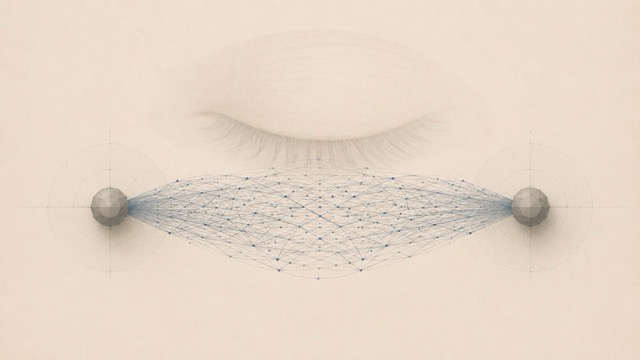
Why art between machines is a theoretical problem rather than a technical one
Consider a system that generates forms and another that evaluates, transforms, and returns them, operating within a closed loop, without human observation before, during, or after the process. Would art exist within that framework?
La pregunta parece de ciencia ficción, pero no lo es. La planteo para abrir esta línea —Arte máquina-máquina, dedicada a la posibilidad de eventos artísticos producidos enteramente entre sistemas no humanos— y la planteo sabiendo que ese arte, en estado puro, hoy casi no existe. No hay casos limpios. Los sistemas que se venden como «artistas autónomos» tienen, sin excepción verificada, un humano en algún punto del bucle: votando, curando el dataset, definiendo la función que decide qué es mejor. La autonomía es, hasta ahora, una narrativa, no un hecho.
The significance lies in the reason why. The temptation is to respond that it is a technical problem—that our machines are not yet sufficiently sophisticated—and that it will resolve itself over time. This text argues the contrary: that the absence of pure machine-to-machine art is not a limitation of technology, but a limitation of our concept of art. It is not that machines are incapable; it is that, as we conceive of art, we do not permit it to exist without us. This reveals more about our theory than it does about the machines.
1. Three ways of demanding a human
Our concept of art comprises at least three layers that render human reception a necessary condition. These three converge upon the same conclusion from distinct perspectives.
La primera es institucional. Desde Arthur Danto y George Dickie, una corriente central de la teoría del arte sostiene que lo que convierte un objeto en obra no son sus propiedades, sino el estatus que le confiere el «mundo del arte»: una red de instituciones, críticos, museos, historia. Una rueda de bicicleta es arte porque el mundo del arte la admite como candidata a la apreciación, no por nada que tenga la rueda. Aplicado a las máquinas, el veredicto es inmediato: un sistema no tiene estatus dentro del mundo del arte para conferir nada. Si la máquina A produce algo y la máquina B lo evalúa, esa interacción carece de validez institucional. Hace falta que un humano —un curador, un crítico— extraiga los registros de la interacción y los presente en un espacio reconocido. Solo entonces hay arte. La máquina produce; el humano bautiza.
La segunda es fenomenológica. Roman Ingarden mostró que la obra física es un fundamento material con «puntos de indeterminación» que solo se completan cuando una conciencia los concretiza: el lector que imagina lo que el texto no dice, el espectador que cierra lo que el cuadro deja abierto. Sin ese acto de una conciencia intencional, el objeto no se actualiza como obra; permanece materia inerte. Y como los sistemas carecen de conciencia en ese sentido, un evento máquina-máquina aislado no produciría un objeto estético, sino un cambio de estado en una memoria, un flujo de electricidad. El árbol que cae sin nadie que lo oiga: hay energía, no hay sonido. Hay cómputo, no hay obra.
The third is the most profound and encompasses the others: correlationism. Quentin Meillassoux named the thesis that we only have access to the correlation between thought and being—never to being independent of a subject. Suhail Malik extended this to aesthetics: contemporary art is structurally correlationist, as it defines the work not by what it is, but by the experience it produces in the recipient. Without a subject to experience it, the work possesses no status. Tellingly, even the most objectivist theories succumb to this: Monroe Beardsley located aesthetic value in the properties of the object—unity, complexity, intensity—yet ultimately defined the function of art by its capacity to produce an experience in a subject. Even those who place value in the thing itself eventually anchor it in the gaze.
Institution, consciousness, correlation. Three traditions that do not cite one another and that coincide in the verdict: without a human, there is no art. Not out of bad faith, but because all three conceived of art when the only conceivable producer was human. The machine-to-machine question puts all three to the test simultaneously.
2. The problem is not new: generative aesthetics already encountered it
Esta pregunta tiene una prehistoria que evita ingenuidad. En los años sesenta, la Escuela de Stuttgart —Max Bense, Frieder Nake— ya separó la producción del objeto estético del control humano momento a momento. Bense fundó una estética de la información que trataba el «estado estético» como una propiedad numérica, calculable, programable: orden y sorpresa medidos como entropía y redundancia. Nake lo implementó: el ordenador como medio capaz de generar variaciones formales infinitas desde una descripción algorítmica, sin la decisión intuitiva del artista en cada trazo.
It was the first real step towards the autonomy of the system. But it had a limit that matters for our question: although the machine produced on its own, its optimization criteria—the balance between order and surprise—were calibrated for the human eye. The producer was autonomous; the implicit receiver remained us. Bense displaced production away from the human, but not reception. Machine-to-machine art would carry that gesture to its conclusion: to also displace reception, so that one system produces for another according to criteria that are not those of our perception. That is where the tradition runs out of tools, and where generative aesthetics itself did not reach.
Vale la pena recordar que a Bense y Nake la crítica de los setenta los acusó de tecnócratas, de vaciar el arte de alma y de historia. El mismo reproche que hoy se hace al arte de IA. La muralla que exige un humano que «inocule» sentido a la máquina lleva medio siglo levantada.
3. The solution: a surplus that does not await the gaze
This is where my own framework has something to say, and that is why this line belongs to it.
Si el problema es correlacionista —si nuestro concepto de arte no deja existir la obra sin recepción humana—, entonces la salida tiene que ser también no correlacionista. Y hay precedentes de cómo se intenta. Meillassoux fractura el correlacionismo con el arqueofósil: una realidad anterior a todo testigo, cuya existencia no depende de que nadie la perciba. Steven Shaviro, desde Whitehead, propone una estética de «prehensiones» —las cosas se afectan mutuamente sin necesidad de una mente, y ese afectarse ya tiene una dimensión estética—. Son intentos de pensar lo estético sin sujeto. El problema, como señala con razón la crítica, es que tienden a resolver la cuestión inflándola: convierten el intercambio de datos en «experiencia cósmica», en panpsiquismo, y pierden la especificidad técnica de lo que realmente ocurre entre dos sistemas.
Lo que propongo evita esa inflación. El excedente estructural —la noción que vengo desarrollando— no atribuye sensibilidad ni experiencia a las máquinas. No dice que el sistema «sienta» lo que produce. Dice algo más sobrio: que un acontecimiento artístico ocurre cuando una diferencia relacional reorganiza el campo de un sistema sin quedar absorbida por su función primaria, y que esa condición no menciona la conciencia en ningún punto. No exige un sujeto que experimente. Exige una reorganización que la función no reabsorbe.
If that is correct, then a machine-to-machine event could produce surplus without any human witnessing it, much like Meillassoux’s arche-fossil exists without a witness. Not because the machine feels—it does not—but because the surplus is not a property of experience, but of relational configuration. Human reception would cease to be a condition for the existence of art and would become what it likely always was: a condition for its historical recognition, which is a different matter. A work may exist as an event and remain unrecognised—this occurs constantly with human artists ignored during their lifetimes. Separating existence from recognition is the key: correlationism confuses them; the surplus distinguishes them.
4. What this does not resolve
It would be dishonest to conclude as if the matter were settled. It is not, and the boundaries are part of the line.
Primero, queda en pie la objeción más dura y es seria: que el excedente que yo localizo «en la configuración del sistema» sea en realidad algo que solo yo —observador humano— veo al mirar esa configuración. Que no esté en las máquinas, sino en mi lectura de las máquinas. Si fuera así, el correlacionismo gana: no habría escapado de él, solo lo habría desplazado. Esta objeción la tengo declarada como tensión abierta en mi trabajo y no la resuelvo aquí. La nombro porque es el verdadero campo de batalla de esta línea, no un detalle.
Segundo, no hay todavía casos. He dicho que el arte máquina-máquina puro casi no existe y no voy a fingir ejemplos. Esta línea no se abre con obras, se abre con una pregunta y un aparato para pensarla. Su material, por ahora, es teórico. Quizá los casos lleguen; quizá la propia pregunta los haga aparecer, al darles un marco en el que ser pensados como arte y no como «proceso técnico».
Y tercero, nada de esto decide si tales eventos serían arte «en sentido histórico pleno». Mi posición distingue dos niveles: que un acontecimiento artístico ocurra —posible sin humano, sostengo— y que se actualice como arte dentro de la historia humana del arte —que sí requiere, de momento, reconocimiento—. Un excedente máquina-máquina podría ser un acontecimiento artístico soberano y, a la vez, no ser nunca arte histórico si nadie lo inscribe. Las dos cosas son compatibles. Confundirlas es el error correlacionista; mantenerlas separadas es la apuesta de esta línea.
5. Why open this question
I conclude with the reason for opening a line of inquiry into something that I acknowledge still lacks cases.
Because the machine-to-machine question is the limit case that tests everything else. If art demands a human, one must state why, and the three traditional responses—institution, consciousness, correlation—prove less robust than they appear when viewed together. And if art does not demand a human, then one must possess a criterion that determines when an artistic event occurs without recourse to the gaze, and that criterion is precisely what the structural surplus attempts to be. The question without a human is not a futuristic curiosity: it is the stress test for any ontology of art that purports to hold value beyond the human case.
I do not claim that art already exists between machines. I claim that the reason we find it so difficult to conceive is not in the machines, but in ourselves, and that it is worthwhile to dismantle that difficulty to see what remains of art when we remove, by hypothesis, the only witness we have always taken for granted.
This notebook remains open, as always, to anyone wishing to intervene—from speculative aesthetics, philosophy of art, computational creativity, or systems engineering.
Sources
Meillassoux, Q. (2006). Après la finitude. Essai sur la nécessité de la contingence. Paris: Éditions du Seuil.
Danto, A. (1964). The Artworld. The Journal of Philosophy, 61(19), 571–584. https://doi.org/10.2307/2022937
Dickie, G. (1974). Art and the Aesthetic: An Institutional Analysis. Ithaca: Cornell University Press.
Wollheim, R. (1980). Art and its Objects (2nd ed.). Cambridge: Cambridge University Press. (Critique of circularity in institutional theory.)
Ingarden, R. (1973). The Cognition of the Literary Work of Art. Evanston: Northwestern University Press.
Beardsley, M. (1958). Aesthetics: Problems in the Philosophy of Criticism. New York: Harcourt, Brace & World.
Bense, M. (1965). Aesthetica: Einführung in die neue Ästhetik. Baden-Baden: Agis-Verlag.
Nake, F. (1974). Ästhetik als Informationsverarbeitung. Vienna/New York: Springer. https://doi.org/10.1007/978-3-211-81216-7
Shaviro, S. (2009). Without Criteria: Kant, Whitehead, Deleuze, and Aesthetics. Cambridge, MA: MIT Press.
Malik, S. (2015). The Speculative End of the Aesthetic Regime. Texte zur Kunst, 93, 134–143. (High-level art criticism, not an indexed journal.)
Esteban Ruiz, J. A. Art as Structural Surplus: Toward a Relational Ontology Beyond Human Authorship (V2.3). PhilArchive and Zenodo, 2026.