
A position on the emerging debate
The debate has been circling itself for three years; in recent months, it has begun to find a partial resolution. I propose a complete one.
The debate is this: who is the author of a work created with artificial intelligence? For three years, responses have oscillated between two poles, both of which are exhausted.
At one pole lies legal anthropocentrism. Copyright offices—led by that of the United States—demand a controlling human behind the work to grant it protection. Without a conscious human subject in command, there is no author and no protectable work. This position is administratively convenient yet philosophically impoverished: it reduces the question of authorship to a search for the finger that pressed the button.
At the other pole lies co-authorship through the sum of parts. An AI work does not possess a single author, but several: the model programmer, the dataset, the individual who writes the prompt. Distributed authorship. This is less naive than the former, yet it remains trapped within the same question: it merely substitutes 'one author' for 'several authors'. It persists in seeking subjects to whom the work may be assigned.
Between these two poles, in recent months, a more compelling third way has begun to emerge: a return to Alfred Gell. Gell's anthropology of art (Art and Agency, 1998) possesses a virtue that the debate required: it deactivates the requirement for consciousness. For Gell, an object possesses agency not because it 'thinks', but because it acts within a network of social relations: it fascinates, compels, captures. The work is a trap that retains the intention of its creator and acts upon the viewer. Applied to AI, this permits a discussion of the agency of the work without attributing a mind to it. It is an advancement; I understand why the field is turning in that direction.
Yet this is merely a partial solution. Gell resolves one problem while inheriting another. He resolves that of consciousness: we no longer need to inquire whether the machine thinks. However, he inherits a well-documented vulnerability within anthropology itself. The classic critique of Gell—formulated by Robert Layton, Howard Morphy, and others—is that his notion of object agency is 'an analogy taken too far': objects do not act, nor do they change of their own accord; there is a subject who attributes agency to matter. Gell's trap functions only insofar as it effectively simulates a human intention. In other words: Gell displaces anthropocentrism, he does not transcend it. He maintains it through a deferred route. An AI work would be a trap because it successfully mimics what a human would do.
Furthermore, there is something else, which is decisive. Gell's ontology is instrumental at its root: for him, art is a system of action designed to influence others—to capture, enchant, or socially control. The trap demands a functional performance: it exists to do something to someone. This sits poorly with what truly interests us when we discuss art, and it sits especially poorly with AI, where the system's primary function is already defined in advance: to generate an output that responds to the prompt. If art is merely effective capture, then an AI image that fulfills the request well would be the perfect case of Gellian art. Yet we know this is not the case. Fulfilling the function does not make it art.
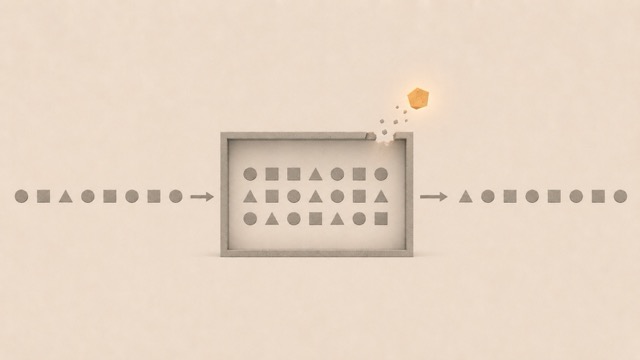
This is where I have been working in a different direction for years. What defines the artistic event is not who originates it—human or machine—nor its efficacy in influencing others. It is something I have termed structural surplus: a relational difference that persists and reorganises the field of a system's possible configurations, without allowing itself to be absorbed by that system's primary function.
Translated to the context of AI: the primary function of a generative system is to produce an optimal output that responds to the prompt. That is the purpose for which the system exists. The artistic event—if there is one—does not lie in the fulfilment of that function, however well it may be performed. It lies in the surplus: in what remains, in the difference that the system produces which its own function fails to reabsorb. Art is not the successful output. It is the remainder that overflows the task.
This alters the entire question. It ceases to matter who the author is—the question of the first two poles. It ceases to matter whether the work 'acts' as a trap—Gell's question. The question becomes: does this encounter produce a surplus that reorganises something and refuses to be reduced to the function that originated it? And that question may be posed equally of an oil painting, a generative work, or even an interaction between two machines, without the necessity of seeking a subject behind it or feigning that the object possesses volition.
The advantage is not merely rhetorical. Gell explains one part well: how AI functions as an infrastructure of capture that redistributes prior human agencies—those of the engineers, those of the millions of artists whose work is in the data. That is true and useful. But Gell cannot conceive of what we do need: the possibility of an artistic event that does not refer back to any human agent, not even in a deferred manner. Structural surplus can, because it does not locate art in the agent that originates the action, but in the persistence of a difference that no agent controls entirely.
The question of art in the age of AI is not whose work it is, nor whom it captures. It is what, in that encounter, overflows the function and reorganises the field.
This is what I have been calling structural surplus, the framework from which I will continue to work on this issue. Not as another variant of the relational turn, but as its consequence: if art was always relational, AI inaugurates nothing new. It only renders undeniable that the artistic event was never in the author, but in what remains.
Sources
Gell, A. (1998). Art and Agency: An Anthropological Theory. Oxford: Clarendon Press.
Layton, R. (2003). Art and Agency: A Reassessment. Journal of the Royal Anthropological Institute, 9(3), 447–464. https://doi.org/10.1111/1467-9655.00158
Morphy, H. (2009). Art as a Mode of Action: Some Problems with Gell’s Art and Agency. Journal of Material Culture, 14(1), 5–27. https://doi.org/10.1177/1359183508100009
Van Eck, C. (2010). Living Statues: Alfred Gell’s Art and Agency, Living Presence Response and the Sublime. Art History, 33(4), 642–659. https://doi.org/10.1111/j.1467-8365.2010.00767.x
Esteban Ruiz, J. A. (2026). Art as Structural Surplus: Toward a Relational Ontology Beyond Human Authorship (V2.3). PhilArchive and Zenodo.
Esteban Ruiz, J. A. Procesos sin significado. Public Notebook at juanesteban.art, 2026.