
Why art between machines is a theoretical problem rather than a technical one
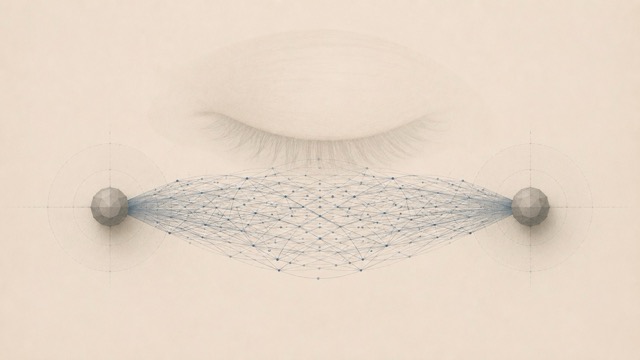
Consider a system that generates forms and another that evaluates, transforms, and returns them, operating within a closed loop, without human observation before, during, or after the process. Would art exist within that framework?
The question may appear to be science fiction, yet it is not. I pose it to inaugurate this series—Machine-to-Machine Art, dedicated to the possibility of artistic events produced entirely between non-human systems—and I do so acknowledging that such art, in its purest state, barely exists today. There are no unadulterated cases. Systems marketed as 'autonomous artists' invariably involve a human at some point in the loop: voting, curating the dataset, or defining the function that determines quality. Autonomy remains, thus far, a narrative rather than a fact.
The significance lies in the reason why. The temptation is to respond that it is a technical problem—that our machines are not yet sufficiently sophisticated—and that it will resolve itself over time. This text argues the contrary: that the absence of pure machine-to-machine art is not a limitation of technology, but a limitation of our concept of art. It is not that machines are incapable; it is that, as we conceive of art, we do not permit it to exist without us. This reveals more about our theory than it does about the machines.
1. Three ways of demanding a human
Our concept of art comprises at least three layers that render human reception a necessary condition. These three converge upon the same conclusion from distinct perspectives.
The first is institutional. Since Arthur Danto and George Dickie, a central current of art theory has maintained that what transforms an object into a work of art is not its inherent properties, but the status conferred upon it by the 'art world': a network of institutions, critics, museums, and history. A bicycle wheel is art because the art world admits it as a candidate for appreciation, not due to any quality of the wheel itself. Applied to machines, the verdict is immediate: a system lacks the status within the art world to confer anything. If machine A produces something and machine B evaluates it, that interaction lacks institutional validity. It requires a human—a curator, a critic—to extract the records of the interaction and present them within a recognised space. Only then does art exist. The machine produces; the human baptises.
The second is phenomenological. Roman Ingarden demonstrated that the physical work is a material foundation containing 'points of indeterminacy' that are only completed when a consciousness concretises them: the reader who imagines what the text omits, the spectator who closes what the painting leaves open. Without this act of intentional consciousness, the object is not actualised as a work; it remains inert matter. As systems lack consciousness in this sense, an isolated machine-to-machine event would not produce an aesthetic object, but rather a change of state in a memory, a flow of electricity. The tree that falls without anyone to hear it: there is energy, but there is no sound. There is computation, but there is no work.
The third is the most profound and encompasses the others: correlationism. Quentin Meillassoux named the thesis that we only have access to the correlation between thought and being—never to being independent of a subject. Suhail Malik extended this to aesthetics: contemporary art is structurally correlationist, as it defines the work not by what it is, but by the experience it produces in the recipient. Without a subject to experience it, the work possesses no status. Tellingly, even the most objectivist theories succumb to this: Monroe Beardsley located aesthetic value in the properties of the object—unity, complexity, intensity—yet ultimately defined the function of art by its capacity to produce an experience in a subject. Even those who place value in the thing itself eventually anchor it in the gaze.
Institution, consciousness, correlation. Three traditions that do not cite one another and that coincide in the verdict: without a human, there is no art. Not out of bad faith, but because all three conceived of art when the only conceivable producer was human. The machine-to-machine question puts all three to the test simultaneously.
2. The problem is not new: generative aesthetics already encountered it
This question possesses a prehistory that precludes naivety. In the 1960s, the Stuttgart School—Max Bense, Frieder Nake—already separated the production of the aesthetic object from moment-to-moment human control. Bense founded an information aesthetics that treated the 'aesthetic state' as a numerical, calculable, programmable property: order and surprise measured as entropy and redundancy. Nake implemented this: the computer as a medium capable of generating infinite formal variations from an algorithmic description, without the intuitive decision of the artist in every stroke.
It was the first real step towards the autonomy of the system. But it had a limit that matters for our question: although the machine produced on its own, its optimization criteria—the balance between order and surprise—were calibrated for the human eye. The producer was autonomous; the implicit receiver remained us. Bense displaced production away from the human, but not reception. Machine-to-machine art would carry that gesture to its conclusion: to also displace reception, so that one system produces for another according to criteria that are not those of our perception. That is where the tradition runs out of tools, and where generative aesthetics itself did not reach.
It is worth noting that critics in the 1970s accused Bense and Nake of being technocrats, of stripping art of soul and history. This is the same reproach levelled today against AI art. The wall demanding a human to 'inoculate' meaning into the machine has stood for half a century.
3. The solution: a surplus that does not await the gaze
This is where my own framework has something to say, and that is why this line belongs to it.
If the problem is correlationist—if our concept of art does not permit the work to exist without human reception—then the solution must also be non-correlationist. There are precedents for how this is attempted. Meillassoux fractures correlationism with the arche-fossil: a reality prior to any witness, whose existence does not depend on anyone perceiving it. Steven Shaviro, drawing from Whitehead, proposes an aesthetics of 'prehensions'—things affect one another without the need for a mind, and this affecting already possesses an aesthetic dimension. These are attempts to conceive of the aesthetic without a subject. The problem, as critics rightly point out, is that they tend to resolve the issue by inflating it: they convert the exchange of data into 'cosmic experience', into panpsychism, and lose the technical specificity of what actually occurs between two systems.
What I propose avoids such inflation. The structural surplus—the notion I have been developing—does not attribute sensitivity or experience to machines. It does not claim that the system 'feels' what it produces. It states something more sober: that an artistic event occurs when a relational difference reorganises a system's field without being absorbed by its primary function, and that this condition makes no mention of consciousness at any point. It does not require a subject to experience it. It requires a reorganisation that the function does not reabsorb.
If that is correct, then a machine-to-machine event could produce surplus without any human witnessing it, much like Meillassoux’s arche-fossil exists without a witness. Not because the machine feels—it does not—but because the surplus is not a property of experience, but of relational configuration. Human reception would cease to be a condition for the existence of art and would become what it likely always was: a condition for its historical recognition, which is a different matter. A work may exist as an event and remain unrecognised—this occurs constantly with human artists ignored during their lifetimes. Separating existence from recognition is the key: correlationism confuses them; the surplus distinguishes them.
4. What this does not resolve
It would be dishonest to conclude as if the matter were settled. It is not, and the boundaries are part of the line.
First, the most difficult and serious objection remains: that the surplus I locate 'in the configuration of the system' is in reality something that only I—a human observer—perceive when looking at that configuration. That it is not in the machines, but in my reading of the machines. If this were the case, correlationism would prevail: I would not have escaped it, merely displaced it. I have declared this objection an open tension in my work and do not resolve it here. I name it because it is the true battlefield of this line of inquiry, not a mere detail.
Second, there are no cases yet. I have stated that pure machine-to-machine art barely exists, and I shall not fabricate examples. This line of inquiry does not open with works; it opens with a question and an apparatus for thinking about it. Its material, for now, is theoretical. Perhaps cases will arrive; perhaps the question itself will cause them to appear by providing a framework in which they can be considered as art rather than as a 'technical process'.
And third, none of this decides whether such events would be art 'in the full historical sense'. My position distinguishes two levels: that an artistic event occurs—possible without a human, I maintain—and that it is actualised as art within the human history of art—which does, for the moment, require recognition. A machine-to-machine surplus could be a sovereign artistic event and, at the same time, never be historical art if no one inscribes it. Both are compatible. Confusing them is the correlationist error; keeping them separate is the wager of this line of inquiry.
5. Why open this question
I conclude with the reason for opening a line of inquiry into something that I acknowledge still lacks cases.
Because the machine-to-machine question is the limit case that tests everything else. If art demands a human, one must state why, and the three traditional responses—institution, consciousness, correlation—prove less robust than they appear when viewed together. And if art does not demand a human, then one must possess a criterion that determines when an artistic event occurs without recourse to the gaze, and that criterion is precisely what the structural surplus attempts to be. The question without a human is not a futuristic curiosity: it is the stress test for any ontology of art that purports to hold value beyond the human case.
I do not claim that art already exists between machines. I claim that the reason we find it so difficult to conceive is not in the machines, but in ourselves, and that it is worthwhile to dismantle that difficulty to see what remains of art when we remove, by hypothesis, the only witness we have always taken for granted.
This notebook remains open, as always, to anyone wishing to intervene—from speculative aesthetics, philosophy of art, computational creativity, or systems engineering.
Sources
Meillassoux, Q. (2006). Après la finitude. Essai sur la nécessité de la contingence. Paris: Éditions du Seuil.
Danto, A. (1964). The Artworld. The Journal of Philosophy, 61(19), 571–584. https://doi.org/10.2307/2022937
Dickie, G. (1974). Art and the Aesthetic: An Institutional Analysis. Ithaca: Cornell University Press.
Wollheim, R. (1980). Art and its Objects (2nd ed.). Cambridge: Cambridge University Press. (Critique of circularity in institutional theory.)
Ingarden, R. (1973). The Cognition of the Literary Work of Art. Evanston: Northwestern University Press.
Beardsley, M. (1958). Aesthetics: Problems in the Philosophy of Criticism. New York: Harcourt, Brace & World.
Bense, M. (1965). Aesthetica: Einführung in die neue Ästhetik. Baden-Baden: Agis-Verlag.
Nake, F. (1974). Ästhetik als Informationsverarbeitung. Vienna/New York: Springer. https://doi.org/10.1007/978-3-211-81216-7
Shaviro, S. (2009). Without Criteria: Kant, Whitehead, Deleuze, and Aesthetics. Cambridge, MA: MIT Press.
Malik, S. (2015). The Speculative End of the Aesthetic Regime. Texte zur Kunst, 93, 134–143. (High-level art criticism, not an indexed journal.)
Esteban Ruiz, J. A. Art as Structural Surplus: Toward a Relational Ontology Beyond Human Authorship (V2.3). PhilArchive and Zenodo, 2026.