
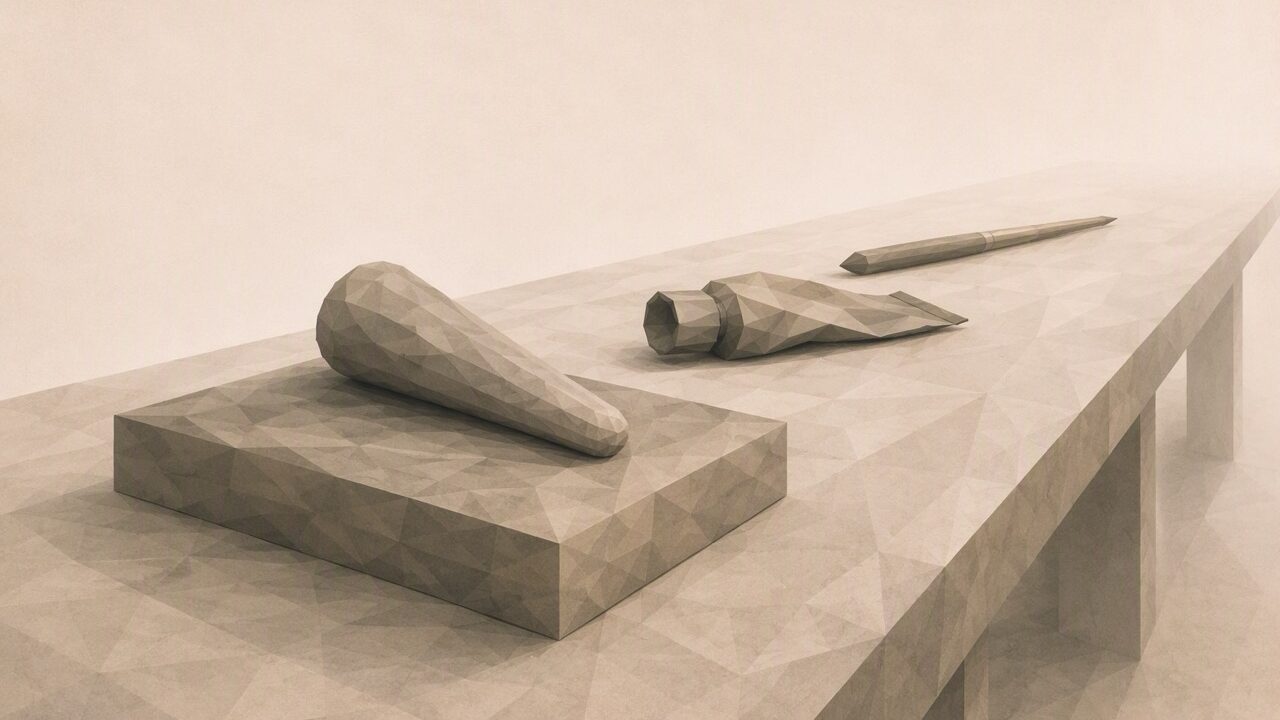
At university, I learned to manufacture my own paints. I would grind the pigment on a slab with a muller until the lumps were broken, incorporate the binder little by little, and discern when the paste had properly bound. I also learned to prepare my supports: to stretch the canvas, to size it, to prime it, and to wait. I know how to do all of this, yet I do not practise it. I purchase tubes and frames, as does almost everyone else, and I know no one who considers this to be cheating.
I recount this because it is from this perspective that I wish to examine the debate regarding the tools of art, including artificial intelligence. Not to settle it—for it cannot be settled with anecdotes—but because those who have stood on both sides of such a divide perceive something that is invisible from a single vantage point.
The line of inquiry to which I refer has a date. On 11 September 1841, a painter named John Goffe Rand patented a collapsible tin vessel with a screw cap for preserving paint in the United States. Prior to that, colour was stored in animal bladders tied with string, which had to be punctured to extract the paste and which would inevitably dry out. Furthermore, prior to that, each studio manufactured its own materials, and apprentices began precisely there: preparing panels and grinding pigments, long before they were permitted to draw. The tube brought an end to all of that within a generation. It also facilitated something that would have been exceedingly difficult without it: painting outdoors with one's materials in tow. Jean Renoir attributed a statement to his father that encapsulates this debt: without paint in tubes, there would have been no Impressionism. One should treat this with caution, as it is transmitted by the son and the causes of a movement are never singular. Yet, the sentiment is precise.
What interests me is that today, no one disputes the legitimacy of the tube. No one maintains that Monet improperly delegated the manufacture of his materials. That line shifted, and it shifted so completely that we no longer perceive it as a line: we perceive it as the very ground upon which one paints.
The following case is more eloquent, for there was indeed a conflict. When photography arrived, the reaction ranged from the fear that it would ruin portraitists—which, to a great extent, it did—to the suspicion that a painter who relied upon it was engaging in something illicit. And yet, they did rely upon it. Delacroix worked with the photographer Eugène Durieu in 1854 to produce images of nude models to serve as study material. Degas immersed himself in photography in 1895 to such an extent that a friend wrote that he abandoned himself entirely to this new passion. Eakins had incorporated the camera into his practice and teaching by 1880, and he explicitly defended it as an instrument of instruction comparable to anatomical drawing, something that served to train the eye to see what was truly before it. Today, none of this scandalises anyone.
There is a third case that I find truly revealing, for it concerns not what the painters did, but how we react. In 2000 and 2001, the optician Charles Falco and the painter David Hockney maintained that certain elements of specific paintings, dating from around 1430, had been produced with the assistance of concave mirrors or lenses. The thesis is far from achieving consensus: there are serious technical and documentary objections, and subsequent studies consider it implausible for the fifteenth century. I do not defend it. What captures my attention is the tone with which it was received. It was not discussed merely as to whether it was true; it was discussed as if it were an accusation, and a significant portion of the defence of the old masters consisted of denying that they had used such instruments, as if having done so would diminish them. The same occurs with Vermeer and the camera obscura, where there is likewise no agreement and where the discussion always carries that burden: those who argue that he used it appear to be detracting from his merit.
Therein lies what I wished to highlight. We treat tools as a moral issue disguised as a technical one. The criteria by which we judge them are not stable: those that existed when we were trained are deemed legitimate, while those that arrived later are viewed with suspicion. I learned with purchased tubes, so for me, the tube is the craft; the painter who ground his own pigments could have looked down upon me with exactly the same argument that we sometimes employ today.
Is it hypocrisy, then? I do not believe so, and I consider it important not to label it as such. Hypocrisy implies preaching what one does not practise, and that is not the case here. Something more interesting occurs, which is more difficult to discern from within: every generation naturalises the instruments with which it was trained and confuses them with the essence of the craft. It is not duplicity; it is perspective. No one sees the water in which they swim.
However, it would be disingenuous to conclude here, for there is a serious objection to this argument, and it is prudent to formulate it in its strongest version. It may be argued, with justification, that my examples delegate different things. Purchasing a tube delegates the preparation of the material. Relying on a photograph delegates part of the observation. A digital brush that corrects a stroke delegates part of the execution. And a generative model may delegate something of a different order: the very decision as to what the image shall be. Anyone who maintains that this is not merely another step on the same ladder, but something else entirely, possesses a point that cannot be dismissed with a list of precedents. Chaining together tools that we accept today does not demonstrate that the next one must be accepted. The argument by analogy, in this instance, does not hold.
What I do believe holds is a change in the question. I have long maintained, in my research, that what causes something to function as art does not depend on who produces it or the medium with which it is produced, but on whether a reorganisation appears that the system does not absorb: if, following that work, the field of what can be seen, said, or done is altered in a manner that is not exhausted by its function. With this criterion, the discussion regarding how much is delegated ceases to be decisive. One may concede that a generative model delegates more, even that it delegates the decision itself, and still have answered nothing, because the criterion was never who decides, but what occurs. And this functions in both directions, which is what renders it useful: the vast majority of what is produced with these tools reorganises absolutely nothing, and the fact that the machine is impressive does not render it more artistic.
I shall add what I do not wish to be deduced from this, as the error is easily made and I have witnessed it many times. That the tool does not determine the artistic status of a work does not mean that artificial intelligence does not pose grave problems. It does pose them, and serious ones: from where the data used for training originates, who performed that labour without knowing or being compensated, what material consumption sustains the infrastructure, and what becomes visible or disappears when circulation is ordered by recommendation systems. These questions are urgent and are not answered by stating that tools have always changed. My contention is more modest: that debating whether using them constitutes cheating distracts us within the realm of the craft, while the terrain where something is truly decided—that of the infrastructures—remains undiscussed. Both conversations are legitimate. It is only that confusing them always benefits the same party.
I conclude where I began, with the slab and the muller. I do not miss grinding pigments, although I am grateful to have learned it, for understanding the composition of a paint alters one's perception of it. I suspect that in fifty years' time, someone will recount how they learned to perform a task that no one else does, and that nothing essential was lost in the process. What remains to be done will continue to be the same as it has always been: not the manufacturing of the material nor the execution of the stroke, but the achievement of eliciting a response in the viewer. No one has automated that yet, and not because it is impossible: it is because it does not depend upon the tool.
On open conversation
This text intersects with a line of inquiry I have been pursuing: that which determines the efficacy of a work as art does not depend upon the agent who produces it nor the medium with which it is produced. Here, I test this against my own training, which included the manufacture of paints and the preparation of supports, and against the habit of treating new tools with suspicion and old ones as craft. Should anyone wish to intervene from the perspective of studio practice, the history of materials, conservation, or work with generative tools, this notebook remains open; I am particularly interested in those who maintain that, on this occasion, there is indeed a difference in nature.
Sources
Rand, John Goffe. Improvement in the Construction of Vessels or Apparatus for Preserving Paint, &c. US Patent No. 2,252, 11 September 1841. Smithsonian, Archives of American Art.
Hurt, Perry. “Never Underestimate the Power of a Paint Tube”. Smithsonian Magazine, May 2013.
Victoria and Albert Museum. Object record “Paintbox”, ca. 1800-1830 (use of animal bladders and their replacement by metal tubes).
National Gallery of Art, Washington. Italian Renaissance Learning Resources: Training and Practice (apprentice tasks: preparation of panels and grinding of pigments).
The Metropolitan Museum of Art. Record for Seated and Standing Male Nudes, after photographs by Eugène Durieu (Delacroix, 1854-1855); Edgar Degas: Photographer (1998); “Thomas Eakins (1844-1916): Photography, 1880s-90s”, Heilbrunn Timeline of Art History.
Cornell University Library. Photography As Art, Painting As Impression (nineteenth-century controversy).
Falco, Charles M. and David Hockney. Thesis on the use of optical instruments (first article, 2000; Hockney, Secret Knowledge, 2001).
Stork, David G. “Did early Renaissance masters use optical projections while painting?”. Frontiers in Optics, 2004. DOI: 10.1364/FIO.2004.FWW5.
Van Laar, Paul, Erma Hermens and Gregor J. M. Weber. “The Vermeer camera obscura hypothesis turned inside out”. ICOM-CC, 2024. DOI: 10.17863/CAM.114154.
Murphie, Andrew and John Potts. Culture and Technology. Palgrave, 2003 (chapter “Art and Technology”).
Esteban Ruiz, Juan A. Art as Structural Surplus. Zenodo, 2026. https://doi.org/10.5281/zenodo.20020706