
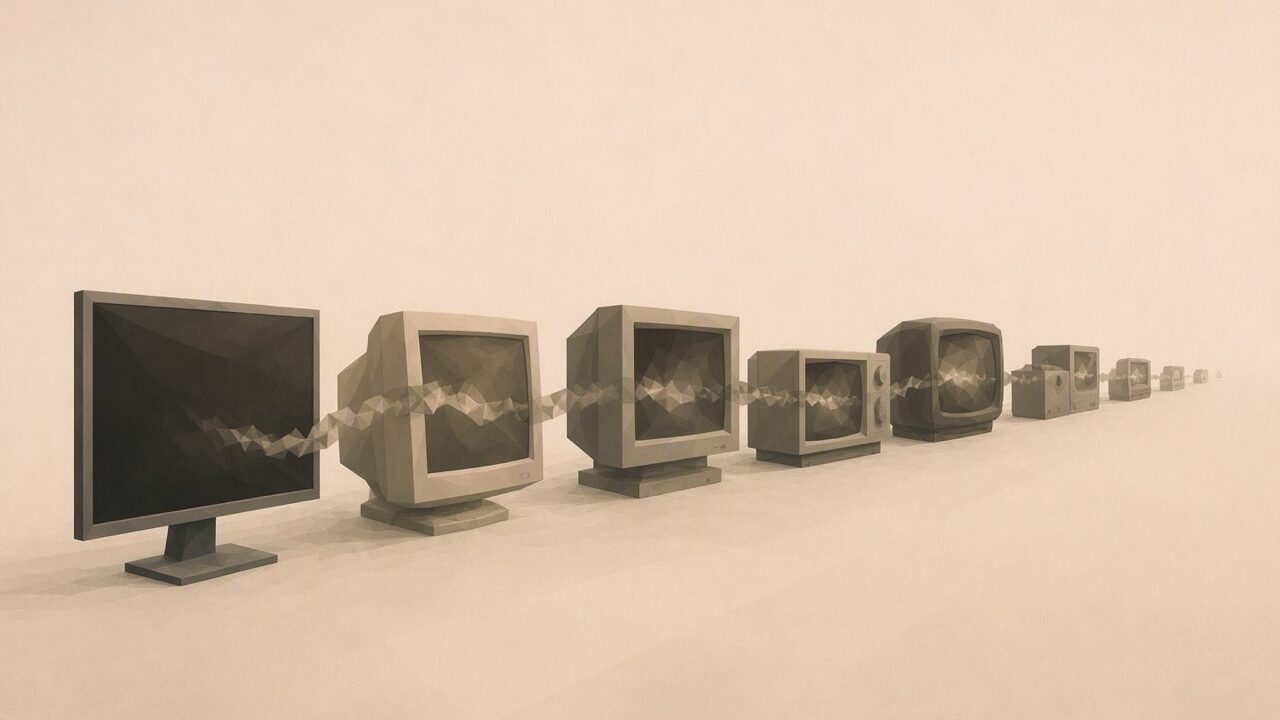
On 31 December 2020, Adobe withdrew support for Flash. Twelve days later, it blocked the execution of any content still utilising it. For almost everyone, this was a footnote, the end of a technology that had been languishing for years. For museums that had collected internet art, it was something else: overnight, an entire segment of art history ceased to function. It was not lost, not erased, not deteriorated. The files remain there, intact, byte by byte. They simply no longer launch.
This presents a problem that traditional conservation has never had to resolve, and its rarity warrants careful consideration. A painting degrades: the varnish yellows, the canvas slackens, the pigment cracks. Matter departs, and conservation consists of delaying that departure. With a work of net art, none of this occurs. The code does not age; it remains exactly as it was the day it was written. What ages is everything else: the player, the browser, the operating system, the machine. The work does not deteriorate; it is left without a world.
And here lies the uncomfortable question: what was the work. If it was the code, it remains complete and nothing has occurred. If it was what transpired when someone executed it—the animations, the interaction, the rhythm, the specific clumsiness of a nineties modem—then the work has vanished even though the file remains safe. Conserving a painting is conserving an object. Conserving a work of this nature is conserving a behaviour, and a behaviour exists only whilst something executes it.
The Guggenheim confronted this earlier than almost anyone else. In 1999, it launched an initiative concerning what it termed variable media, and proposed four possible paths when the medium of a work becomes obsolete: storing the original machine and trusting it to endure; emulating that environment within a modern one; migrating the work to current technology; or reinterpreting it, remaking it each time it is displayed. All four are legitimate and all four carry a cost. Storing eventually fails, because hardware dies. Emulating preserves the behaviour but within a simulation, with a layer of distance. Migrating keeps the work alive while changing its body. Reinterpreting is the most radical: it accepts that the object is not being preserved, but the score, and that each performance will be distinct, as in music.
That the list includes reinterpretation signifies something of importance. It indicates that the institution acknowledges, in writing, that in certain types of work, identity does not reside in the medium. What is preserved is not a file, but an intention of behaviour sufficiently documented to be capable of reproduction. This is why digital art conservation begins by asking the artist what is essential and what is contingent, something that was never asked of a seventeenth-century painter.
The best-documented case is Brandon, the work Shu Lea Cheang created for the Guggenheim between 1998 and 1999, the first web work to enter a permanent collection. Five interfaces, eighty-two pages, pop-up windows, live event logs. Over the years, it ceased to display correctly: broken links, animations that failed to load, mute pages. The museum restored it in 2017 by analysing the source code over two semesters, in collaboration with computer scientists from New York University. Note the detail: the restoration of a work of art performed by reading code with engineering students. The figure of the restorer with a scalpel and solvent is of no use here.
Tate has advanced the methodology further: it creates complete disk images of the hard drives associated with each work, rather than merely the programme, to enable the subsequent reconstruction of the entire environment; and it decides, work by work, whether to emulate or virtualise, as many pieces from the last twenty years operate on architectures for which full emulation would be absurd. They document every decision in template-based reports. It is conservation, yet it resembles the archaeology of a system more than the care of an object.
And now the detail that I find most revealing of all, and with which I wish to conclude. Rhizome, the organisation that has been archiving internet art since 1999 and has rescued works that no longer ran anywhere, built its own tools to do so. One of these is Conifer, which allows for the capture of complex pages for preservation. However: Conifer will cease to accept new captures in June 2026. Existing content will remain accessible, but the tool that served to preserve has itself entered its own end-of-support phase.
There is no irony to be drawn from this, merely an observation. In digital art, there is no firm ground from which to conserve. The conservator does not stand outside of obsolescence observing its passage: they are within it, utilising tools that will also expire, and their work consists less of halting time than of transitioning the work from one technology to the next before the current one is extinguished. It is a relay, not a custodianship. And perhaps this, more than an anomaly of the digital, is what conservation has always been, only with paintings the relay proceeds so slowly that we permit ourselves to term it permanence.
On open conversation
This text continues my interest in the identity of a work when material ceases to be the criterion: if what defines a piece is a behaviour rather than an object, preserving it necessitates deciding beforehand what it was. Digital art carries this question to an extreme where it can no longer be evaded. Should anyone wish to intervene from the perspective of new media conservation, digital art, web archiving, or museum practice, this notebook remains open.
Sources
Adobe. End of support for Adobe Flash Player, 31 December 2020 (content blocking from 12 January 2021).
Journal of the Institute of Conservation (2022). Study on the obsolescence of Flash in net art works and the case of Genesis (2001) by Sinae Kim in the Rhizome ArtBase.
Solomon R. Guggenheim Museum. Variable Media Initiative (1999) and Preserving the Immaterial symposium (2001); storage, emulation, migration, and reinterpretation strategies.
Solomon R. Guggenheim Museum. Restoring Brandon, Shu Lea Cheang’s Early Web Artwork, 16 May 2017.
Rhizome. ArtBase and web archiving tools (Conifer, oldweb.today).
Tate. Time-Based Media Conservation and Software-Based Art Preservation Project; Ensom, Tom and Patricia Falcão, Electronic Media Review 7 (2021-2022).