
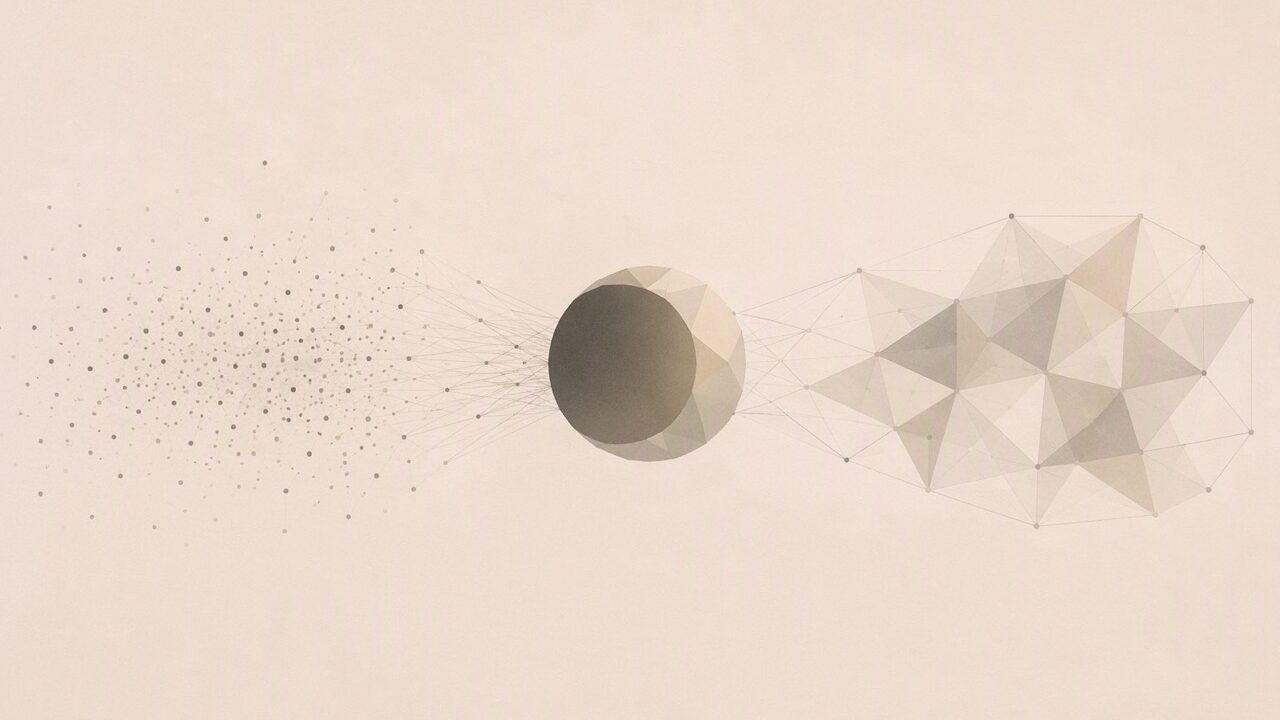
An artistic research programme concerning data as a constituent material of the work. It investigates the conditions under which a computational system, fed by data, produces structural surplus or remains absorbed by its informative, spectacular, or instrumental function.
This line operates within the Structural Surplus experimental programme, in the domain where the framework is tested under algorithmic conditions with human participation. One question articulates the work: when does the computational translation between data and perceptual environment produce an artistic event, and when does it remain subordinate to representation?
The programme is developed across two articulated planes. A theoretical plane, which investigates the status of data as artistic material and the place of human decision within the chain extending from data to the work. And a production plane, which works with astronomical data as a constituent material of generative work. The former critically examines external practices to situate the question; the latter puts it to the test in practice. Both share the same hypothesis: that the decisive factor is not who or what executes the form, but where the difference that the system cannot reabsorb is produced.
Theoretical plane. Data as material and human surplus
Before producing, this line considers what it means to work with data. Two entries inaugurate this plane, tracing a polarity between them: human surplus may appear at the end of the chain, modulating an output that the artist did not produce, or at the beginning, in the very fabrication of the data.
- What the artist does when they no longer make the work.
When data is massive and external and the form is generated by an algorithm, the artist's work does not consist of adding content or form, but of modulating: deciding the threshold, the friction, the taxonomy, the rule. Through Ryoji Ikeda, Laurie Frick, Giorgia Lupi, and Jer Thorp, the entry locates human surplus as an act of subtraction, not addition, and distinguishes it from the mere spectacle of data.
- Fabricating data.
The case that reverses the previous one. When the artist does not receive the data but fabricates it by hand—the ten thousand tulips photographed and labelled by Anna Ridler—the surplus ceases to be in the output and remains sealed in the input substrate, and the algorithm is revealed as what it is: an engine that interpolates prior human decisions. With Akten, Klingemann, and Paglen as variations on the decision at the origin.
Production plane. Astronomical data
Cosmic Data LAB does not illustrate astronomy. It works with data as material, not as reference. The computational system operates as a translation interface between three regimes: scientific measurement, algorithmic modelling, and perceptual experience. The work emerges in that translation, not at its extremes.
Artificial intelligence is employed as an instrument of research, not as an aesthetic substitute. Technology is instrumental. Artistic research is central.
Conditions of rigour
Four methodological guarantees underpin the work:
- Traceable provenance. The source data and their scientific origins are documented in every production.
- Transparent procedures. The computational flows that transform data into generative structure are legible, not opaque.
- Reproducibility. The generative structures may be reviewed and replicated by other researchers.
- Digital sustainability. Energy efficiency and critical awareness of technological infrastructures as a condition of the practice itself.
These guarantees are not merely operational: they are conditions under which the surplus generated by the system can be identified and discussed as such, in contrast to productions where the process is a black box.
First cycle: 2026-2028
The first cycle of the programme is activated by the sequence of solar eclipses visible in Southern Europe between 2026 and 2028. The eclipses function as temporal anchors—not as a theme—and allow for a three-year horizon of work with defined public moments.
Cosmic Data LAB is developed institutionally through Kripties Foundation, coordinating cooperation with astronomical research centres, digital laboratories, and European festivals.
Status
In development. The theoretical plane is incorporated as the research progresses; the production plane is activated with the first cycle.