
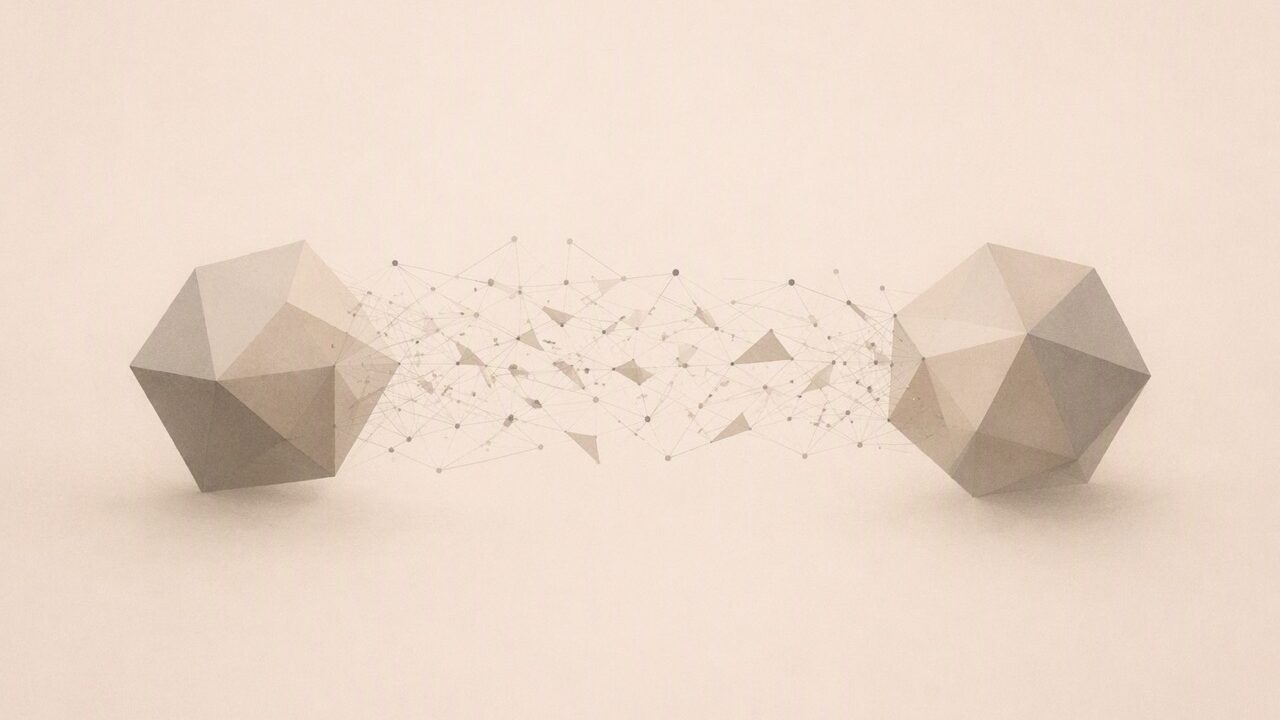
Research line into the possibility of artistic events produced entirely between non-human systems. This represents the programme's limit case: the point at which the human agent is not merely displaced, but disappears from the loop—neither in production nor in reception.
The line operates within the Structural Surplus experimental programme, at its point of greatest human agent displacement. If structural surplus defines the artistic event through a reorganisation that a system's primary function does not reabsorb—without invoking consciousness at any point—then nothing in the framework excludes by definition the possibility of that event occurring between machines. This line examines that possibility: not to affirm it naively, but to test it where it is most difficult to sustain.
Position
Pure machine-to-machine art, today, barely exists as a practice. Systems presented as autonomous artists have, without verifiable exception, a human agent at some point in the loop: voting, curating the dataset, or defining the function that determines what is superior. Autonomy is, for now, a narrative rather than a fact.
The hypothesis of this line is that this absence is not a technical limit that time will resolve, but a limit of our concept of art. Three traditions—the institutional, the phenomenological, and the correlationist—make human reception a condition of the artistic event, and for this reason, an occurrence between machines is classified in advance as a technical process, not as art. The line works upon that boundary: distinguishing the existence of the event from its historical recognition, and questioning what remains of art when one removes, by hypothesis, the only witness that was always assumed.
Declared tension
This line maintains the harshest objection against itself as part of its programme, rather than as an obstacle to be resolved in advance: that the surplus located in the configuration of the systems may, in reality, be something that only a human observer perceives when viewing that configuration. If this were the case, correlationism would not have been overcome, merely displaced. Maintaining that tension—rather than settling it prematurely—is how this line tests the framework at its most exposed point.
The series
- Art that no human would see.
Inaugural text of the line. Why art between machines is a theoretical problem rather than a technical one: the three traditions that demand a human (Danto and Dickie; Ingarden; Meillassoux and the correlationist critique), the prehistory of the issue in the generative aesthetics of Bense and Nake, and the solution offered by structural surplus without attributing sensitivity to machines—separating the existence of the event from its historical recognition.
Status
In development. The line is, for now, theoretical: its material is not works—which barely exist in a pure state—but the question of the conditions under which such works could be considered art. Productions and cases will be incorporated as the field provides them.