
I hold a degree in Fine Arts, specialising in Painting, from the University of Seville. I learned to construct an image with my hand, the brush and time, and I continue to believe that this training teaches one to look in a way that cannot be improvised. Today, I also create generative work. That is why I am uncomfortable with a reaction I often encounter among artists, illustrators, designers and young people: 'generative art' has become a suspicious term.
The suspicion dissolves when faced with the generated world of a video game. Millions of people traverse landscapes that no illustrator composed inch by inch, accept creatures distributed by rules and learn to read systems by their effects, without the algorithm hindering them from recognising a cultural experience. The conflict begins when the image is associated with a model trained on large datasets. Calling both practices 'generative art' erases precisely that boundary.
Sixty years of rules, chance and plotters
Generative art predates diffusion models by decades. On 5 February 1965, Georg Nees exhibited images created with a digital computer at the Studiengalerie of the Technische Hochschule in Stuttgart. In November of the same year, the Galerie Wendelin Niedlich opened Computer-Grafik, featuring works by Nees and Frieder Nake drawn on a plotter. In 1968, the Institute of Contemporary Arts in London presented Cybernetic Serendipity, curated by Jasia Reichardt, where graphics, films, music, and texts produced with computers coexisted with cybernetic devices and painting machines.
The line continued. The Victoria and Albert Museum today preserves more than 3,000 objects of digital art and design, dating from the 1950s. Among them are Structure of Squares, a 1974 plotter drawing by Vera Molnár, and P-O32 (Matrix Elements), a set of punched cards by Manfred Mohr dated 1970.
In those practices, the artist defined rules and ceded part of the decision-making to a machine, to chance or to the intersection of parameters. The system produced configurations that no one had drawn one by one, but the space of possibilities emerged from explicit decisions: variables, limits, distribution, repetition, deviation and selection criteria.
An image produced with generative AI emerges from a different procedure. The model has learned statistical regularities from enormous quantities of material and responds to an instruction through a chain of transformations that the user does not control in detail. Both procedures use algorithms. They do not necessarily share data, responsibilities, degree of legibility or relationship with the prior work of other individuals.
The word 'generative' describes a result produced through a system. It does not state who built that system, what materials it incorporated, what decisions it delegates or who pays its costs.
Video games normalised calculated worlds
Video games now enjoy stable cultural and institutional recognition. The Museum of Modern Art announced the acquisition of its first fourteen video games on 29 November 2012; in selecting them, it considered interaction design, player behaviour, time, space, and the elegance of the code. That same year, the Smithsonian American Art Museum dedicated The Art of Video Games to four decades of the medium. In Spain, the Culture Committee of the Congress approved a non-legislative motion on 25 March 2009 to promote the video game cultural industry. This was cultural and industrial policy; the text does not declare the video game to be art.
Social scale carries weight. The 2025 Video Game Industry Yearbook from the Spanish Video Game Association estimates that 22.8 million people play regularly in Spain, more than 54% of the population aged 6 to 75, with a declared average of 8.5 hours per week.
Many games depend on generative procedures. Microsoft's official documentation explains that Minecraft is not limited to static maps. A seed feeds noise generators, and various phases construct terrain, biomes, structures, vegetation, lighting and creatures. With the same version and the same seed, two people find the same world, even though no one has drawn it block by block.
Bay 12 Games describes Dwarf Fortress as a persistent, randomly generated world, complete with civilisations, centuries of history, cities, caves, and fauna. In this game, generation produces a significant portion of the terrain where the experience can unfold.
The player tolerates this delegation, and often desires it. An entirely hand-designed world would be smaller, less variable or prohibitively expensive. The rules expand what is explorable and also manufacture errors, repetitions and accidents that end up in the game's memory.
No one usually asks Minecraft for a human intention behind every hill. The system, the coherence of the world and what it allows one to do within it are judged. The disposition changes when that same public perceives that generation has taken the place of a voice, an illustration or a text that was previously commissioned from a person.
AI within the game
On 9 January 2024, Steam announced its own policy regarding AI-generated content. Its current documentation distinguishes between material produced during development and that generated in real-time during gameplay. The form focuses on what reaches the product and is consumed by the public: imagery, audio, narrative, localisation, and other materials. Internal tools that merely improve efficiency remain outside the scope of the declaration.
Steam asks for a description of how that content is used and maintains general obligations regarding legality, rights and correspondence between the product and its commercial presentation. The intervention of an algorithm is not sufficient to exclude a game.
Performance work shows the other side. SAG-AFTRA performers held a video game strike lasting approximately eleven months, from July 2024 until the ratification of the 2025 agreement, with AI at the centre of the negotiations. The contract requires consent and disclosure for specific uses of digital replicas and allows for the suspension of consent to generate new material during a strike. The vote concluded with 95.04% in favour.
The agreement leaves aside whether a synthetic voice sounds convincing. It establishes who may authorise its replication, with what information and with what subsequent capacity to object. The problem begins when a technology retains the performance and dispenses with the performer who made it possible.
Players have also protested. The Washington Post documented the cancellation of a project from the Postal series following accusations that its trailer contained AI-generated graphics. The same newspaper reported the withdrawal of an award from Clair Obscur: Expedition 33 after the studio acknowledged having experimented with generated images, which it maintained were not included in the final version. These are cases published by a journalistic outlet; without the records of those decisions, they do not allow any visual suspicion to be converted into proof of use.
Among those who develop games, the attitude is divided. The State of the Game Industry 2025 survey, involving more than 3,000 professionals, found that 52% worked in companies that had implemented generative AI and 36% used it personally. 30% considered its impact on the industry to be negative, twelve points higher than the previous year. Adoption and approval do not advance in tandem.
Young people: high usage, poorly measured assessment
Basic data regarding young Spaniards and AI-generated art is lacking. Between 2023 and 2026, I have not located a survey from the CIS, INJUVE, the SM Foundation, or the Telefónica Foundation that asks individuals aged 13 to 30 whether they consider a generated image to be art, whether they reject it, or whether they use it in their own practice.
Available surveys primarily measure usage. According to the European data portal, 64% of people aged 16 to 24 in the European Union had used generative AI tools in the preceding three months, and approximately 40% employed them for educational purposes. Ofcom reported in 2023 that 79% of connected British teenagers, aged 13 to 17, used generative services.
These figures do not prove artistic acceptance. One may use a generator for study or amusement and reject its output being exhibited, awarded, or sold as art. One may also accept a licensed tool while rejecting another due to its training data.
Special Eurobarometer 562 provides a reference for the European adult population as a whole, without isolating young people in the published report. More than eight out of ten people prefer content created by human beings; 73% are concerned about the effect of generative AI on the employment or income of artists, and less than 48% claim to be able to distinguish an AI-generated work from a human one.
The assessment changes with the label. In the experiment by Martin Ragot, Nicolas Martin, and Salomé Cojean, presented at CHI 2020 with 565 participants, paintings perceived as human-made received better ratings than those perceived as artificial. The design crossed attributed authorship with actual provenance, so it does not equate to showing the same painting twice to each person.
In 2026, André D. Gopal published an experiment with sixty young adults. While the origin remained hidden, human and generated works received similar scores; upon revealing it, the appreciation, emotional involvement, and purchase intention for those attributed to AI decreased. A workshop communication from the same year, with 150 participants and surveys in four languages, associated familiarity with AI with greater openness and formal creative training with more scepticism.
These are small or non-representative samples, and they do not authorise any thesis about 'youth'. They indicate that an image is not valued solely for what is seen within it. Beliefs regarding intention, agency, authenticity, training, ownership, and economic effect all play a part.
Drawing for a living
Among illustrators and designers, the rejection has a material basis. The FADIP survey published in 2025, with professionals of an average age of 40, places the advancement of AI among the sector's problems. It does not allow for the isolation of those under thirty.
In the United Kingdom, the 2026 survey by the Association of Illustrators gathered 549 responses, according to The Bookseller. 46% know they lost work because a client chose generative AI. 62% had received generated images within commissions or reference panels, and 36% had received requests to copy, retouch, or redraw those materials. This is what a self-selected professional sample declares, not a market measurement.
Complete substitution is not the only effect. The illustrator may retain the commission while losing the research, conception, or visual direction. They receive a generated image that the client has already approved and are left responsible for executing it, correcting anatomies, unifying the style, or preparing usable files. Human labour remains, displaced towards repair and negotiated from a weaker position.
Professional platforms have responded in different ways. ArtStation requires the declaration of generative use and allows it to be hidden; since September 2026, it has activated its NoAI protection by default and announced measures against automated scrapers. Cara does not admit generated portfolios while, according to its policy, the ethical and privacy problems of datasets persist. DeviantArt offers its DreamUp generator, admits generated images, and marks works as unauthorised for external training by default.
The three are testing different combinations of labelling, filtering, consent, and visibility, and none opposes the algorithm as such. They are debating who controls the work and how its provenance is declared.
Consent, labour, provenance
This part is my own interpretation: the rejection points less to generation than to its conditions. A Minecraft world arises from rules written by a team and does not need to extract a visual regularity from millions of illustrations. Those who play traverse the result, learn its limits, and know that a system lies behind it. The image obtained with a generative model arrives with three questions that the game does not pose: who performed the work, with what materials was the model trained, and who loses the commission.
The performers' strike, industry surveys, and platform policies speak of consent, remuneration, attribution, traceability, and contractual power. None demonstrate that an algorithmic procedure invalidates a work in itself.
These objections have concrete responses: machine-readable rights reservations, contracts, licences, data documentation, declaration of AI use, and the effective capacity to refuse. In the guide on rights reservation against data mining, I explain their scope and limits. A technical indication does not become an absolute barrier with these, but it leaves a record of intent and may have legal effects depending on the case.
The critique loses precision when it extends suspicion to every work made with rules, chance, or code. One can question a model trained without consent while simultaneously recognising the tradition of Vera Molnár, Frieder Nake, Manfred Mohr, or Casey Reas.
My theoretical work maintains that neither the agent nor the medium decides if an artistic event occurs. It is decided by what happens in the encounter: if the work introduces a difference that forces a reorganisation of what was expected of it. The thesis is developed in Art as Structural Surplus. It does not exempt any procedure from its labour or legal conflicts. Nor does it allow for the artistic condition to be decided before viewing the work.
An experiment with public data from the AT Protocol
ATMOSPHERE allbut.art is my practical essay on that distinction. For sixty seconds, the piece generates a composition based on structural features of the public activity of an account on the AT Protocol: rhythm, gesture distribution, lengths, signs, time slots, and reactions received. It does not use texts, links, or names as visual material, nor does it attempt to infer personality, ideology, or emotional state.
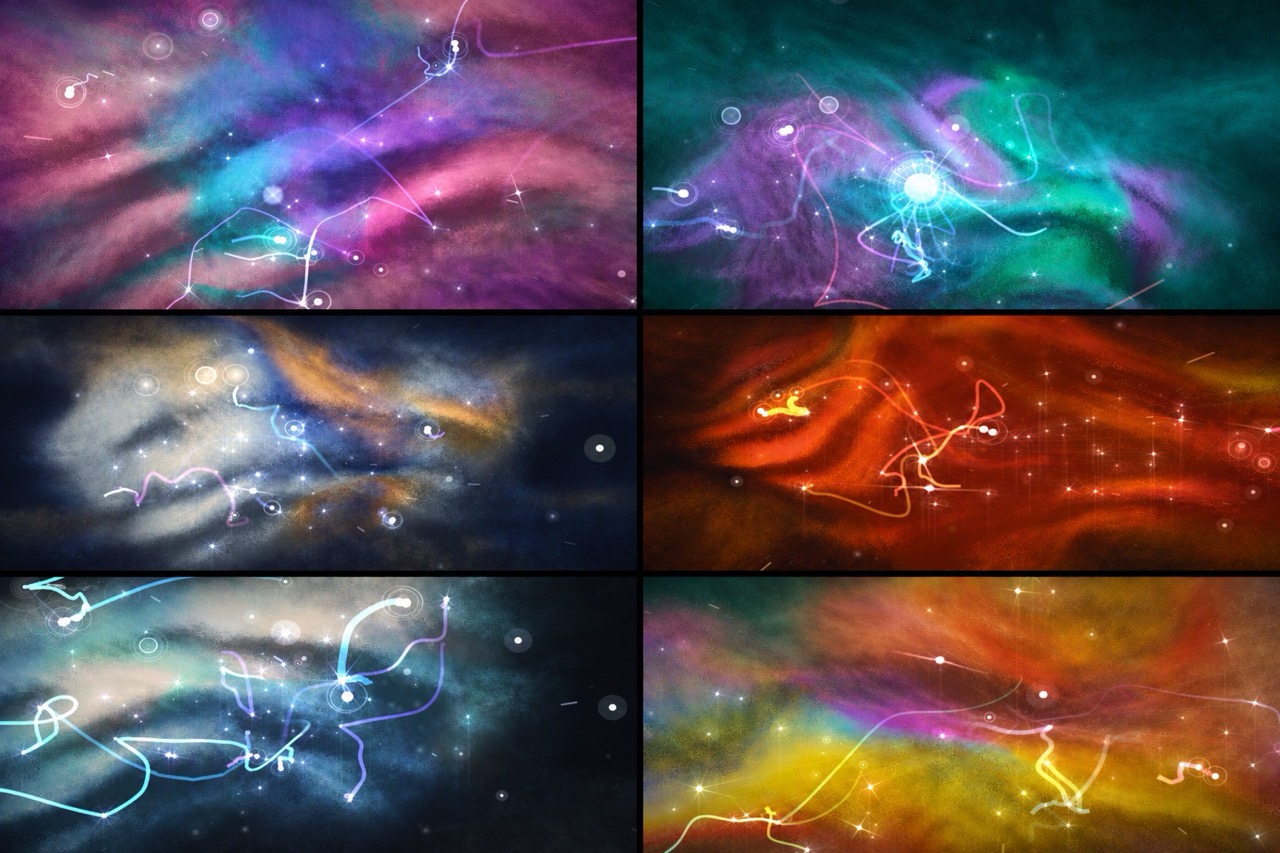
The generation occurs on the participant's device. After viewing it, each person decides whether to share the piece. Only then are the image, the derived structure necessary to reproduce its movement, and a record in the AT Protocol repository for that account published. The shared pieces enter a gallery that will gradually form a larger composition. Participation is via a Bluesky or Eurosky account, and anyone who wishes may request the removal of their piece by email.
I do not use any image model trained on others' work. I have written the rules and designed the margin of indeterminacy, but I do not decide the public activity that fuels each execution nor whether the piece ends up in the gallery. The participant witnesses how their image is formed and decides whether to incorporate it into the common work.
The project does not, in itself, demonstrate that a generative system produces art. It may fail as an experience or remain a mere visual effect, and for this reason, I present it as an experiment. It serves to separate the act of generation from the artistic question and the legal issues of other procedures.
The project page explains what it queries, what it transforms, and what it publishes. One aspect of the experience remains unexplained during this phase, as knowing it in advance would alter the participant's behaviour. This does not affect the information required for consent.
Learning to read systems
Video games have taught several generations to inhabit systems: to traverse a world that was not drawn, to recognise rules by their effects, and to return to see what changes. That experience need not end with the game. A generative work may demand a similar level of attention without an objective, score, or reward: observing how it changes, identifying the decisions embedded within the system, and recognising the contribution made by the participant.
Formal education in Spain is scarce. The Universitat Politècnica de Catalunya offers a Generative Art with Processing subject in 2026 within the Multimedia Degree, which uses p5.js to teach programming, visual exploration, and artistic projects. Medialab Prado held a Processing Community Day in 2019 with generative animations for participants from the age of ten, already outside the recent period.
Between 2023 and 2026, I have not located a documented Spanish school or museum programme that teaches algorithmic art to adolescents with Processing or p5.js, nor a participatory generative work aimed at a young audience in a Spanish museum or festival. The absence refers to the public sources consulted; there may be local workshops, unindexed educational projects, or practices without accessible documentation.
Those who play Minecraft already accept that an algorithm generates a world worth traversing. Art education could provide them with the vocabulary to distinguish between rule, model, data, tool, author, worker, and platform.
Without that vocabulary, 'AI' ends up naming everything and explaining very little.
On the open conversation
This text continues the line of the Notebook on generative AI, authorship, cultural labour, and the conservation of works that depend on digital infrastructures. I am primarily seeking experiences that contradict or nuance the distinction between rejecting the algorithm and rejecting its conditions of production, from illustrators, designers, video game developers, teachers of art and code, or gaming communities. You may write to me. This notebook remains open.
The author’s relationship to the case
I am the author of ATMOSPHERE allbut.art, cited and linked in the text, and I collect digital art in the Esteban-Ruiz Collection. The article defends a distinction that favours the reading of my own work, and for this reason, I declare the relationship. I maintain no economic or professional relationship with the companies, platforms, museums, or associations cited.
Sources
- DAM Projects, '1965: The Beginning', exhibition by Georg Nees in Stuttgart.
- COMPART, Computer-Grafik, Galerie Wendelin Niedlich, 1965.
- Internet Archive, Cybernetic Serendipity catalogue, ICA, 1968.
- Victoria and Albert Museum, digital art and design collection.
- MoMA, acquisition of fourteen video games, 29 November 2012.
- Smithsonian American Art Museum, The Art of Video Games, 2012.
- Congress of Deputies, Minutes of the Culture Committee, 25 March 2009 (PDF).
- Spanish Video Game Association, 2025 Yearbook (PDF).
- Microsoft, Minecraft world generation documentation.
- Bay 12 Games, features of Dwarf Fortress.
- Steam, announcement regarding AI content, 9 January 2024.
- Steamworks, content survey, 8 July 2026 version.
- SAG-AFTRA, approval of the 2025 video game agreement.
- The Washington Post, gamer protests against the use of AI, 26 January 2026.
- Game Developers Conference, State of the Game Industry 2025 (PDF).
- data.europa.eu, use of AI in Europe, 20 July 2026.
- Ofcom, adoption of generative AI by teenagers, 28 November 2023.
- European Commission, Special Eurobarometer 562.
- Ragot, Martin and Cojean, 'AI-generated vs. Human Artworks', CHI 2020.
- Gopal, 'Young Consumer Responses to AI-Generated vs. Human-Made Art', The Retail and Marketing Review, 2026.
- Koo et al., 'Perceiving Creativity in the Age of AI', SocialLLM, ICWSM 2026.
- FADIP, results of the survey for the III White Paper on Illustration, 11 July 2025.
- The Bookseller, Association of Illustrators survey, 29 October 2026.
- ArtStation, AI declarations and filters.
- Cara, AI policy.
- DeviantArt, DreamUp.
- Polytechnic University of Catalonia, teaching guide for Generative Art with Processing.
- Medialab Prado, Processing Community Day, 2019.