
On experience converted into content, and the remainder that escapes it
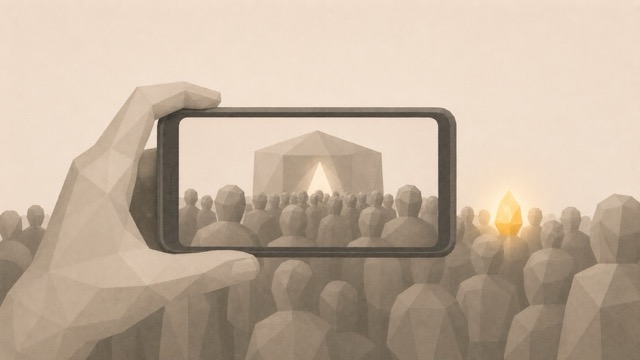
There is a question that the cultural industry has already answered without formulating it: the contemporary festival is designed not only to be experienced, but to circulate. Recent research states this bluntly. The experience consumer seeks, in addition to the moment, shareable narrative material—'storyfodder', as they call it—and digital sociability raises the demand for experiences that fuel platforms. The festival has become, to a large extent, a machine for producing experiences convertible into content.
This is not the suspicion of a killjoy. It is a documented consensus. What interests me is not to repeat the diagnosis, but to ask about what that diagnosis leaves out: if the festival has become content, what part of it resists becoming so? Because there, in the remainder that does not fit in the frame, something is at stake that should not be lost.
1. The conversion chain
First, the fact. Literature on festivals and digitisation converges on the idea that networks are no longer external promotion for the event: they are a constitutive part of the experience. The festival is consumed in three stages. Before, as a promise, expectation and conversation: the relationship with the event begins long before stepping onto the premises. During, as documentation and proof of presence: one does not only participate, one registers the participation to incorporate it into one's public identity. And after, as memory and narrative: the festival does not end when the programme concludes, it continues in clips, memorable titles and an archive of identity.
A chain is thus formed: experience → documentation → narrative → memory → recirculation. In it, the attendee ceases to be a receiver and becomes a micro-producer of brand, memory and meaning. Research on music festivals even shows that content generated by attendees carries more weight than that of influencers regarding attitude and engagement towards the event. The public does not consume the festival: they manufacture and disseminate it.
2. Not all festivals are equally capturable
A distinction is necessary, because the phenomenon is not uniform. Comparing three types of festival—musical, heritage and art—a revealing gradation appears in how each converts experience into content.
The music festival is the most intense case. It combines community, body, presence of recognisable artists, massive atmosphere and high photogenicity; the experience becomes content almost without friction, with little interpretive mediation. The heritage festival shifts the axis towards the place: the content functions as a spatial index—'I was here', 'I discovered this building'—and, if well-oriented, it can even redistribute attention towards undervalued heritage. The art festival is the most strained: a significant part of its experience depends on mediation, process and complexity, elements that compress poorly into brief formats.
That resistance of art is neither a moral virtue nor a guarantee: it is structural. The art festival still carries a certain obligation of interpretation and discourse that makes it less translatable into a clip. But precisely for that reason, it runs a specific risk: not immediate festive trivialisation, but excessive translatability—that the work or performance is redesigned to be visible, fragmentable and shareable, reducing complexity in exchange for social traceability. The danger is not that the festival 'has networks'. It is that it ends up being designed from the anticipation of the network.
3. The remainder that does not trade
And here is what matters to me, because it connects with something I have been maintaining. No matter how perfect the conversion chain may be, there is a remainder that does not enter into it. Content can capture the proof of presence—the 'I was here'—, the atmosphere, the artist, the outfit, the scene. It cannot capture the event: what happens when someone encounters a work, a sound, a place, and something in their field of the possible is reorganised. That is not a photographable thing. It is a relationship, and relationships do not fit in the frame.
The evidence lies within the research on festival memory itself: enduring recollections condense into phrases, brief titles, and narratives of profound emotional resonance, imbued with a sense of meaning. What remains is not the visual archive—which accumulates and is eventually forgotten—but rather that intimate reorganisation which the archive, at best, indicates without containing. The festival leaves behind content and, separately, something else: a modification of the individual who was present. The former circulates; the latter, not necessarily.
This does not imply that content is the enemy of experience. It signifies that they are of a different nature. The more perfect the capture, the more distinct that which escapes it becomes. The owner of the archive possesses the images; the event preserves its own flight.
4. What this is not
This is not a nostalgia for a “pure” festival, predating social media. Such purity never existed: every cultural experience has always been mediated by some medium, some narrative, or some method of recounting it afterwards. The opposition is not between authentic experience and mediated experience, but between two things that should not be confused: that which is capturable and that which is reorganised.
Neither is this a reproach to those who photograph. Documenting one’s lived experience is an ancient and legitimate gesture; the collection of photos from a concert is no less sincere than the travel journals of the past. The problem does not arise with the one who records, but when the record becomes the objective and the experience is subordinated to its own visibility: when one listens less effectively to record more effectively, when one chooses the angle before the moment. At that point, the conversion chain begins to consume that which it claimed to serve.
5. A question to take away
If the festival is today a machine for experiences convertible into content, the pertinent question is not how to resist it—one cannot, nor would it be necessary—but how to leave space for the remainder. How to design, programme, and experience a festival such that, in addition to producing images, it produces events: encounters that reorganise something and are not exhausted by their visual proof.
For those who programme culture, this has concrete consequences: to nurture moments that are not photogenic but are transformative, to protect the complexity that cannot be clipped, to resist the temptation to design everything based on the anticipation of the feed. And for those who attend, a single, simple one: that the photograph does not arrive before the experience. Look first; capture, if at all, afterwards. Because the best part of a festival—what we truly take with us—is usually precisely that which does not fit into the photograph. And discovering this is not a cause for sorrow: it is a relief. It signifies that there is still something that is ours, that occurs once, and that no archive will ever be able to repeat or deplete.
On open conversation
This text intersects with a question that permeates my work: what exceeds capture, what remainder refuses to be converted into an asset or content. If anyone wishes to intervene from the perspectives of festival management, the sociology of cultural consumption, platform studies, or professional experience in event production, the notebook remains open.
Sources
Bennett, Andy; Taylor, Jodie; Woodward, Ian (eds.) (2014). The Festivalization of Culture. Routledge. https://doi.org/10.4324/9781315558189
Yeoman, Ian S.; McMahon-Beattie, Una (2019). “The experience economy: micro trends.” Journal of Tourism Futures, 5(2), 114-119. https://doi.org/10.1108/JTF-05-2019-0042
Chen, Z.; Yu, T. (2025). “Festivals and digitalisation: a critique of the literature.” Tourism Critiques, 6(1), 2-17. https://doi.org/10.1108/TRC-05-2024-0022
Kádár, B.; Klaniczay, J. (2022). “Branding Built Heritage through Cultural Urban Festivals: An Instagram Analysis Related to Sustainable Co-Creation, in Budapest.” Sustainability, 14(9), 5020. https://doi.org/10.3390/su14095020
Marić Stanković, A.; et al. (2026). “Dancing with the Algorithm: Gen Z’s Social Media Practices on TikTok and Instagram and Their Influence on Music Festival Experiences.” Tourism and Hospitality, 7(1), 27. https://doi.org/10.3390/tourhosp7010027
Gilstrap, C.; et al. (2021). “Social music festival brandscapes: A lexical analysis of music festival social conversations.” Journal of Destination Marketing & Management, 20, 100567. https://doi.org/10.1016/j.jdmm.2021.100567
Zhang, C.; Fong, L. H. N.; Li, S. (2019). “Co-creation experience and place attachment: festival evaluation.” International Journal of Hospitality Management, 81, 193-204. https://doi.org/10.1016/j.ijhm.2019.04.013
Wood, E. H.; Kinnunen, M.; Coll, P. F. (2024). “The Structure and Purpose of Shared Festival Memories: A Storytelling Approach.” Event Management, 28(4), 511-529. https://doi.org/10.3727/152599523X16907613842273