
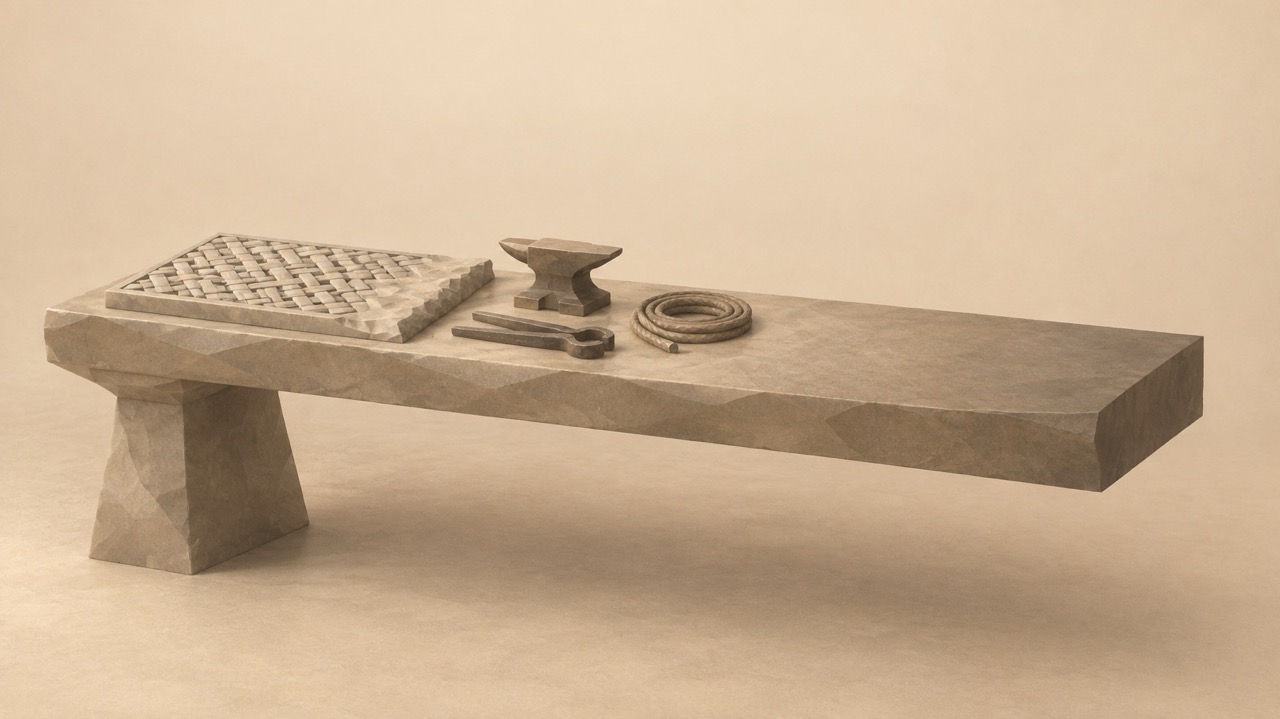
The University of Edinburgh will cease to admit students from 2027 to three Edinburgh College of Art degree programmes: Performance Costume, Textiles, and Jewellery and Silversmithing. The university intends to maintain part of this teaching as elective modules within other design degrees. The substitution appears reasonable if one views a curriculum as a sum of subjects. It ceases to be so when one observes what a specialised workshop transmits and how much time is required to do so.
The decision was announced on 15 September 2026, according to information subsequently published by the sector and the press. Craft Scotland requested its reversal via an open letter backed by organisations, professionals, and collections managers. The university's students' association indicated on 27 October that currently enrolled students would be able to complete their studies.
The protest reached the Scottish Parliament. On 29 September 2026, MSP Q Manivannan of the Scottish Green Party tabled motion S7M-01386, which condemns the closure, calls upon the university to halt the process, and requests the publication of the case justifying it before irreversible steps are taken. As of the 30 October consultation, twenty-one MSPs had signed the motion. The motion states that an online petition exceeded ten thousand signatures; the Change.org petition created on 24 September showed 5,740 on that same day. I have been unable to verify whether the motion refers to that petition or another, and therefore I do not consider either figure definitive.
The motion also contains two assertions presented as its own understanding, which I have not verified: that these are the last craft-based degrees offered by the school and that their skills are among the most resistant to replacement by artificial intelligence. The local press placed the three degrees within a group of over ninety courses marked for closure at the university, including History of Art and Scottish Literature. I have not located this list in a university source either.
The three closures are part of a wider restructuring. The University of Edinburgh has linked its situation to a £140 million cost-reduction programme. The UCU had previously warned of up to 1,800 jobs at risk. The 2024/25 accounts record £1,477 million in revenue and an EBITDA of £96 million, equivalent to 6.5% of revenue and below the budgeted figure. A positive EBITDA does not eliminate cash flow pressures, financial costs, investment requirements, or a potential adverse accounting result. Nor is it, in itself, sufficient to justify the specific closure of three degree programmes.
The ECA itself has indicated that it does not foresee staff reductions directly associated with these degrees and that the teaching staff will be integrated into the five programmes remaining in the School of Design: Animation, Fashion, Graphic Design, Illustration, and Product Design. It also states that there will be electives accessible to students of the university. The conflict, therefore, does not consist of the immediate disappearance of every technique, but in the transition from a specialised and continuous education to a partial offering within different structures.
What a studio-based degree contains
An introduction may teach a technique, its tools, and its safety regulations. Specialised training allows one to recognise when something fails, how the material responds, which decisions leave a mark, and which solutions do not appear in a manual. This knowledge is formed through repetition, correction, time, and engagement with the practices of others.
In jewellery and silversmithing, it is not enough to know isolated operations of soldering, casting, forming, or finishing. One must learn how they interact, what tolerances a material admits, and how an early decision conditions the entire process. In textiles, structure, fibre, colour, surface, and use are not interchangeable modules. In performance costume, the object must respond to the body, movement, light, the duration of the production, maintenance, and the conditions of the stage.
An elective may offer a valuable experience. It does not necessarily replace:
- Multi-year progression.
- Continued access to facilities.
- A stable relationship with technical staff.
- Peer critique among those who share a discipline.
- The accumulation of errors and solutions.
- The integration of research, design, and execution.
- A professional identity recognisable to employers and sectors.
The difference is not between theory and practice, as if the former were abstract and the latter manual. The studio produces embodied theory: a criterion regarding materials, time, risks, repairs, and limits.
Dispersed infrastructure, concentrated cost
Studio-based disciplines are fragile within university accounting because they concentrate visible costs. They require space, ventilation, extraction, machinery, tools, consumables, insurance, maintenance, and technical staff. Groups cannot grow indefinitely without compromising safety and learning.
Its benefits appear dispersed. Graduates work in stage and audiovisual productions, design studios, workshops, teaching, conservation, museums, and small businesses. Craft Scotland maintains that ECA graduates have contributed to museum collections, creative industries, and international reputation. An example documented by the school itself: Anna Robbins, costume designer for Downton Abbey, graduated in Performance Costume in 2005 and has attributed her dedication to historical costume to her studies in Edinburgh. The association further highlights that Textiles remained among the top six programmes in the United Kingdom for nine years in The Guardian rankings, holding second place in Britain and first in Scotland in 2026. A ranking does not prove quality on its own nor does it guarantee financial sustainability, but it contradicts the notion that this is a residual offering without recognition.
The institution pays for the studio, and other sectors receive part of the yield. A departmental account may interpret this dispersion as a deficit. A cultural and industrial policy understands it as training infrastructure. The problem is not that the university calculates costs. It is that the calculation omits external dependencies and the future price of rebuilding a capacity that currently exists.
The loss does not occur on the day of the closure
When students stop enrolling, knowledge does not disappear. It remains with teachers, technicians, graduates, companies, and independent studios. This continuity cushions the effect and makes the closure appear reversible.
The loss arrives through accumulation. There are fewer people trained to teach, less demand to justify maintaining equipment, less specialised research, and more dependence on private training. Access narrows towards those who can afford materials, space, and tuition outside of a public or university institution.
Geographical diversity is also reduced. A course may exist elsewhere in the United Kingdom, but relocating implies housing, networks, costs, and immigration conditions. The national existence of a subject does not guarantee local access nor does it replace its relationship with a specific productive tradition.
The ECA originated in 1760 as the Trustees’ Drawing Academy, linked to the training of designers for manufacturing, especially textiles. That history does not oblige the conservation of every programme without change. It does, however, prevent treating the affected disciplines as accidental additions detached from the institution.
What should precede a closure
Before ceasing to admit students, a university should publish an evaluation that allows for the discussion of the decision. At a minimum:
- Number of students, applications, and completion rates.
- Full cost and calculation methodology.
- Affected teaching and technical staff.
- Facilities and equipment that will cease to be used or will be repurposed.
- Techniques that will continue and the actual depth of the elective modules.
- Dependencies with other degree programmes and research.
- Linked sectors and employers.
- Impact on equality of access and territorial distribution.
- Alternatives studied: shared degrees, consortia, biennial admission, common modules, or sectoral alliances.
- Estimated cost of recovering capacity should the decision be reversed in the future.
The publicly available information does not allow for the reconstruction of this analysis for the three programmes. The decision, the financial context, and the sectoral response are known, but the file that weighed the alternatives is not. This absence limits any definitive judgement on the accounts and, at the same time, weakens the public legitimacy of the closure.
More than preserving a tradition
The defence of these degrees should not rely solely on heritage continuity. Tradition can become a static image and exclude technical, cultural, and labour-related changes. What is being defended is a contemporary capacity to investigate materials, produce objects, work with the body, and sustain industries that depend on specialised knowledge.
Nor does every form of workshop deserve to be preserved without review. Working conditions, material sustainability, accessibility, safety, and the relationship with precarious sectors must be examined. Maintaining the infrastructure allows for precisely this transformation from within. Replacing it with an elective module reduces the time and community available to discuss it.
The artificial intelligence argument
The parliamentary motion introduces an argument that also circulates within the sector: that closing craft-based studies would be a mistake because their skills resist automation. It is effective in a political debate. In my view, it is also a fragile argument.
It is so for two reasons. The first is empirical: no one knows with precision which tasks will resist automation in ten years' time, and a defence based on a prediction becomes obsolete when the prediction changes. The second is fundamental: justifying the workshop by its future employability reproduces the logic that Useful culture, surplus art discusses for cultural policy, that of legitimising a practice through an external return. The value of these degrees does not depend on a machine being unable to do the same. It depends on the fact that the knowledge incorporated into working with materials forms judgement, and that judgement also serves those who design, evaluate, or reject objects produced by other means.
There is a more robust version of the same argument. At a time when a good portion of visual production is being automated, institutions that preserve a direct relationship with the material become scarcer and, therefore, more necessary for investigating what is lost in the substitution. That version does not promise employment. It defends a place of knowledge.
What a university maintains
A university does not transmit content alone. It maintains places where a practice can accumulate memory, critique, and renewal. When that continuity is broken, the knowledge does not evaporate. It is privatised, dispersed, or becomes more difficult to reach.
On the open conversation
This analysis relies on the publicly available information and does not replace the university's internal file, which has not been located. If you studied or worked in these programmes and can provide documentation regarding the process, the alternatives, or the scope of the elective modules, you may write to me.
Sources
- Craft Scotland, open letter regarding the closures.
- Edinburgh University Students’ Association, financial situation.
- University of Edinburgh, annual accounts 2024/25.
- UCU, analysis of job cuts.
- The Art Newspaper, 29 October 2026.
- Edinburgh College of Art, BA (Hons) Performance Costume programme 2026/27.
- Scottish Parliament, motion S7M-01386, 29 September 2026.
- Change.org, “Save the Craft and Design Courses at Edinburgh College of Art”.
- Edinburgh Evening News, international reaction to the closures.
- Irene Kernan, column in The Scotsman.
- Edinburgh College of Art, alumni profiles.