
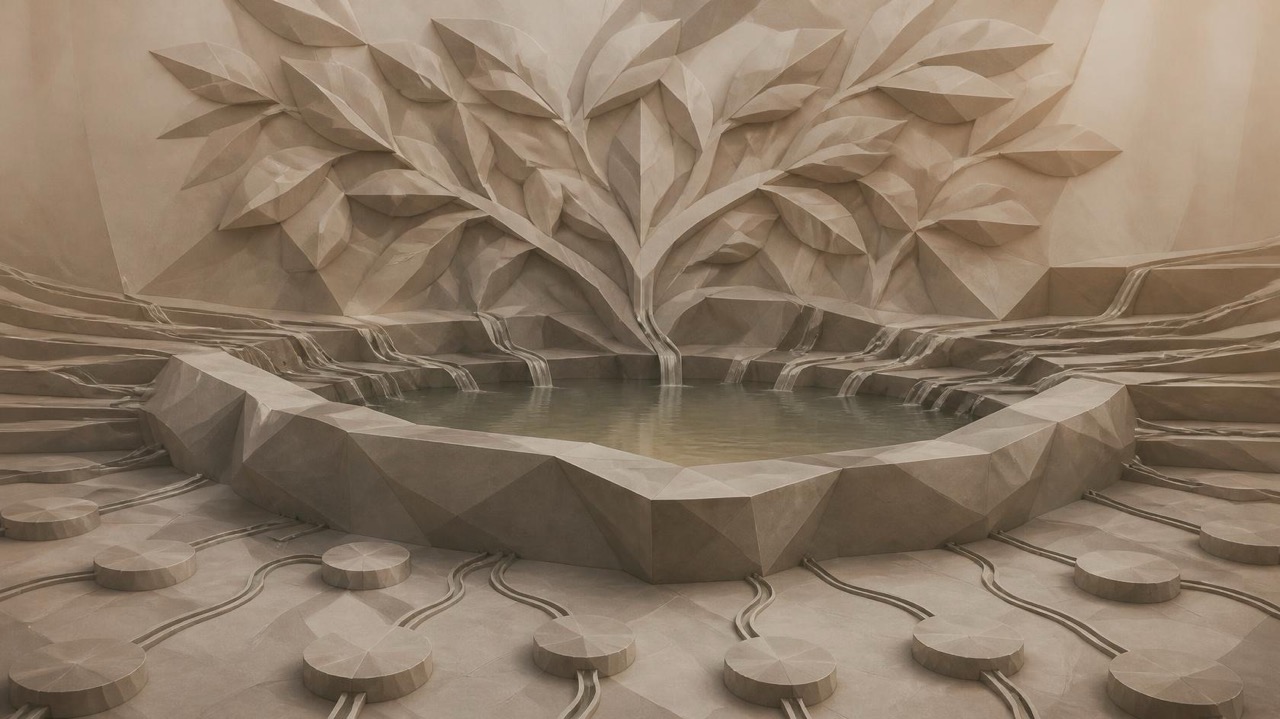
On 20 June 2026, Dataland opened in Los Angeles, founded by Refik Anadol and Efsun Erkılıç in The Grand LA complex. It presents itself as the world's first museum of AI arts. The claim is promotional and I do not need to resolve it to examine what matters: the museum has placed the provenance of the data and the participation of the public at the centre of its legitimacy.
Its inaugural exhibition, Machine Dreams: Rainforest, occupies five rooms and will remain open until 31 January 2027. Image, sound, scent and architecture respond in real time to two streams of information: ecological data from rainforests in different parts of the world and signals collected from those traversing the exhibition.
The system that articulates the works is the Large Nature Model, developed by Refik Anadol Studio. Dataland describes it, according to its website, as an open-source or open-access model trained exclusively on nature data, and claims it utilises one of the most extensive "permission-based" natural datasets. The exhibition also refers to an "ethically curated" ecological archive and over 1.2 billion ecological data points.
These are strong expressions. "Permission-based" addresses who authorised the usage. "Ethically curated" adds a valuation regarding how the materials were selected and treated. Neither can be reduced to a verbal guarantee when the archive constitutes the material of the work.
What Dataland does identify
Public documentation now allows for greater precision than a first reading suggested. The opening note from Dataland, published by Related Companies, names data agreements with the Smithsonian, the Cornell Lab of Ornithology, Getty, iNaturalist and the Natural History Museum in London. It adds that the model incorporates data obtained directly from sixteen tropical rainforest environments.
The collaboration with the Yawanawá people is described in greater detail. The Dream of Ruwe Pinu was developed alongside that community in Acre, Brazil. Dataland declares that the story is shared with their permission and that it remains Yawanawá cultural heritage. The exhibition further attributes to the spiritual leader Nixiwaka Yawanawá the recognition and naming of the figure that articulates the work.
This matters. It would not be accurate to state that Dataland identifies no sources or that the entire archive remains hidden. There are named institutions, declared fieldwork and expressly recognised cultural authorisation.
However, identifying collaborators is not equivalent to publishing the complete provenance of the training set. The pages consulted do not feature a downloadable inventory linking each collection or dataset to its institution of origin, its licence, the specific conditions of the permission, the transformations performed and its weight within the model. Nor have I located any document releasing the code or the weights that would allow the technical scope of the terms open source and open access, which are used differently within the project's own communication.
The lack of information does not prove that permissions do not exist, but it does mean that an external party cannot yet verify the claim in its entirety.
Provenance does not end with the provider's name
A museum would not consider it sufficient to register a work with a label stating only "from various institutions". It would document authorship, title, date, materials, owner, history, rights and conditions of use. If the museum asserts that data is pigment, it must apply a comparable standard to it.
As I argued in An image without provenance, the authority of a cultural institution depends on being able to account for the origin of what it displays. And in Who holds the key, I noted that opening a digital collection does not eliminate the authority of those who select, classify and describe its contents. Dataland presents both problems: it needs to accredit where its data comes from and explain what decisions turned them into the archive with which the model learns.
A sufficient register should allow one to know, at least:
- What datasets the archive contains.
- Who produced them and who authorised their incorporation.
- Under what licence or agreement they are used.
- Whether the permission includes training, exhibition, generation of new works and commercial exploitation.
- What materials were excluded and by what criteria.
- How indigenous knowledge and culturally sensitive content were treated.
- What versions of the archive and the model underpin each work.
- What parts of the system are actually available for examination, reuse or audit.
Publishing this information does not require revealing sensitive data or technical secrets. It can be done through a layered register: a public provenance record, expanded documentation for research and justified restrictions where rights, security or community knowledge require protection.
The Yawanawá collaboration shows precisely that openness is not the only value. There are materials that should not remain available for any reuse. Transparency also consists of documenting who retains the authority to decide upon them.
When the visitor becomes a data source
The exhibition's second material comes from the public. Dataland provides each visitor with a device and employs biosensors and spatial tracking to record signals such as pulse, movement, proximity, and position within the galleries. These signals modify images, sounds, and atmospheres in real time. In The Sanctuary, the accumulated flow is translated into a nine-metre data painting which the museum terms "collective emotional temperature".
The system measures physiological and behavioural signals; that a valid collective emotion can be inferred from them is an interpretation by the studio, not a fact demonstrated in the documentation consulted. The pulse may vary for multiple reasons and does not, in itself, contain an unequivocal emotional state. The work may employ this metaphor, but the museum's mediation should distinguish it from a scientific measurement of emotions.
Dataland declares that data associated with each visit is anonymous by default and is automatically deleted upon completion, unless the individual decides to retain their experience via Data.Token and the museum's application. It also asserts that the visitor maintains control over this data.
If a record allows for an individual experience to be retained and subsequently retrieved, it must be explained with precision when and how it transitions from being anonymous and transient to becoming linked to an account, a device, or an identifier. "Anonymous" is not synonymous with the museum omitting the name. Data is only anonymous when the person cannot be reasonably identified, including through combination with additional information.
Dataland's public privacy policy, dated 11 December 2024, describes personal data, technical information, purposes, retention and rights in general terms. In the accessible text, I have not located a specific and separate explanation of the processing of pulse, movements, position in the room, Data.Token and voluntary retention of the experience. Information may be provided in person when purchasing a ticket or receiving the device, but I have been unable to verify this from the public documentation consulted.
Consent at the door is not enough
The fact that the device forms part of the visit does not automatically render consent to process bodily signals informed. The individual should know before commencing:
- Which sensors are employed and which signals they record.
- Whether participation is mandatory or if the exhibition may be visited without measurement.
- Which identifier the device receives.
- Which data is processed individually and which in an aggregated form.
- When they are anonymised and when they are deleted.
- What occurs upon retaining the experience.
- Which providers are involved.
- Whether the data is used solely to execute the work or also for research, system improvement, security, or commercial analysis.
- How to withdraw consent and exercise applicable rights.
California recognises consumers' rights to information, access, deletion, correction, and limitation of specific uses of sensitive information for companies subject to its legislation. I do not assert here which concrete obligations correspond to Dataland, as this depends, among other matters, on the applicability of the regulation, the actual architecture of the processing, and whether the data is personal or has been effectively anonymised.
In Europe, the General Data Protection Regulation considers data relating to health to be that which reveals information about physical or mental state, and applies enhanced protection to it when it is personal data. Biometric data constitutes a special category when obtained through specific technical processing and allows for or confirms unique identification. Therefore, a visitor's pulse is not automatically biometric data subject to Article 9 by the mere fact of originating from the body. It may be personal data, health data or anonymous data depending on what it reveals, how it is processed and whether the person is identifiable.
This legal distinction does not reduce the institutional requirement. A museum that converts a bodily signal into artistic material must explain its processing even when it succeeds in anonymising it such that personal data legislation ceases to apply. Museum ethics do not begin where the law ends.
The work is also its infrastructure
In Curating that which is never the same twice I argued that a generative work is not merely each image it produces, but the regime of emergence that permits its production. Dataland renders this thesis visible at an institutional scale. The work includes the archive, the model, live environmental data, sensors, translation rules, and decisions regarding conservation and deletion.
This alters what a gallery label should recount. It is insufficient to name the artist, the model, and the number of data points. The version of the system, the provenance of its materials, the companies involved, the rules of interaction, the duration of storage, and the margin each collaborator retains over their contributions are also significant.
The issue equally affects conservation. If a work depends on live data, external providers, portable devices, and an evolving model, the museum does not merely conserve files and equipment. It must conserve the conditions that render the work recognisable: which data may change, which relationships must not be altered, which authorisations remain in force, and what occurs if a community or institution withdraws access to its materials.
Provenance then ceases to be a preliminary note and becomes part of the artistic system itself.
A standard that Dataland can set
Dataland aspires to set a standard for AI arts. It has the opportunity to do so in the least spectacular and most decisive terrain: documentation.
It has already taken steps that must be recognised. It names several provider institutions, documents a collaboration with the Yawanawá community, declares which signals it collects from the public, affirms that it deletes them by default, and converts part of its infrastructure into exhibition content. This is more information than many AI art projects offer.
Precisely for this reason, more may be demanded of it. When an institution adopts expressions such as "ethically curated", "permission-based", "visitor-controlled", "anonymous", and "open source", it is not using ornamental adjectives. It is formulating verifiable claims regarding provenance, consent, control, and access.
A minimum public standard could assemble three living documents:
- Model provenance register: datasets, providers, licences or bases of authorisation, restrictions, versions, and exclusion criteria.
- Visitor data processing record: sensors, purposes, flows, identifiers, retention, providers, options and rights.
- Cultural governance protocol: how communities whose knowledge, narratives or records form part of the works authorise, review or withdraw their contributions.
The intention is not to demand that everything be open, but rather that every opening and every restriction be justifiable. Transparency consists of making visible who decided, with what authority and under what conditions.
By whose permission
The question in the title has two recipients.
The first is the ecological archive. Dataland has identified several collaborators and a community whose authorisation it expressly declares. Public documentation that would allow one to trace the chain from each set to the model and from the model to the work remains missing.
The second is the visitor. Dataland provides information on the signals it collects and the default deletion, but the accessible public documentation does not allow for a complete reconstruction of what is consented to upon receiving the device, what alternatives exist and what changes when one decides to retain the experience.
I do not assert that Dataland trains without permission or that it processes the data of its public illicitly. The sources consulted do not support such a claim. They do, however, allow one to state that several of its central guarantees still rest upon declarations by the institution itself that cannot be audited entirely from the outside.
A museum exhibits its works with provenance, credits and conditions of custody. If data is the material and the public enters the circuit that produces it, both must appear in that documentary chain. Not as a legal annex, but as part of the work the museum claims to display.
About the open conversation
This text distinguishes between what Dataland declares, what its public documentation allows one to verify and what remains insufficiently documented. It does not maintain that all data must be opened or that all bodily measurement is illicit. It maintains that an institution which founds its legitimacy on permissions, provenance and participation must allow one to know what those words signify exactly at each layer of the system.
If you work in museums, data governance, digital art conservation, indigenous communities or privacy and wish to refine this reading, this notebook remains open: write to me.
Sources
- Dataland, Machine Dreams: Rainforest, exhibition website, consulted on 14 October 2026. Description of the five rooms, Large Nature Model, 1.2 billion ecological data points, biosensors, Data.Link, Data.Token, default deletion and Yawanawá collaboration.
- Dataland, museum homepage, consulted on 14 October 2026. Institutional self-description and reference to a "permission-based" natural dataset.
- Dataland, Large Nature Model, consulted on 14 October 2026. Description of the model as open and trained on data about nature.
- Related Companies, "DATALAND, the museum of AI arts, opens to the public Saturday, June 20, 2026", 23 April 2026. Opening date, founders, duration of the exhibition, collaborating institutions and fieldwork.
- Dataland, Privacy Policy, last declared update: 11 December 2024. General policy on collection, use, retention and exercise of rights.
- California Department of Justice, California Consumer Privacy Act (CCPA), update of 28 August 2026. Consumer rights and categories of personal and sensitive information.
- European Parliament and Council, Regulation (EU) 2016/679, General Data Protection Regulation, in particular articles 4.5, 4.13, 4.14, 4.15 and 9, and recital 26.