
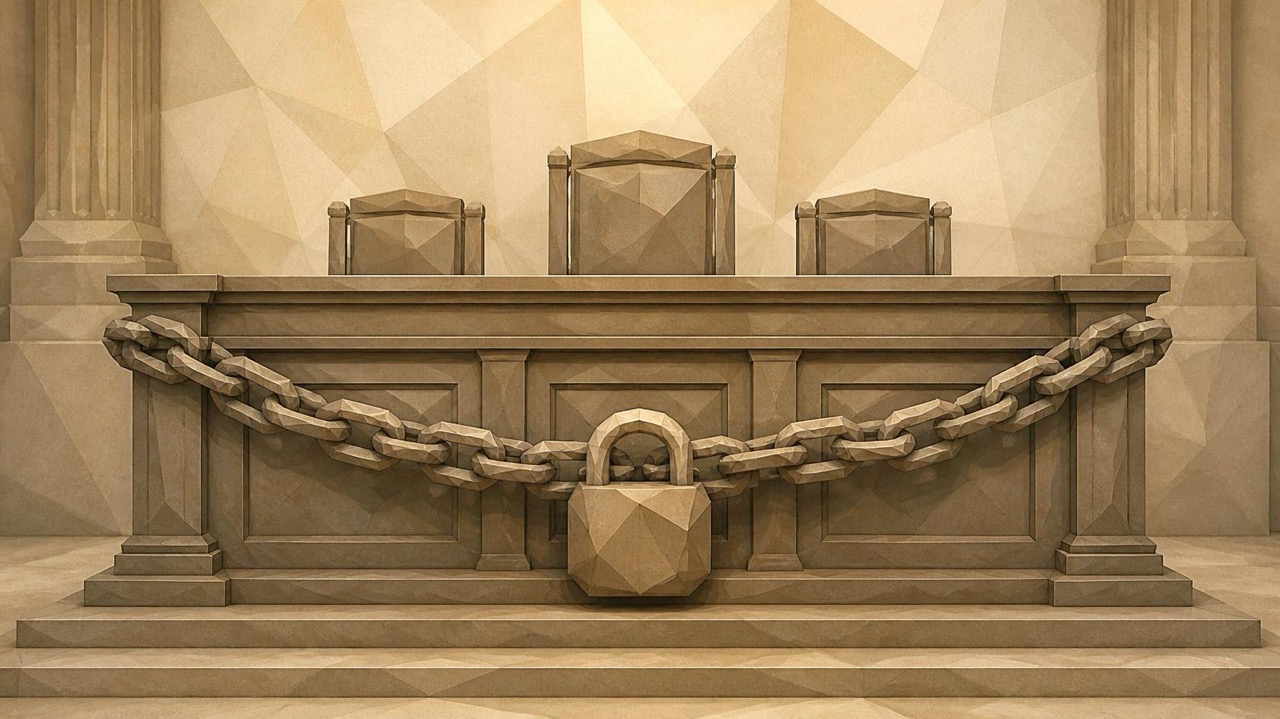
The International Criminal Court, based in The Hague, investigates and prosecutes individuals accused of genocide, war crimes, crimes against humanity and aggression, within the jurisdiction conferred upon it by the Rome Statute, to which 125 States are party. Since February 2025, the United States, which is not a party to the Statute, has sanctioned judges, prosecutors, staff and organisations linked to the Court. On 9 October 2026, it took an unprecedented step: sanctioning the Court itself as an institution.
Chronology
- 6 February 2025. President Donald Trump signs Executive Order 14203, which authorises sanctions against those who participate in the Court's proceedings concerning United States persons or persons from allied countries that have not accepted its jurisdiction. The annex to the order designates the prosecutor, Karim Khan: blocking of his assets in the United States and restriction of entry into the country.
- 5 June 2025. Sanctions against four judges: Solomy Balungi Bossa, from Uganda; Luz del Carmen Ibáñez Carranza, from Peru; Reine Alapini-Gansou, from Benin, and Beti Hohler, from Slovenia.
- 9 July 2025. Sanction against Francesca Albanese, UN Special Rapporteur on the occupied Palestinian territories. She does not work for the Court: Washington sanctioned her for collaborating, in its view, with its proceedings.
- 20 August 2025. Sanctions against judges Kimberly Prost, from Canada, and Nicolas Guillou, from France, and the two deputy prosecutors, Nazhat Shameem Khan, from Fiji, and Mame Mandiaye Niang, from Senegal.
- 4 September 2025. Sanctions against three Palestinian human rights organisations: Al-Haq, the Al Mezan Center and the Palestinian Center for Human Rights.
- 18 December 2025. Sanctions against judges Gocha Lordkipanidze of Georgia and Erdenebalsuren Damdin of Mongolia.
- 18 August 2026. Sanctions against the President of the Court, Japanese judge Tomoko Akane, and a member of her staff, Abdoulaye Seye.
- 9 October 2026. Sanction against the Court as an institution. The Treasury's Office of Foreign Assets Control (OFAC) includes it in its list of blocked persons and entities, which comprises those sanctioned under various United States sanctions programmes. It simultaneously publishes four general licences (13 to 16) that authorise specific transactions without lifting the designation: licence 13, certain transactions necessary to maintain or wind down the Court's operations, contracts and agreements, such as continued operations, States Parties' payments, salaries, health insurance and medical services for staff, and rent, until 12:01 a.m. eastern daylight time on 7 April 2027, unless amended or extended; licence 14, certain telecommunications, internet services and enterprise software; licence 15, certain transactions relating to pensions, subject to the conditions set for payments to blocked persons; and licence 16, certain transactions relating to the health, safety, welfare and detention facilities of the detainees listed in its annex. These licences set out authorised transactions but do not annul the institutional designation.
On announcing the measure, Secretary of State Marco Rubio warned that, if allies do not rein in the Court, the United States will continue its campaign to dismantle it "brick by brick" until Americans are no longer threatened.
What Washington alleges
The 2025 executive order maintains that the Court has engaged in illegitimate and baseless actions targeting the United States and its close ally Israel, and that it has no jurisdiction over either because neither is a party to the Rome Statute. The order cites the 2024 arrest warrants for Israeli Prime Minister Benjamin Netanyahu and his former Minister of Defence, Yoav Gallant, and the preliminary investigations concerning United States and allied personnel. The reference to the investigation into the conduct of United States personnel in Afghanistan comes from the State Department's August 2025 note on judge Kimberly Prost, whom it designates for her decision to authorise it.
How the Court and the UN responded
Following the 9 October sanction, the Court described it as "an attack on the rule of law and the very foundations of the international legal order", stated that it seeks to disrupt its functioning and intimidate those who work for it or collaborate with it, and asserted that it will continue to exercise its mandate.
According to his spokesperson, UN Secretary-General António Guterres deemed the sanctions "a serious blow to our collective pursuit of international criminal justice". That same day, independent experts appointed by the Human Rights Council characterised them as "an assault on the foundations of international accountability and the rule of law".
These experts have repeatedly criticised the expansion of the sanctions. In August 2026, they further lamented that six States parties had announced their intention to withdraw from the Court.
What Europe can do
The European Union has Regulation (EC) 2271/96, known as the blocking statute. It protects European companies and operators against the extraterritorial effects of certain foreign laws, those listed in its annex: it prohibits compliance with them in certain cases, limits the recognition of the rulings that apply them, and allows damages to be claimed for the harm they cause.
United States sanctions against the Court do not currently appear in the annex to Regulation (EC) 2271/96, so the regulation does not cover them automatically. This check refers to the current consolidated version consulted on EUR-Lex on 19 October 2026 and does not rule out a proposal, deliberation or amendment not yet incorporated into the consolidated text. To protect the Court, the Union would need to incorporate them into the scope of the regulation or adopt another legal measure. Independent UN experts have been requesting this since August 2025, and on 9 October they demanded that it be done immediately. I have not identified a decision by the European Commission to that effect, nor a position from the Government of Spain regarding the use of this regulation in response to these sanctions.
Justice without exceptions
In my view, the debate is not whether the International Criminal Court is perfect. It is not, and its history contains imbalances that warrant criticism. The debate is whether a State may financially penalise judges and prosecutors for decisions adopted in the exercise of their functions. Criticising a judicial decision, appealing it, or refusing to recognise a jurisdiction are legitimate positions. Blocking the accounts of those who judge belongs to a different order.
If international law only reaches those who cannot sanction the judge, it ceases to be universal.
About the open conversation
This text separates the data from my position and is not an exhaustive legal analysis. If you work in international law or human rights and wish to clarify a detail or discuss this reading, this notebook remains open: write to me.
The author's relationship with the cases
There is no economic, professional, or collection-based relationship with the individuals, companies, and institutions cited.
Sources
- White House, Executive Order 14203, "Imposing Sanctions on the International Criminal Court", 6 February 2025.
- Department of State, sanctions against four judges, 5 June 2025.
- Department of State, sanction against Francesca Albanese, 9 July 2025.
- Department of State, sanctions of 20 August 2025.
- Department of State, sanctions against three Palestinian NGOs, 4 September 2025.
- Department of State, sanctions against two judges, 18 December 2025.
- OFAC, action of 18 December 2025.
- OFAC, action of 18 August 2026.
- Department of State, statement by Secretary of State Marco Rubio, 9 October 2026.
- OFAC, designation of the Court and general licences, 9 October 2026.
- International Criminal Court, "The ICC strongly rejects US sanctions against the institution", 9 October 2026.
- Office of the UN High Commissioner for Human Rights (OHCHR), statement by experts of 9 October 2026.
- UN News, “‘Serious blow’: Guterres condemns new US sanctions on International Criminal Court”, 9 October 2026.
- Office of the UN High Commissioner for Human Rights (OHCHR), statement by experts of 28 August 2026.
- Office of the UN High Commissioner for Human Rights (OHCHR), statement by experts of 22 August 2025.
- Regulation (EC) 2271/96, blocking statute (EUR-Lex).
- Coalition for the International Criminal Court, 9 October 2026.