
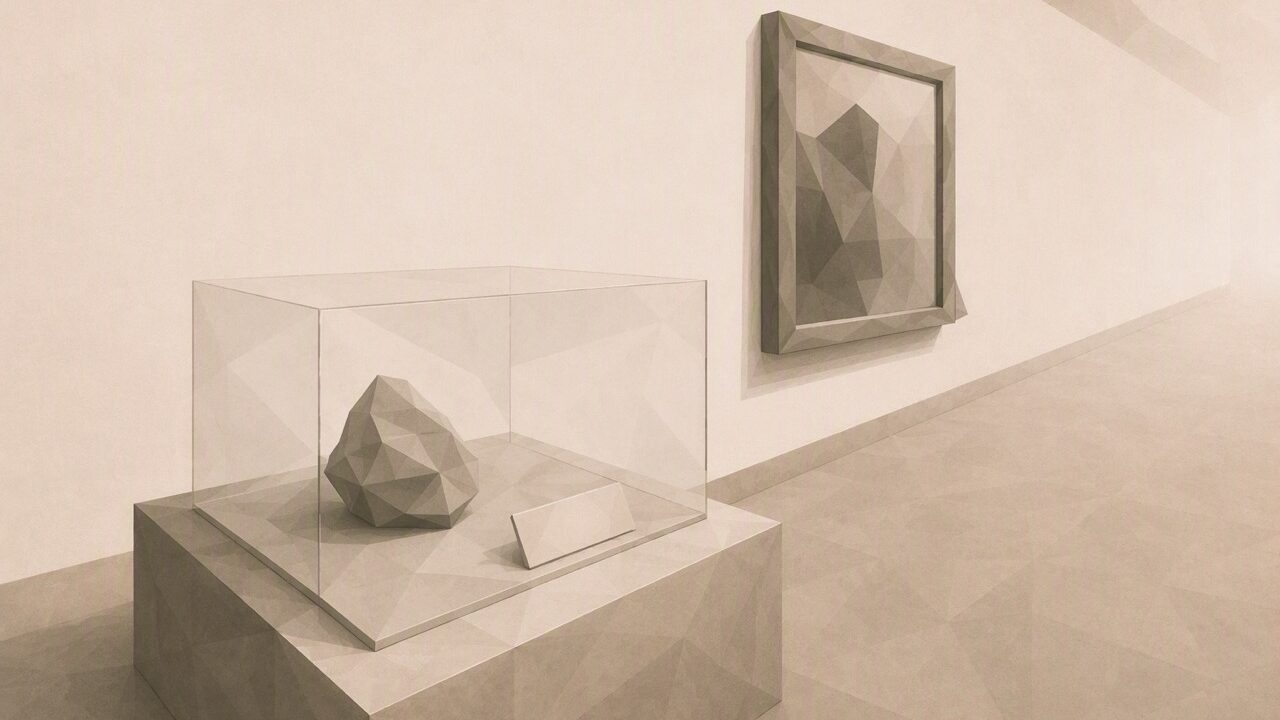
On 27 January of this year, the British Museum published a series of images on Instagram and Facebook depicting a young woman contemplating pieces within its galleries. The accompanying text invited viewers to pause, suggesting that looking with composure is always worthwhile. The images were generated using artificial intelligence, a fact not disclosed in the caption. They were, however, tagged—for those who chose to examine the tags—with the account of a generated model and that of the agency responsible for their production. Six hours later, following criticism from archaeologists and heritage professionals, the museum removed them. A spokesperson stated to the specialist press that they do not publish images created with AI and that, acknowledging their potential sensitivity, they had deleted them. They added that they were developing internal guidelines regarding the use of these tools.
I shall begin by declaring my own position, for without that I would have no standing to write this text. The images that head my articles are generated using artificial intelligence. I do so with a proprietary prompt that I have been refining for years, and I have explained this on a page of my website where I detail what I use it for and what I do not. I do not believe that using these tools is illegitimate, nor shall I feign a modesty here that I do not possess. What interests me about this case is something else, and it is not what dominated the discussion.
What dominated the discussion was whether a museum should use generated images. One of the most prominent voices, archaeologist Steph Black, argued that the institution was testing the extent to which the public accepts these images in order to subsequently avoid hiring creative professionals, and she attributed this to cost-cutting. That is her interpretation, and as a suspicion it is reasonable in a precarious sector, but it is unproven and I do not subscribe to it. Her other request seems to me much more robust and less cited: that the museum explain what had happened and who approved it.
Because the problem is not the image. The problem is that it did not state its origin.
And here it is worth pausing to consider where this occurred, for it is no ordinary accident. The authority of a museum such as the British Museum rests entirely upon one operation: attesting to the origin of things. Everything within that building is accompanied by a documentary chain that explains where it came from, who made it, and where it has been. Without that chain, an object is not a museum piece: it is merely an object. Provenance is not an administrative requirement of the institution; it is literally what the institution sells, and in its case, it is also the area where it is most scrutinised, as a significant portion of its collection is in dispute precisely because of how it arrived there.
Thus, we have an institution whose function is to accredit the origin of what it displays, publishing an image without accrediting its origin. It is not hypocrisy, and I would not call it that: it is an asymmetry, and I believe a very revealing one. What is displayed inside is subjected to an extremely high standard of provenance. What is published outside, through the channel by which the institution speaks to the world, is governed by marketing standards. As if communication were an exempt zone.
This is not an isolated case, and there is a figure that measures it. In a survey of more than three hundred gallery professionals conducted in February of this year, sixty-one per cent responded that none of their artists use artificial intelligence in their practice. Fifty-seven per cent responded that they use it to draft their emails and communications. Read the two figures together. Almost the same institutions that declare there is no AI in their art employ it to speak about that art. There is no deception in that, and likely none have considered it a contradiction. Yet it describes with precision where this technology has entered the art world: not through the work, but through the voice.
The precedent frequently cited is that of Christie’s, which in February 2025 announced the first auction composed entirely of works created with AI. More than three thousand individuals signed an open letter calling for its cancellation, arguing that the models employed exploited human artists by using their work without permission or compensation. The auction was not cancelled and closed at just over seven hundred and twenty-eight thousand dollars, a modest figure for what was billed as a historic event. However, it is prudent to observe the difference between the two cases, as it is not insignificant. Christie’s performed an action that was open to debate and did so transparently, by announcing it. The British Museum performed an action that was less open to debate and did not disclose it. It is the latter that erodes trust, not the former, because what is discovered subsequently carries more weight than what is declared beforehand.
This text arrives, furthermore, on a date that is no longer coincidental. As of today, 2 August 2026, the transparency obligations of the European Artificial Intelligence Act are in force: certain generated or manipulated content must be labelled clearly and visibly, and must carry machine-readable marks. The question of whether it is advisable to declare such content ceases to be a matter of institutional style and now has a legal answer. Underlying the regulation is an existing infrastructure for compliance: since 2021, a technical standard for digital content provenance has existed, promoted by a coalition including Adobe, the BBC, Microsoft, and Intel, whose credentials function, according to their own description, like the nutritional label on a food product. They record what was used to create an image and what was done to it subsequently. It is precisely what a museum has been doing with objects for centuries, applied to files.
The fact that the sector has not adopted it is telling. There are recommendations—the European museum network was already calling in 2024 for the maintenance of integrity in the use of AI and highlighting the importance of trust and transparency, and this year UNESCO and ICOM have launched a global consultation to prepare a joint report—but there are no labelling guides as yet, and there is no evidence that any major museum has publicly adopted the technical standard that already exists. The principle is being debated while the tool is available.
I conclude with what I truly believe is at stake, which is not the image of a fictional girl looking at display cases. A museum can afford many things, but there is one it cannot: for its public to discover that something of its own was not what it seemed. Not because it has lied, but because its entire profession consists of one being able to trust what one is told about the origin of things. Every time such an institution publishes something without declaring where it comes from, it spends a little of the only thing it cannot replenish. Declaring it costs nothing. It is a line of text at the foot. And in an institution that lives by provenance, that line is not a formality: it is consistency with what is done in the galleries.
On open conversation
This text continues my interest in authenticity, understood as a documented chain rather than an inherent property of an object, and extends it to the sphere where cultural institutions discuss themselves. I do not maintain that the use of generated imagery is illegitimate; I use my own and declare it on my website. I maintain that an institution whose authority rests upon the accreditation of provenance cannot afford to publish without accrediting it. If anyone wishes to intervene from the perspectives of museum communication, conservation, professional illustration, or regulatory compliance, this notebook remains open.
Sources
Artnet News, 2 February 2026, and ARTnews, 3 February 2026: coverage of the British Museum episode (publication on 27 January 2026, removed the same day) and statements from the museum spokesperson.
The Art Newspaper, 10 February 2025: open letter with over 3,000 signatures against Christie’s 'Augmented Intelligence' auction (announced 7 February 2025; held 20 February to 5 March 2025; results published by Christie’s).
NEMO (Network of European Museum Organisations). Policy recommendations on artificial intelligence and museums, 20 March 2024.
UNESCO and ICOM. Global survey on the use of artificial intelligence in museums, launched 20 May 2026.
European Commission. Transparency obligations of the Artificial Intelligence Act in force since 2 August 2026, and code of practice on the transparency of generated content.
Coalition for Content Provenance and Authenticity (C2PA), established 22 February 2021; Content Authenticity Initiative (Adobe, 2019).
Artsy. The Artsy AI Survey 2026, 18 March 2026 (more than 300 gallery professionals surveyed in February 2026).