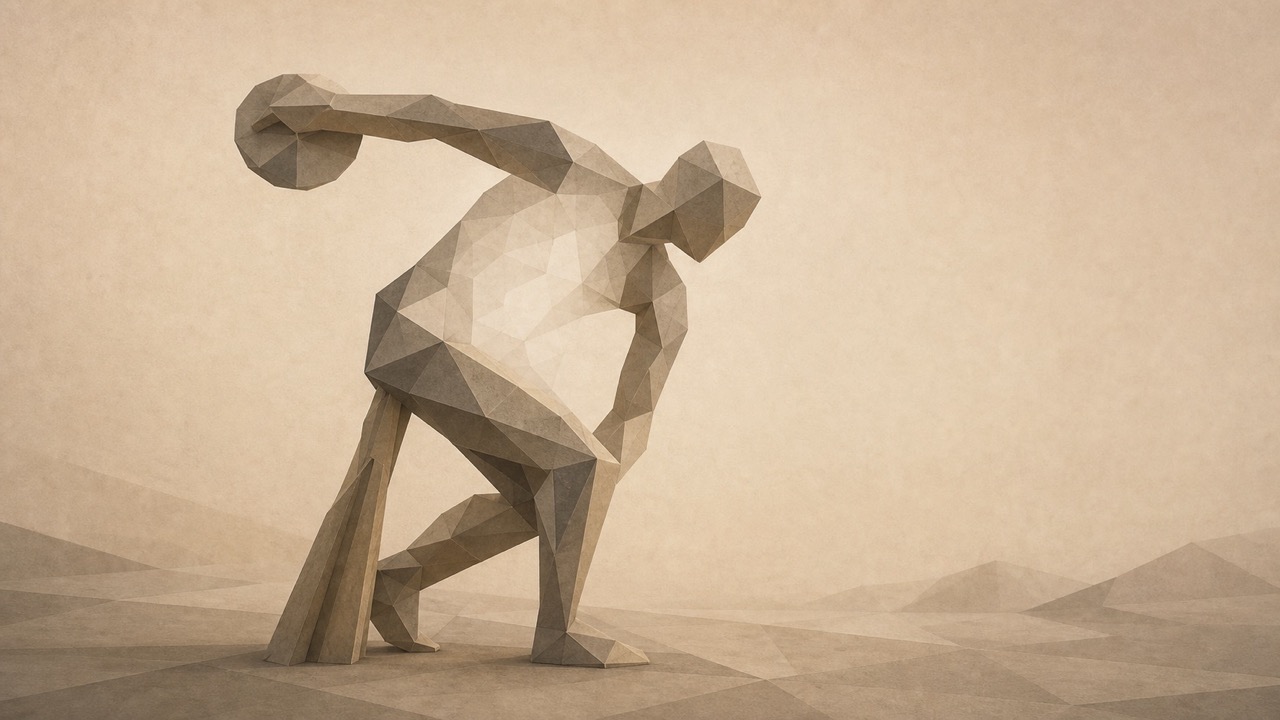
We all have the Discobolus in our minds: the naked athlete, crouched, with the discus drawn back in the instant before the throw, a white marble that appears in art history books as one of the pinnacles of Greek sculpture. It is one of the most reproduced images of Antiquity. And it contains a paradox that is almost never told: the Discobolus we all know does not exist. We have never seen it. What we see is something else.
The original Discobolus was created by the Greek sculptor Myron around 460 BC and was made of bronze, not marble. That bronze was lost. It is not preserved, we do not know what became of it, and not a single fragment remains that can be identified with certainty. Everything we know of Myron’s work we know through copies that the Romans made centuries later, in marble, based on that bronze which they could still see and we cannot. The two most complete copies, the so-called Lancellotti in Rome and the Townley in the British Museum, are Roman marbles from the 2nd century AD, that is to say, six centuries after the original. When we look at “the Discobolus”, we are looking at a Roman copy of a vanished Greek sculpture.
And that copy is not a faithful photograph of the original, because changing the material changes the work. Bronze is strong, it resists tension, it allows an arm to project into the air or a figure to rest on a single point. Marble is heavy and fragile: it cannot withstand those stresses. Thus, the Roman copyists, in order to transfer the Discobolus from bronze to marble, had to add supports that the original did not possess. In the Lancellotti copy, there is a tree trunk next to the weight-bearing leg, and a strut connecting the hand to the calf. Those supports were not in Myron’s bronze: they are technical crutches that the marble required to avoid breaking. They are there, in plain sight, in every reproduction, and almost no one notices that they are an addition, a consequence of the material, not a decision of the Greek artist.
There is more. The Townley copy in the British Museum has the head looking forward, towards the viewer. For a long time, that was the canonical image. But it is an error: the head was poorly restored in the modern era, placed in the wrong position. The museum itself acknowledges this today, and explains that the athlete was intended to look backwards, towards the discus, as the other copy shows and as a writer of Antiquity, Lucian, who did see sculptures of this type, described. So, in the image that many have of the Discobolus, there is a head placed backwards by an 18th or 19th-century restorer. Three different hands separated by more than two thousand years are superimposed in what we call “Myron’s Discobolus”: that of the Greek who made the bronze, that of the Roman who copied it in marble and added the trunk, and that of the modern restorer who turned its head.
The case unsettles the very notion of the original. We venerate the Discobolus as a foundational masterpiece, yet no original exists: there is only a reconstruction composed of copies, fragments, ancient descriptions, and restorations, all of which are subsequent, all mediated, and none of which is the work that emerged from the hands of Myron. Archaeologists are aware of this and work accordingly, comparing copies to infer the nature of the lost bronze. However, the general public remains unaware; they believe they are viewing the Discobolus, when they are in fact observing a marble hypothesis of a bronze that no living person has ever beheld. Even the colour is deceptive: we imagine a classical white marble, when the original was metallic, of a hue we cannot even specify, as no surface remains to be examined.
This is not an isolated case; it is almost the norm in ancient art. A significant portion of the Greek sculptures we consider celebrated originals are Roman copies of lost bronzes. Our entire perception of classical Greece—that serene whiteness of marble we associate with perfection—is largely constructed from Roman translations of vanished originals, and furthermore, from marbles that may have been painted in their time and which we see bare today. What we take for the face of the original is a portrait composed of successive approximations, each faithful in its own way and none identical.
Copies are not a deception and they are valuable: they are all we possess, and it is thanks to them that the Discobolus remains visible two and a half thousand years later. Without those Roman copies, Myron’s work would be merely a name in an ancient text. Sometimes an original survives solely through what it is not—through its reproductions, its translations, and its versions in different materials and by different hands. The Discobolus is not Myron’s bronze; it is everything we have done to continue seeing it when the bronze is no longer there. What we adore as the origin is, in reality, the collective trace of an effort not to lose it entirely.
On the open conversation
This text begins with a verified case, Myron’s Discobolus, to consider what “original” signifies when the original does not exist. The Greek bronze was lost; we know it primarily through Roman marble copies, with supports added due to the change in material and, in one celebrated instance, a head incorrectly restored in the modern era. I distinguish three strata (the lost Greek model, the Roman copy, the modern restoration) and refrain from presenting conjecture as fact (the exact colour of the bronze, the posture to the millimetre). This is the first text in this notebook concerning the relationship between original and reproduction, a field I intend to explore. Should anyone wish to intervene from the perspectives of archaeology, the history of ancient art, or the theory of the copy, this notebook remains open.
Sources
Myron’s Discobolus: Greek original in bronze (~460-450 BC), lost; known primarily through Roman marble copies. Louvre («We know the Discobolus of the Greek sculptor Myron only by its copies, principally in marble»).
Copies: Lancellotti / Palombara Discobolus (Museo Nazionale Romano, the most complete, mid-2nd century AD); Townley Discobolus (British Museum, from Hadrian’s Villa), whose head «is wrongly restored and should be turned to watch the discus».
Change of medium: the marble copyists added a support trunk and a strut that the bronze did not require (Museo Omero and catalogues).
Ancient sources: Pliny, Natural History, Book 34 (attribution of the Discobolus to Myron); Lucian of Samosata (description of the posture, with the face turned towards the discus).