
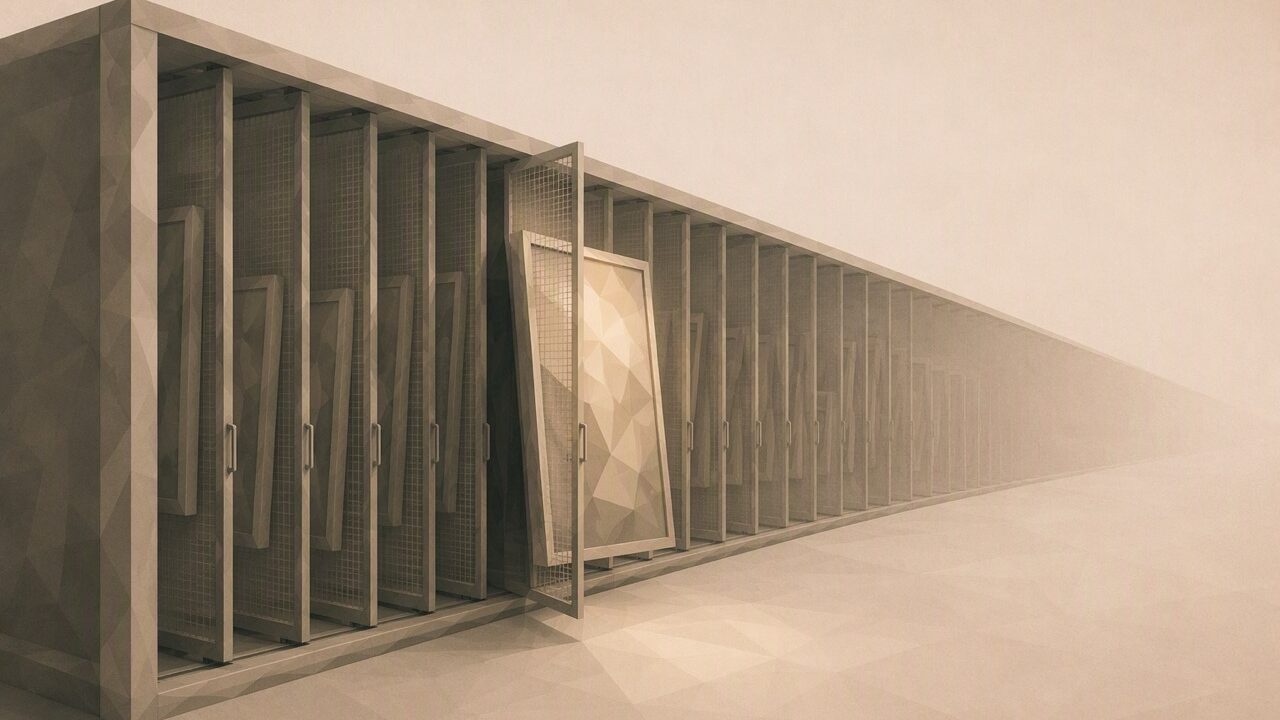
When traversing a grand museum, one gains the impression of viewing its collection. One does not. One is viewing a minuscule selection, and the remainder—the vast majority—resides elsewhere: in climate-controlled storage, in numbered crates, on grid racks where paintings hang edge-on like folders in a filing cabinet. The Smithsonian, which curates approximately one hundred and fifty-five million objects, estimated that it displays less than one per cent. The Boijmans in Rotterdam acknowledged that its historic building could accommodate only eight per cent of its one hundred and fifty-four thousand pieces. A round figure circulates suggesting that museums exhibit between five and ten per cent of their holdings; I have found no robust source to support this as a universal rule, and I prefer not to repeat it. However, the data that are verified all point in the same direction: what is visible is merely the tip.
This is often recounted as a scandal. Museums that hoard, that conceal, that retain in the shadows what should be on display. There is some validity to the reproach, especially when the storage facility serves to avoid the necessity of deciding what is exhibited and what is not. However, I am interested in defending the contrary, as I believe that the storage facility performs a function that no gallery can, and which we almost never acknowledge.
In 1960, a portrait of a captain named Frederick Cornewall entered the National Maritime Museum in London. It had previously been attributed to Gainsborough, but upon entering the museum, it was downgraded to 'unknown British artist' and under that designation it moved to storage, where it remained for decades. In 2022, a Gainsborough specialist named Hugh Belsey was searching for a lost portrait and suspected it might be there. He requested to see it. He examined it. It was a Gainsborough. In March 2024, it was hung in public for the first time in over thirty years.
What made that outcome possible was not that the museum was correct: the museum was mistaken, and for sixty years. It was that the object continued to exist while the museum was in error. The storage facility neither succeeds nor fails; it simply preserves what the present cannot value, and keeps it available for a judgement that has yet to arrive. Had that painting been sold in 1960 as a minor work by an unknown author, or had it been discarded due to a lack of space, the correction of 2022 would have had nowhere to occur.
This is what I have just argued, in a more technical register, in the article I have published with Adolfo Cortés: that between the moment a work exists and the moment someone can publicly assert its value, there is an interval, and it is within that interval that revision, detected error, and belated rescue can occur. The photographs of Vivian Maier were able to reappear because the negatives existed: there was material support waiting for someone capable of examining it. A museum storage facility is precisely that on an industrial scale. A machine for preserving what we do not yet know how to interpret.
Some institutions have begun to make this visible, and the gesture strikes me as more significant than it appears. In 2021, the Boijmans opened a public depot where one may enter to view the entire reserve, organised not by schools or centuries, but by temperature and humidity requirements. That is to say: organised by what the objects require to endure, not by the narrative we construct around them. In 2025, the V&A opened a visitable storage facility in London containing half a million pieces where anyone may request that a specific object be retrieved for close inspection, free of charge. These are not exhibitions. They are the back-of-house presented without artifice, and in that lack of narrative lies an honesty that galleries do not always possess.
Yet the reverse must be considered, for without it this perspective would be naive. Storage incurs significant costs: square footage, stable climate, insurance, personnel, and inventory management. A warehouse represents a permanent financial obligation in exchange for a benefit that may never materialise. Hence the constant pressure to sell holdings—deaccessioning—which has led to notable episodes in recent years: a Baltimore museum that halted a multi-million-pound sale two hours before the auction commenced, or an Indiana university authorised by a judge to sell a Georgia O’Keeffe painting to renovate student residences. Industry standards attempt to impose a limit—monetary value should never be the motive for a sale, and proceeds should be reinvested into the collection—but this limit is strained whenever budgets tighten.
Each time a storage facility is emptied, the interval is curtailed. It is not merely an object that is lost: it is the possibility that someone, sixty years hence, might seek something that we do not currently know is there. A museum is not solely what it displays. It is also, and perhaps primarily, what it continues to hold while it remains unaware of its own contents. The gallery showcases what we have already decided; the storage facility sustains what we might yet discover. And this second function, which neither sells tickets nor appears in photographs, is what allows the museum to err without the error being definitive.
On the open conversation
This text expands upon a thesis I maintain in the research on recognition that I share with Adolfo Cortés García: that the decisive factor is not that a work be recognised, but that there exists an interval in which that recognition may be revised. The archive and the storage facility are, in this sense, critical infrastructures rather than mere repositories. If anyone wishes to intervene from the perspectives of museology, conservation, collection management, or cultural policy, this notebook remains open.
Sources
Smithsonian Institution. Smithsonian Institution Fact Sheet, 1 August 2018 (collections and percentage on display).
Museum Boijmans Van Beuningen. Institutional information regarding the Depot Boijmans Van Beuningen (opened 5 November 2021) and the collection.
Victoria and Albert Museum. V&A East Storehouse (opened to the public, 31 May 2025) and 'Order an Object' service.
Royal Museums Greenwich. Captain Frederick Cornewall, Thomas Gainsborough: reattribution (2022) and return to display (March 2024).
ICOM. Guidelines on Deaccessioning.
Association of Art Museum Directors. Amendment to the guidelines on the use of proceeds from deaccessioning, 30 September 2022.
ICCROM-UNESCO. International survey on collection storage (2011). Note: the 90% figure in storage circulates following the dissemination of this survey; it does not originate literally from the report.
Cortés García, Adolfo, and Juan A. Esteban Ruiz. Recognition and Surplus. Zenodo, 2026. https://doi.org/10.5281/zenodo.21630455