Whenever a machine learns to perform a task we once considered our own, there is a tendency to claim that the task was never truly significant. When machines surpassed our capacity for calculation, we dismissed calculation as mechanical. When they mastered chess, we argued that chess was merely calculation governed by rules. When they began to compose coherent paragraphs, we asserted that writing is not synonymous with thinking. Historians of artificial intelligence identified this reflex decades ago: every achievement of the machine ceases to be classified as intelligence once its mechanics are understood, and the definition of what is truly human retreats further, always to the domain of what machines have yet to master.
It is easy to interpret this reflection as a retreat, as if we were losing ground and seeking consolation. I interpret it in reverse. I have no interest in joining those who fear that artificial intelligence will steal what makes us human, not least because I do not believe it to be true and because I see how much it contributes: there are systems that have accelerated the prediction of protein structures, that solve mathematical problems of olympiad level with every step verified, that refine diagnostic imaging. I do not see it as a threat; it is an extraordinary tool in hands that know how to use it. And the question I ask myself concerns us.
If every capacity the machine acquires ceases to seem essential to us, perhaps the problem is not that we are being hollowed out: it is that we have spent centuries looking for ourselves in the wrong place. We placed humanity within a list of skills: calculating, memorising, reasoning, executing with dexterity. And one after another, those skills prove to be replicable. The machine does not take anything from us that was truly ours; it removes the comfortable answers, those that confused what we can do with what we are. Each boundary that falls is a false definition that falls with it. What remains afterwards is not less, but cleaner: the stark question of what a human being is when they can no longer be defined by any task that a system cannot imitate.
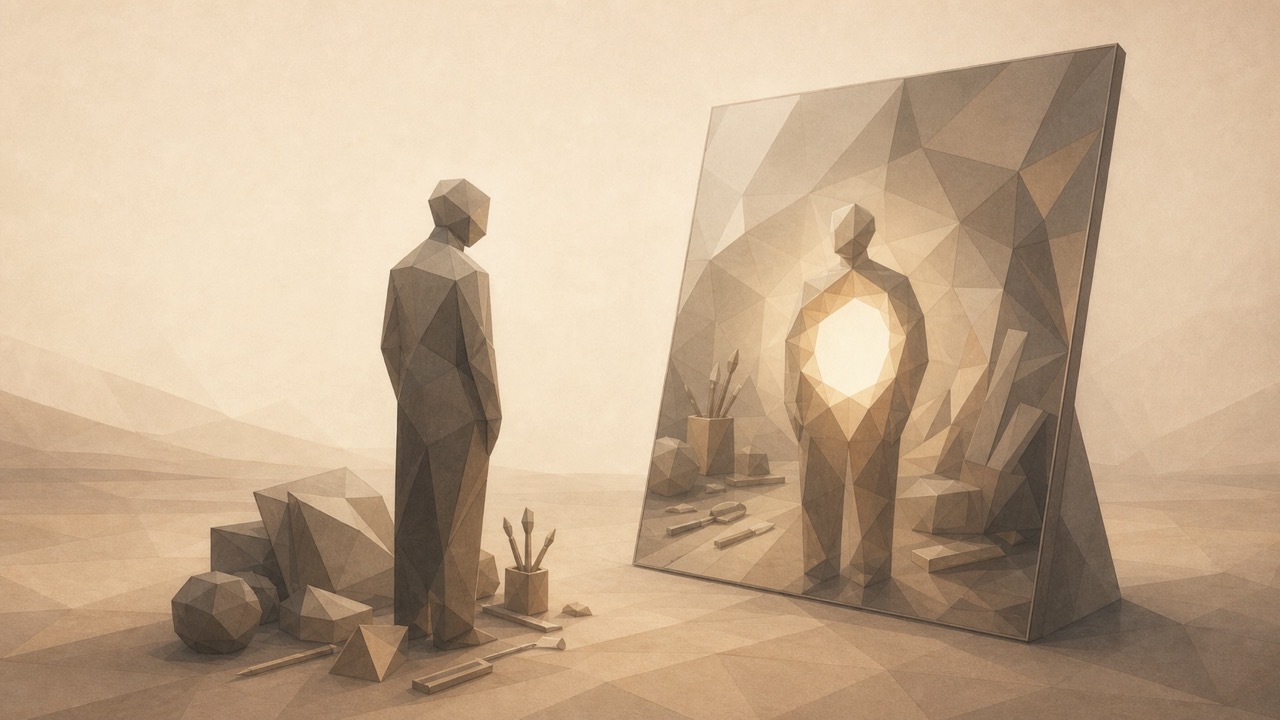
I will not answer that question because to answer it would be to repeat the error. If I were to say now that “what makes us unique is consciousness”, or creativity, or bonds, I would be doing the same thing again: placing a piece on a square, waiting for someone to build the machine that occupies it and forces me to move again. Human singularity, if the word means anything, may not be a property that one possesses and can lose, like someone losing a position in a competitive examination. Perhaps it is something else: not a skill, but the fact that no one occupies the place from which one acts. Hannah Arendt distinguished between what someone is, which is described by capabilities and attributes, and who someone is, which only appears when acting and speaking among others, and which cannot be reduced to a list. The machine can equal the what; the who is not a superior skill: it is of a different order.
I do not contend that 'the human' has ever been a pure and stable essence currently under threat. It has never been so; for centuries, the definition of what it meant to be fully human excluded women, colonised peoples, and those who did not conform to the reasoning of the definer. The machine does not destroy a clear boundary; it illuminates the fact that the boundary was never innocent. Furthermore, I do not believe the machine compels us to act, as if it possessed a will of its own. We are compelled by human decisions regarding what to construct, for what purpose, and for whose benefit. Technology does not think independently; it is utilised by corporations, states, and individuals. Attributing pressure to the technology itself is a convenient method of avoiding scrutiny of those who make the decisions.
And here lies a matter of responsibility, not nostalgia. If the singularity of each person does not lie in what they produce but in the fact that they occupy a place that no one else occupies, safeguarding it does not consist of slowing down the machine or competing with it on its own ground, which I believe is a lost and, furthermore, absurd battle. It consists of not organising life in common as if the only thing that mattered were what is replicable, measurable, and productive. A society that only recognises what can be automated will end up treating people as slow versions of a machine. The task is not to protect skills that are no longer scarce, but to sustain the conditions in which someone can continue to appear as someone: non-productive time, care, the word that does not yield, the gesture that optimises nothing. That is not saved by technology, nor is it threatened by it: we decide that ourselves.
I do not know where human singularity lies, and I am suspicious of anyone who claims to be certain. But I am grateful that a machine capable of almost everything has stripped me of easy answers. We spent centuries believing that we were special because of what we knew how to do, and it turns out that almost all of that can be taught to something else. What has not been copied, yet, is not a more difficult skill: it is the very fact of being here, occupying a place, answering for what one does. It may be that there is nothing there to defend, no fortress. Only someone, unrepeatable, whom the machine knows how to imitate in every way except for the fact that it is him.
On the open conversation
This text is not a critique of artificial intelligence, which I consider an invaluable tool in science, research, and many fields, but a question about ourselves: what is human singularity when the machine equals, one after another, the capabilities with which we defined it? I maintain that it does not subtract from it, it reopens it, and that the answer does not lie in taking refuge in the next skill not yet imitated. I distinguish the verified fact (the effect described by historians of AI, the real advances and their limits) from the philosophical interpretation, which I support with Arendt, Haraway, and Braidotti without attributing to them theses on AI that they did not formulate. If anyone wishes to intervene from the perspective of philosophy, the ethics of technology, science, or work with these systems, this notebook remains open.
Sources
Pamela McCorduck, Machines Who Think (1979), on the pattern by which every achievement of the machine ceases to count as thought (the “AI effect”). The formulation “AI is whatever hasn’t been done yet” is attributed to Larry Tesler; Douglas Hofstadter popularised it in Gödel, Escher, Bach (1979).
Hannah Arendt, The Human Condition (1958): distinction between “what” someone is and “who” someone is; singularity in action and plurality.
Donna Haraway, A Cyborg Manifesto (1985) and Rosi Braidotti, The Posthuman (2013): on the historical instability of the boundary of “the human”.
Verified contributions of AI with their limits: AlphaFold (Kovalevskiy et al., PNAS, 2024); AlphaProof and AlphaGeometry 2 at the 2024 Mathematical Olympiad (Hubert et al., Nature, 2025); AI in clinical practice (Han et al., The Lancet Digital Health, 2024).