A painting from four centuries ago has been relined, its varnishes removed and replaced, its frame changed several times, its cracks stabilised, and certain areas repainted by hands other than those of the author. If one were to count the atoms, perhaps very little of the material that left the original studio would remain.
We call it authentic, we insure it as authentic, we hang it under its name. No one who defends it would claim it is a different object. This, which we take for granted, conceals a question: if the material has changed so much, in what exactly does its authenticity reside? It is clear that physical permanence does not sustain it. The work has gradually lost and replaced its body, much like the Ship of Theseus whose planks are replaced one by one, and yet we continue to assert that it is the same vessel. That which certifies its identity must lie elsewhere.
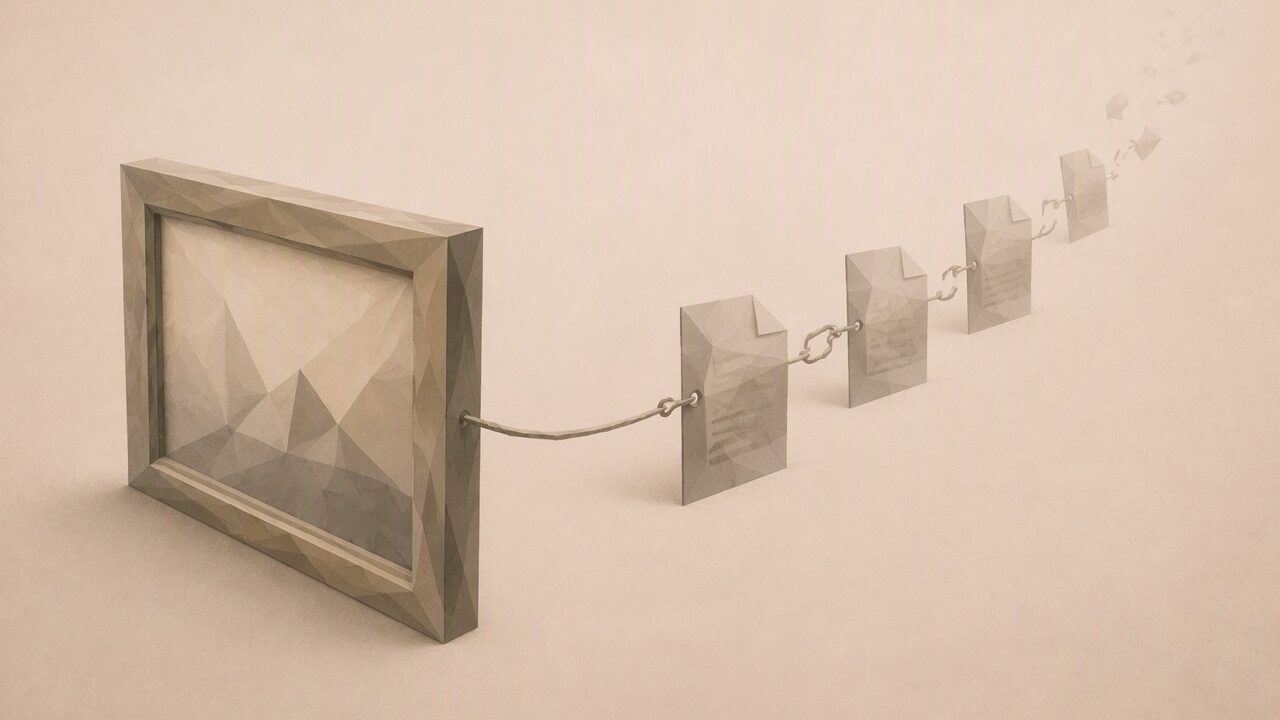
It lies in a chain. Not in the object, but in the documented continuity of acknowledgements we choose to believe: who created it, where it has been, who attributed it, which hands cared for it, and which documents attest to it. The authenticity of a work is not a property that can be touched; it is a relationship sustained over time between the piece and a web of testimonies. When we purchase 'an authentic work', we are primarily purchasing the solidity of that chain.
A perfect forgery could be, materially, superior to the original: better preserved, more intact, perhaps even more beautiful. And yet we reject it as the work of another, and rightly so. What concerns us is not the quality of the material before us, but whether that material is linked to the true chain. We prefer the damaged and mended original to the impeccable forgery. This demonstrates, better than any argument, that authenticity is not a quality of the object: it is a bond with a history, and that bond may or may not exist regardless of the piece's appearance.
Nelson Goodman formulated this with precision decades ago by distinguishing between autographic and allographic arts: in painting, unlike music, the distinction between original and copy is constitutive, because the work is bound to the concrete history of its production. Walter Benjamin had previously noted this attachment when speaking of the 'here and now' of the piece, its existence in a unique time and place. This should not be read as nostalgia: Benjamin was not defending the aura, he was diagnosing its fracture and anticipating what would follow. However, his description serves the purpose here: the identity of a visual work is tethered to an unrepeatable trajectory, not to what is visible within it.
If authenticity is sustained by a chain of recognition and documentation, then it is only as solid as that chain, and chains break. A lost opinion, an interrupted provenance, a testimony that cannot be verified: each broken link does not damage the material of the work, but it weakens its demonstrable authenticity, which for all practical purposes is much the same. Hence, the art market is so vulnerable in this regard, and so dependent upon paperwork: not because the documents are the work, but because they are the only means of keeping the bond visible when living memory fades.
That demonstrable authenticity depends upon a chain does not mean that what the work does depends upon it. Before a painting, what occurs — if it arrests us, if it opens something — does not consult its certificate. One may lose all documentation for a piece and still have before them exactly what moved them yesterday; what is lost is not the experience, but the possibility of proving it to others, of insuring it, of selling it. The chain does not sustain the encounter with the work. It sustains its circulation in the world, which is a different matter, and one that also carries weight.
A certificate, whatever its form, never guarantees that which would be most worth guaranteeing. It protects the transaction, not the discovery; the heritage, not the gaze. It renders an identity demonstrable to third parties that the work, in its silent presence, already possessed without the need for proof. And perhaps there is something almost consoling in this: that the most valuable aspect of a work is, precisely, the only thing that no documentary chain can certify. Not a trait that can be archived, but something the work continues to be capable of, whether or not someone is present, and which occurs again, anew and without witnesses, each time someone pauses to look at it.
On the open conversation
This text belongs to my series on the ontology of the work: what constitutes it beyond its material, and how authenticity, far from being a property of the object, is sustained by a chain of documented recognition. I intentionally distinguish between demonstrable authenticity—which requires such a chain—and what the work performs before the viewer, which requires no certificate whatsoever. Should anyone wish to contribute from the perspectives of philosophy of art, conservation, the law of authenticity, or market practice, this notebook remains open.
Sources
Goodman, Nelson. Languages of Art: An Approach to a Theory of Symbols. Indianapolis: Bobbs-Merrill, 1968. (Distinction between autographic and allographic arts.)
Benjamin, Walter. “The Work of Art in the Age of Mechanical Reproduction” (1935-1936). In Illuminations, London: Fontana.
Plutarch. Parallel Lives, “Theseus” (Ship of Theseus paradox).
Cortés García, Adolfo, and Juan A. Esteban Ruiz. Recognition and Surplus: On the Double Dissociation between Structural Surplus and Historical Recognition, and Its Compression under Algorithmic Mediation. Zenodo, 2026. https://doi.org/10.5281/zenodo.21630455