
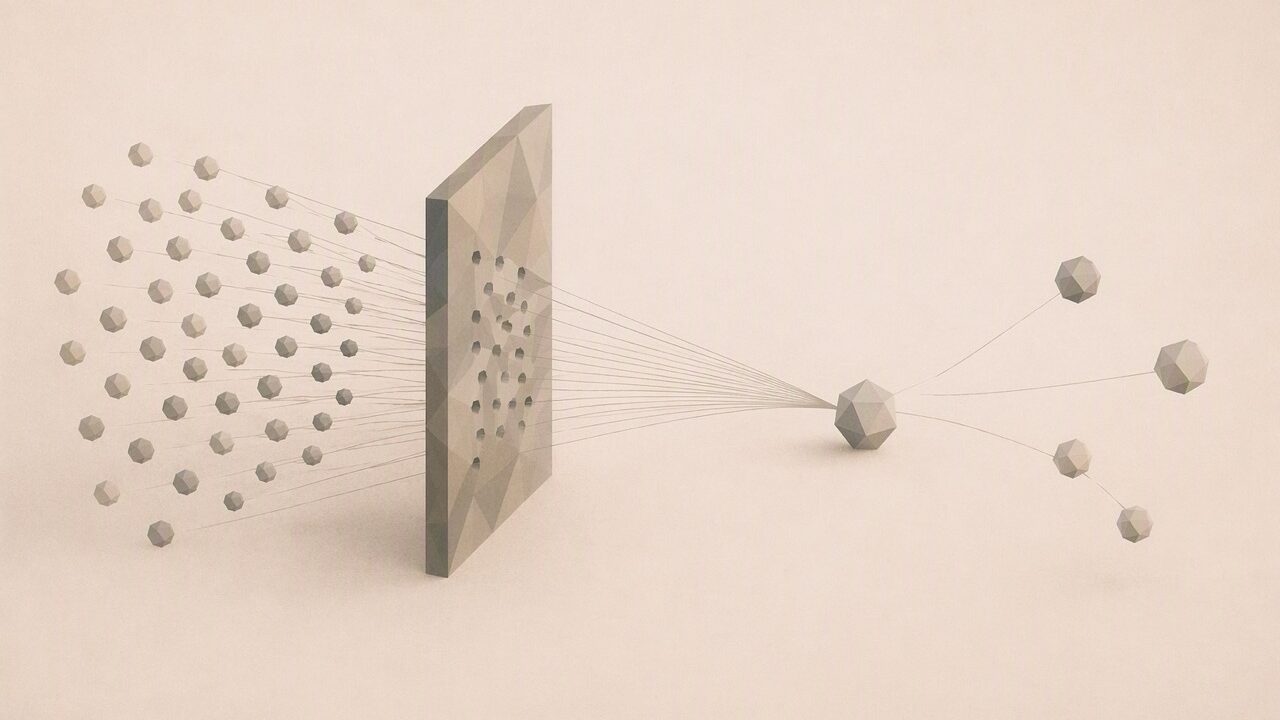
When a cultural institution uploads its collection to the internet, it performs a gesture that appears to be one of justice: that which previously required travel, payment, and prior knowledge of its existence is now available to anyone with a single click. I work within the digital sphere and I believe in a significant portion of that promise. However, the data tells a story that is less complete than we would like.
The most unsettling study on this subject analysed cultural participation in the United Kingdom over the course of a decade. Its conclusion dismantles easy optimism: digital media does indeed attract some new audiences, yet inequality does not disappear—and, in museums and galleries, the gap between advantaged and disadvantaged audiences proved greater in online access than in physical visits. Those who already possessed the habit, the cultural capital, and the digital competencies took advantage of the online offering; those who did not remained just as excluded, if not more so. Technical access was expanded for all; the capacity to appropriate it was not.
Placing something on the internet is not the same as making it accessible. A digitised archive still requires one to know it exists, to know how to search for it, to understand its language, to possess the prior interest, and to have the equipment and connection to enjoy it. The symbolic barrier I discuss in other texts does not remain at the door of the physical museum: it travels intact to the screen, and at times it is aggravated, because in the digital realm, even the human accompaniment that could build a bridge within the gallery space disappears.
The algorithm also presents new problems. Increasingly, what we encounter is not entirely of our own choosing; it is proposed to us by a recommendation system that decides what becomes visible and what remains buried. This has been well studied in music. An analysis of consumption on Spotify found that listening guided by algorithmic recommendation is associated with less diversity: the system is efficient at providing more of what you already like, and for that very reason, it tends to narrow your horizons. Another study on Deezer nuanced the idea of the filter bubble—the algorithm can introduce novelty, even more than one might seek out on one's own—but it is a confined novelty, close to the familiar, without leaps. Recommendation does not entirely enclose you, but it rarely takes you far.
For centuries, mediation meant building a bridge towards that which you did not know: the librarian who introduced you to an author, the programmer who took risks, the teacher who pushed you beyond your own tastes. Algorithmic recommendation does, to a large extent, the opposite: it returns to you, refined, what you already were. It is comfortable; yet culture that merely confirms is not that which reorganises anything, and that which reorganises nothing can hardly broaden anyone. If we allow access to culture to be governed by systems designed to maximise dwell time and clicks, we shall have more consumption and less discovery.
The digital realm has made possible forms of access, archiving, and encounter that did not previously exist, and to abandon it would be to surrender that territory to those who might manage it less effectively. Digitising is not democratising. Uploading a collection to the network or opening a profile does not fulfil the promise of access if it is not accompanied by genuine mediation—by someone who continues to build bridges, even within the screen. Digital infrastructure, like any infrastructure, is not neutral: it favours certain outcomes and hinders others, and deciding which is a responsibility, not an automatic effect of technology.
Precisely because the screen does not democratise on its own, the human work of mediation becomes decisive once more, perhaps more so than ever. An algorithm optimises; a person can surprise. The task of those who mediate in the digital sphere is not to compete with the machine in providing each individual with more of the same, but to do what the machine cannot: to open doors towards that which no one had requested, to build the unexpected bridge, to defend discovery against convenience. Technology distributes access; the meaning of that access is something we must continue to provide ourselves. And that is the only thing that can ensure the promise of the screen, one day, is truly fulfilled.
On the open conversation
This text concludes my sub-series Art and Society, and carries its underlying theme into the digital realm: what culture promises socially and what it truly delivers; here, why digitisation is not, in itself, democratisation. Should anyone wish to intervene from the fields of platform studies, digital culture, or online cultural mediation, the notebook remains open.
Sources
Mihelj, Sabina, Adrian Leguina and John Downey. “Culture is digital: Cultural participation, diversity and the digital divide”. New Media & Society 21, no. 7 (2019): 1465-1485.
Anderson, Ashton, Lucas Maystre, Rishabh Mehrotra, Ian Anderson and Mounia Lalmas. “Algorithmic Effects on the Diversity of Consumption on Spotify”. Proceedings of The Web Conference 2020.
Shakespeare, Dougal, Victor Chareyron and Camille Roth. “Reframing the filter bubble through diverse scale effects in online music consumption”. Scientific Reports 15 (2025): art. 4071.
Poell, Thomas, David Nieborg and José van Dijck. “Platformisation”. Internet Policy Review 8, no. 4 (2019).