
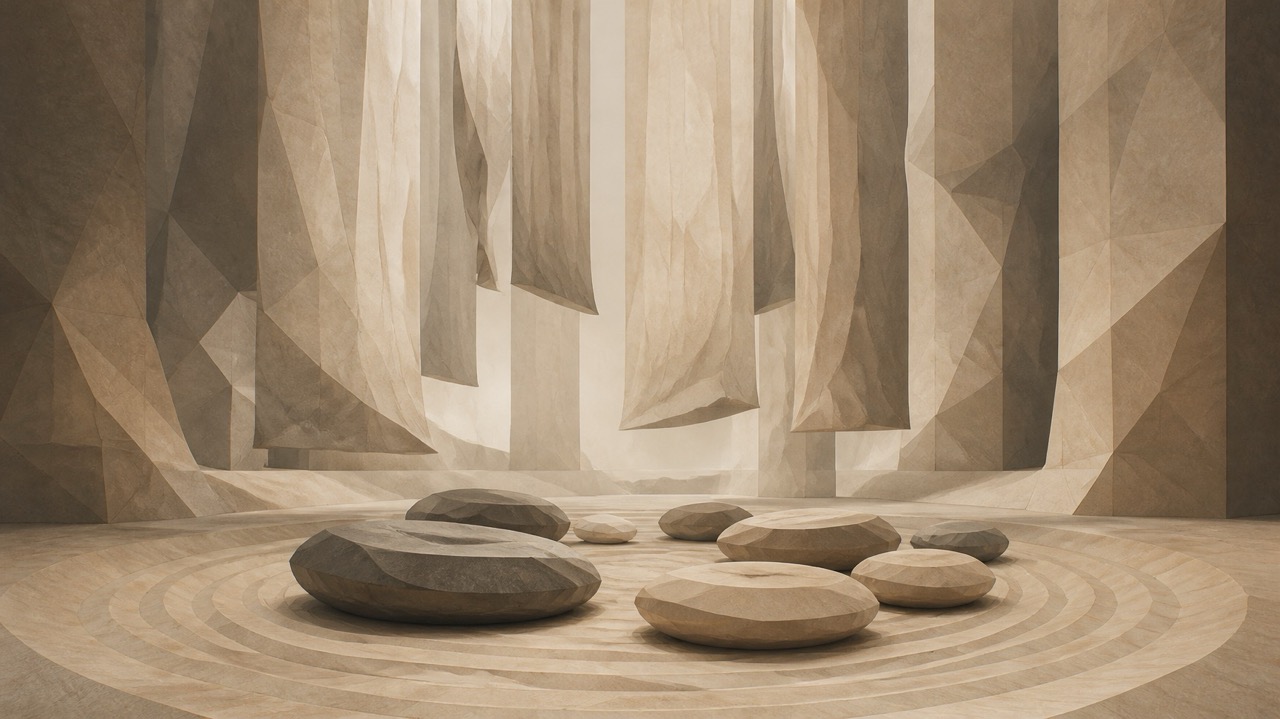
The Turbine Hall at Tate Modern typically imposes a vertical relationship between the artwork and the visitor. The industrial scale of the space compels one to look upwards, measure distances, and traverse an architecture that renders even the largest pieces as episodes within a greater volume. In Hold, Tarek Atoui utilises this disproportion, yet shifts the centre of the experience. The installation does not merely occupy the hall nor propose that one stand before a sound composition: it distributes instruments, vibrations, air currents, and places to remain, so that listening depends upon how the space is traversed and inhabited.
The Hyundai Commission is presented from 13 October 2026 to 11 April 2027. It brings together wind and percussion instruments, electronics, stone, bamboo, textiles, and 3D-printed forms. The composition changes with the activity in the hall, environmental conditions, the software, and the performances scheduled during the six months of opening. The work does not remain the same while awaiting different publics; it is modified with them.
I have not visited the installation. This analysis is based on the exhibition documentation, the guide, the press release, and the accessibility information published by the Tate. This distinction is significant: it allows for an examination of the artistic proposal and its institutional communication, but not for a direct evaluation of the spatial experience, sound pressure, usage times, or the effective operation of the support measures.
Listening is not localised in the ear
Atoui develops instruments and environments in collaboration with musicians, instrument makers, engineers, researchers, and communities. In Hold, this method appears concentrated in an orchestra without a single centre. A suspended network of bamboo tubes connects approximately seventy-five shengs—mouth organs from China and Southeast Asia—activated by air currents. There are drums constructed with In Seok Seo using Korean techniques; heat lamps alter the tension of the skins and, consequently, their tuning. A metallic karnai and two large horns printed in a mixture of sugar resin and bamboo powder extend the form of these Central Asian ceremonial instruments into the air.
The materials do not illustrate a musical geography ordered by country. They arrive in the hall through processes of translation, reproduction, and transformation. Atoui does not treat the sheng, the karnai, or the drum as stable pieces that technology modernises, but as instrumental families with distinct histories and possibilities that remain open. This operation requires care: gathering traditions from East, Central, and West Asia within a large European institution can reduce them to a global availability of forms and sounds. The information published by the Tate, however, indicates that the project is supported by identified collaborations and prolonged research, rather than an anonymous collection of cultural references.
Air fulfils several functions. It activates the instruments, moves the textiles, and relates the installation to the temperature, humidity, and currents of the Turbine Hall. The fabrics, manufactured from washi, nylon, cotton, and polyurethane, incorporate a strip of conductive ink. A low-voltage electrical current passes from this strip to a synthesiser and is converted into low frequencies. The pieces oscillate physically and produce a further electronic oscillation: they do not represent the wind, but respond to it.
There are also suspended modules that Atoui terms sunflowers. These combine skins, ceramics, bronze, gongs, and microphones. They collect sounds from the environment and process them through a programme created by the artist: some modules generate loops or reverberations; others distort or perform spectral transformations. The hall does not function as a neutral container. Its noises, echoes, and the presence of the public enter the system and return, converted into layers of the composition.
For this reason, the assertion that no two visits will be identical should not be understood as a promotional formula regarding interactivity. The variation proceeds from a concrete network of dependencies. The air, humidity, bodies, sounds collected by the microphones, software responses, and, at certain moments, the intervention of musicians, all change. Authorship does not disappear: Atoui designs instruments, relationships, and margins for transformation. What he declines to fix is a singular outcome.
Stone, contact, and permanence
The stones situated on the floor introduce another scale. These are pieces of Brazilian and Swedish granite, Kashmiri marble, and Carrara marble, carved to act as surfaces for resting, resonators, and elements that function similarly to lithophones. Several contain loudspeakers. The visitor may sit or lie down and perceive the sound through contact.
This gesture modifies the habitual conduct within an art institution. Sitting on an artwork, leaning one's back against it, or remaining lying down is usually prohibited, unless a device is expressly conceived for such a purpose. In Hold, contact is not a concession: it is part of the act of listening. The stone ceases to be merely sculptural matter and begins to support bodies, transmit vibrations, and gather people. Atoui conceives one of these arrangements as a communal table where one may rest, meet, or connect equipment during a performance.
The title acquires a material sense here. Hold may denote the act of supporting, securing, maintaining, or providing space. The work supports instruments and materials in an aerial network, but it also offers surfaces upon which to remain. It does not compel one to traverse the Turbine Hall with the speed of a visitor accumulating images. It proposes pausing long enough for a frequency to become perceptible and for the public space of the museum to function, at least temporarily, as a place of gathering.
This dimension does not eliminate hierarchies. The work remains inscribed within an institutional commission funded through a long-term corporate partnership between Tate and Hyundai. Nor does it, of itself, convert the hall into a common space. It does, however, alter something more precise: the position anticipated for the spectator. It no longer presupposes solely an upright, mobile body with typical hearing and attention oriented towards a stage. One may listen with the back, the hands, the body's points of support, and the duration of one's stay.
Integrated accessibility and the limits of information
Vibration offers a pathway to sound that does not depend exclusively upon the ear. This does not permit the assertion that the work is universally accessible. The experiences of deaf or hearing-impaired individuals are diverse; a frequency perceived through contact does not automatically substitute for other resources. Mobility, balance, fatigue, sensitivity to stimuli, the comprehension of instructions, the ability to wait, or the need for assistance also condition the experience.
The contribution of Hold lies elsewhere: the tactile dimension does not appear as an adaptation added after the work is completed. It intervenes in its conception. The vibrating stones, the bass produced by the textiles, the visible movement of the materials, and the possibility of modifying the body's position expand listening because they form part of the artistic structure. This difference matters. A work does not become accessible merely by incorporating a sensory resource, but an artistic practice can, from the outset, question the narrow model of the public for which it is typically designed.
The Tate provides useful general information: all Tate Modern entrances are step-free, there are lifts and accessible toilets, a quiet room, ear defenders available at the desks, and a visual story to prepare for the visit. The programme also includes audio-described tours for blind or partially sighted visitors on various dates between November 2026 and March 2027.
Such information does not resolve all the specific questions posed by a large-scale sound and tactile installation. The documentation does not specify the levels or variations of sound intensity, which zones concentrate low frequencies, how long the wait to use the stones might be, whether assistance exists for climbing or changing posture, which elements are exclusively auditory, nor what alternatives allow one to follow the transformation of the sounds. Nor does it announce on the main page transcriptions, sign language interpretation, low-stimulus sessions, or easy-read materials.
The absence of these public data does not demonstrate that support does not exist. It signifies that it cannot be known from the documentation. The difference is important because an accessibility policy does not begin at the museum door. It begins when a person decides whether they can travel, how much time they require, what conditions they will encounter, and what resources they must request. Prior information is not an administrative complement to the artistic experience: it determines who can plan it with autonomy.
In a work that transforms listening, mediation should not be limited to explaining the origin of the instruments. It must describe how the space is used, what may be touched, where vibrations are perceived, how intensity changes, and what alternatives exist. It must also collect divergent experiences without converting people with disabilities into unpaid verifiers of an institutional promise. The relationship with the work of mediation and cultural accompaniment is direct: the decisive work often remains outside the narrative of authorship, even though orientation, accompaniment, and the real possibility of remaining depend upon it.
A work that does not end with its objects
Hold brings together ancient instruments, electronic devices, and industrial materials, but its interest does not reside in the easy contrast between tradition and technology. The software does not replace the instruments; it listens to, alters, and redistributes them. The motors do not automate a closed score; they introduce breaths and rhythms into materials sensitive to the climate. The stones do not decorate the floor; they change posture and the regime of attention. The public does not activate a simple response, but enters an environment that was already listening before their arrival.
The performance programme reinforces this condition. Throughout the commission, various musicians use the installation as a sound system, a collection of instruments, and an acoustic environment. The work then functions as an infrastructure available for external interpretations without ceasing to preserve the architecture defined by Atoui. It is a form of openness more demanding than symbolic participation: it requires that the device support uses that the artist does not entirely control.
The institutional question is whether that openness extends beyond the artistic programme. Presenting the Turbine Hall as a place of encounter entails attending to who can enter, comprehend, touch, rest, and return. Accessibility is not the declared theme of Hold, but the work makes visible that every form of listening distributes positions among bodies, materials, and spaces. The institution completes or contradicts that proposal through the information it publishes, the support it offers, and the manner in which it evaluates the experience.
An open conversation
This text distinguishes between the data published by the Tate and an interpretation conducted without having visited the installation. If you are familiar with the work or work in sound, accessibility, or mediation and can clarify any of its aspects, you may write to me.