
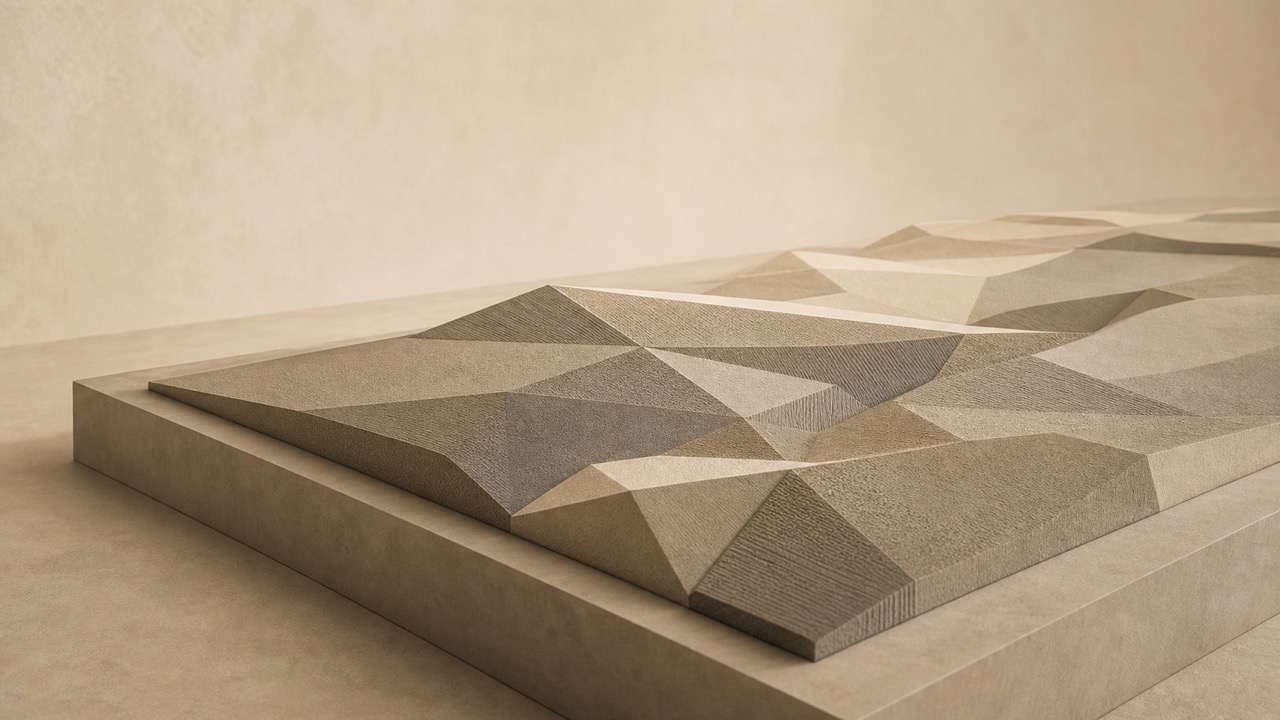
In 2015, the Museo del Prado mounted a small and unusual exhibition. It was titled 'Hoy toca el Prado' (Today, Touch the Prado) and consisted of six paintings from the collection reproduced in relief, with textures and volumes of up to six millimetres, so that they could be explored with the hands: a Velázquez, a Goya, a Greco, a Correggio, a still life by Van der Hamen, and the Mona Lisa from Leonardo’s workshop. Three of them were at full scale. Alongside each, there was an audio guide, braille, and a guided route for the hands. It remained open for nine months and has since travelled across half of Spain.
Major museums now maintain similar programmes. The Metropolitan offers verbal description tours and a specific collection that may be touched. The MoMA operates a programme based on description and conversation. The Louvre publishes braille booklets that include dimensions and material samples. Tate organises monthly tactile tours of three works. It is a consolidated field, supported by standards, professional guides, and significant research.
I could write about this in a celebratory tone, yet it would be a facile and rather futile text. I am interested in something else: what this work reveals regarding a question that is not one of accessibility, but of substance. What exactly it means to perceive a work of art. For centuries, we have taken for granted that it is to see it, and these programmes compel us to verify whether that is true.
The obvious temptation is to assume that relief translates: that if a painting is converted into volume, the hand receives what the eye would receive. It is precisely here that research and testimonies concur in saying no. Georgina Kleege, a writer, university professor, and blind person, wrote in a Tate publication something worth citing, as it comes from one who possesses the experience rather than one who assumes it: that many tactile tours fail precisely because they assume a perfect analogy between the touch of a blind person and the sight of a sighted person, as if placing one's hand upon a surface automatically generated a mental image. She adds something even more disquieting: that such tours often leave participants feeling rushed, exposed, and uncertain as to what they are expected to derive from the experience.
Empirical research points in the same direction, without drama. Identifying a line drawing in relief proves difficult, with low success rates and long durations, because touch gathers information sequentially and fragmentarily: there is no tactile equivalent to a glance; there is a journey that must subsequently be integrated. Matters improve significantly with texture rather than line, with prior verbal context, and with practice. Furthermore, studies suggest that, at times, a cutout communicates a form more effectively than a relief, which dismantles the intuition that merely lifting a drawing from a plane is sufficient.
Consider the implications of this, for it is not what it seems. It does not suggest that touch is a poor substitute for sight. It suggests that touch is not a spare sense: it is another form of access, with its own conditions, and to evaluate it by its resemblance to vision is to measure it with an inappropriate standard. The error does not lie in the hands. It lies in the assumption that the only legitimate way to receive a work of art is the one shared by the majority.
Once that assumption is removed, the interesting aspect emerges. A recent study interviewed twenty-one people with acquired blindness as they explored a Castellani surface with their hands, and documented how, following an initial difficulty in interpreting the stimulus, imagination, personal memories, and the construction of meaning appeared. That is not the recognition of a figure; it is an aesthetic experience, of the same nature that anyone would describe when confronted with a work that resonates with them. There was no translation of the image. There was an encounter with a surface, which is, at its core, what is always present.
Audio description reveals the same tension from the other side. Best practice dictates describing what is perceptible rather than interpreting: one should not state that a woman is sad, but rather that she is reading a letter, lets it fall, and covers her face. The rule is sound, for to interpret on behalf of another is to deprive them of the work. Yet in a museum, this line is impossible to maintain entirely: choosing what to describe first, what to mention, and what to omit constitutes an interpretation in itself. There is no neutral description, just as there is no neutral lighting. What the guidelines require, when properly understood, is not an impossible objectivity, but rather not closing off the work: providing sufficient material for the other to interpret, rather than delivering the interpretation pre-formed.
And this is where the matter ceases to be one of accessibility and becomes a matter for everyone. For the exact same criticism may be levelled at a caption beside a painting, an audio guide in the ear of a sighted visitor, or a critic who explains a work before one has had the opportunity to view it. There, too, the risk is substituting the encounter for its already digested version. Accessibility does not pose a separate problem: it poses, with greater clarity because it cannot conceal it, the perennial problem.
I shall retain what accessibility teaches unintentionally. That there is no privileged channel that delivers the entire work, not even our own. That viewing a painting is also a partial access, conditioned by light, distance, fatigue, what we know, and what we expect. And that asking what is lost when a painting is traversed with the hands compels one to ask, immediately thereafter, what is lost when it is traversed with the eyes—a question we almost never pose because we take for granted that nothing is missing there.
On open conversation
This text does not speak on behalf of anyone: it is supported by documented programmes, peer-reviewed research, and published testimonies from blind individuals, and its question is not how others perceive, but what accessibility reveals about what it means to perceive a work. It is a matter I have been working on from another angle, that of whether human perception is the yardstick by which to measure any other mode of access. If anyone wishes to intervene from the perspective of museum accessibility, audio description, research into haptic perception, or personal experience as a visitor, this notebook remains open, and in this instance, with greater cause.
Sources
Museo Nacional del Prado. Hoy toca el Prado (20 January – 18 October 2015). Relief reproductions using the Didú technique (Estudios Durero).
The Metropolitan Museum of Art, MoMA (Art inSight), Smithsonian American Art Museum (America InSight), Musée du Louvre, and Tate: programmes for blind and low-vision visitors.
Kleege, Georgina. Tate Etc., 8 September 2022.
Vinter, A., Orlandi, O. and Morgan, P. “Identification of Textured Tactile Pictures in Visually Impaired and Blindfolded Sighted Children”. Frontiers in Psychology, 2020.
Kalia, A. et al. Multisensory Research, 2014 (reliefs versus cut-outs in the communication of form).
Uboldi, S. et al. (2025). Study on the tactile aesthetic experience of people with acquired blindness regarding the work of Enrico Castellani.
Li, F. et al. Proceedings of CHI 2023 (interviews and survey on access to visual art).
ADLAB (2011-2014); VocalEyes; American Council of the Blind, Audio Description Guidelines and Best Practices (v3.1, 2010).