
When the Vatican Museums concluded, in 1994, fourteen years of cleaning the frescoes of the Sistine Chapel, the world encountered a Michelangelo it did not expect. Beneath centuries of candle soot, brazier smoke, animal glue, and overpainting from previous restorations, an explosion of colours appeared: pinks, acidic greens, luminous yellows, far removed from the solemn gloom that entire generations had admired as “the” Michelangelo. For many, it was a revelation. For others, a disaster. And the discussion that opened then is not, at its core, a discussion about cleaning technique. It is a question that permeates all restoration and which we almost never formulate with clarity: when we restore a work, to what state exactly do we return it?
For a work bearing the weight of centuries does not possess a single original to which one may return. It possesses many. There is the work that left the artist's hands on the day they deemed it finished, which we almost never know with certainty. There is the work as it was seen by its contemporaries, already subject to change. There is the work that aged, darkened, became covered in varnishes that shifted and in retouching from other eras, and which for generations was the version the public knew and loved. And there is the work that technical analysis allows us to imagine beneath all those layers. When a restorer intervenes, they must choose which of all those states they consider the true one. And that choice, however informed it may be, is not dictated by the work: it is made by a person.
The case of the Sistine Chapel illustrates this in its most acute form. A faction of specialists maintained that, by removing the grime, the cleaning may have stripped away glazes and shadows that Michelangelo himself had applied in secco, upon the dried fresco, to refine the volumes. The Vatican restorers denied this: what was removed, they argued, was dirt and subsequent additions, not the artist's own hand. I shall not enter into who was correct; it is likely impossible to know entirely. What concerns me is the nature of the decision. If those layers were Michelangelo's, removing them was to erase the artist in the name of recovering him. If they were dirt, leaving them would have been to conserve the deterioration rather than the work. Faced with the same surface, two opposing ideas of what constituted 'the original', and only one possible, irreversible intervention, which had to be executed in one direction or the other. There was no neutral option. To clean was to decide; not to clean, likewise.
This is not exclusive to the Vatican. In the mid-twentieth century, the National Gallery in London experienced its own 'cleaning controversy': critics accused the gallery of stripping away, along with the yellowed varnishes, the final glazes with which the old masters had muted and harmonised their colours. The gallery maintained that it was merely removing filth and oxidised varnish. The disagreement, once again, was not about whether to clean well or poorly, but about where the dirt ends and the work begins. A boundary that appears objective yet is not, because it depends upon which version of the painting one has decided to treat as the authentic one.
Serious restoration understands this, and for that reason, it has established rules to avoid deception. The Venice Charter, the great code of 1964, establishes two principles which are, in reality, confessions of humility: that restoration must cease where conjecture begins, and that everything added must be distinguishable from the original, so as not to falsify the document. Cesare Brandi, the great Italian theorist, had formulated it a year earlier: to restore is not to complete the work to our own taste, but to re-establish its possible unity without committing either artistic or historical forgery. That which fills a gap must be read as a filler, not passed off as what is missing. These rules do not eliminate the decision; they render it honest. They acknowledge that the restorer intervenes, and they demand that they do not erase the traces of having intervened.
The perfect counter-example, the one that became world-famous for the opposite reason, is the Ecce Homo of Borja. In 2012, an octogenarian local resident without formal training wished to restore on her own initiative a modest Ecce Homo painted a century earlier by Elías García Martínez on the wall of a sanctuary in Zaragoza, and she transformed it into an unrecognisable image that travelled the world. We all laughed, and with good reason. But it is worth examining exactly what went wrong, because it was not merely a lack of brush dexterity. It was that the person who intervened did not ask herself any of the questions that a restorer asks: what was this work, what state had to be respected, where did the boundary lie between conserving and reinventing. She restored without asking herself to which original she was returning, and for that reason, she did not restore: she repainted. The difference between the two does not lie in the skill of the hand. It lies in the awareness that one is making a decision regarding the identity of the work, and in the respect for what that decision should not destroy.
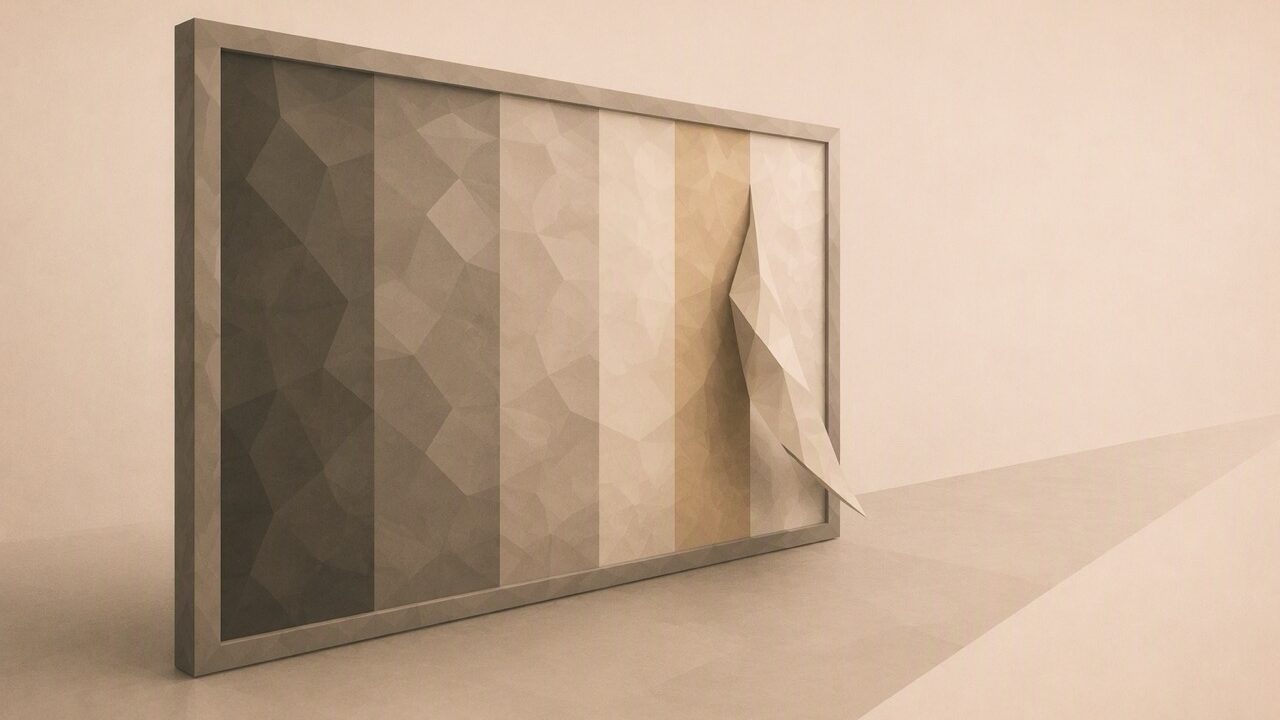
And therein lies what I believe merits reflection, beyond the anecdote. We tend to imagine restoration as a rescue: removing what is superfluous so that what lay beneath may reappear, intact and waiting. As if the true work existed somewhere and one only needed to clear it. But beneath, there is not one single work waiting: all its ages wait simultaneously, and to choose one is to let the others go. Restoration is not the discovery of the original. It is the decision as to which of its lives we declare the authentic one, and the acceptance of the responsibility for that choice. The work does not tell us which is the correct one. It is we who, each time, decide to which version of it we wish to return, and in that gesture, we reveal less about the work than about what we, in each era, believe a work ought to be.
On open conversation
This text intersects with my interest in the identity of a work over time and the decisions, often invisible, that construct it. To restore is not to uncover an original waiting intact, but to choose which of the states of a work is declared the true one, and that choice is a form of discreet authorship. If anyone wishes to intervene from the perspective of conservation-restoration, art history, heritage theory, or museum practice, this notebook remains open.
Sources
Colalucci, Gianluigi. “Michelangelo Buonarroti: Restoration of the Frescoes… in the Sistine Chapel”. Conservation Science in Cultural Heritage 16, 2016. DOI: 10.6092/issn.1973-9494/7166. Restoration Jun 1980 – Apr 1994.
“The Restoration of the Ceiling of the Sistine Chapel”. Encyclopædia Britannica (synthesis of the debate regarding a secco painting).
National Gallery (London), Research Centre Archive, file NG29 regarding the “picture cleaning controversy” (1950-1962); The Burlington Magazine, February 1962, “The National Gallery Cleaning Controversy” (Gombrich, Kurz).
Bergua, J. Á., Serrano, C., Valero, D. and Plumed, M. “Borja’s Ecce Homo: Network, Dialogued Art and Demopoiesis”. European Scientific Journal, 2013.
International Charter for the Conservation and Restoration of Monuments and Sites (Venice Charter), 1964, ICOMOS.
Brandi, Cesare. Teoria del restauro. Turin: Einaudi, 1963.