
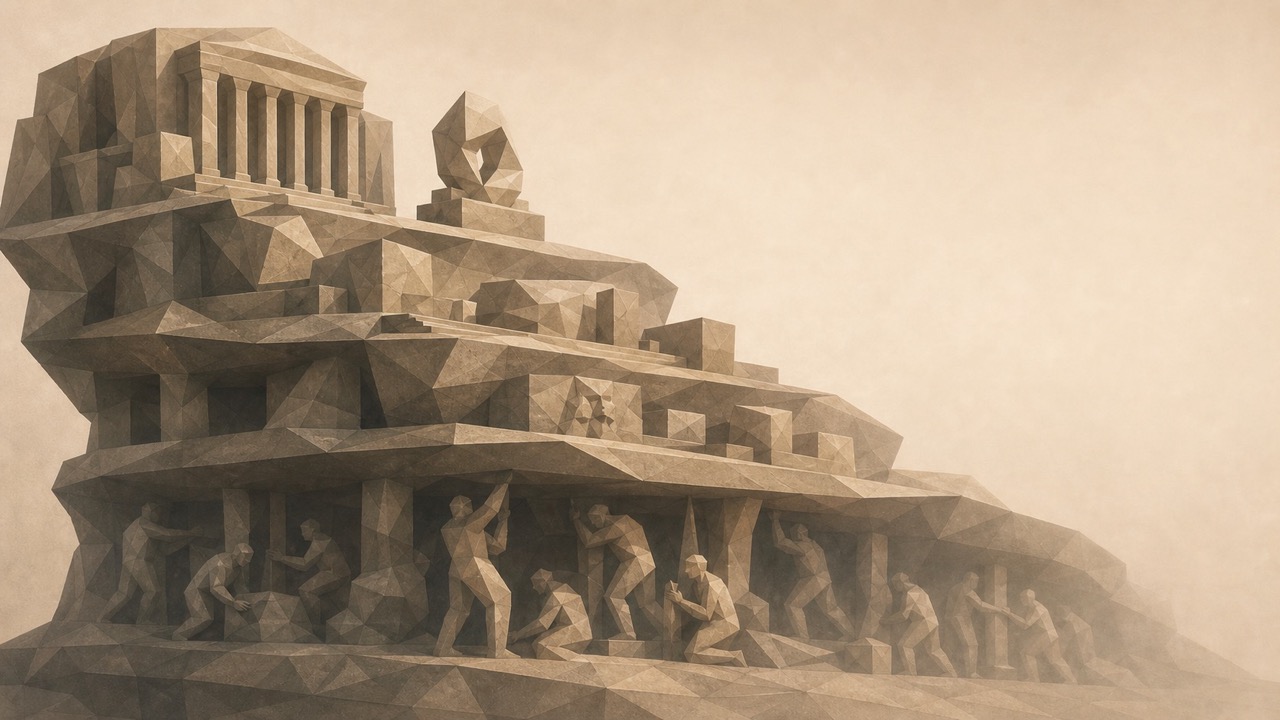
A series from the Public Notebook on culture, ownership, decision-making and labour (2026).
This series grew out of measuring the health of culture by what it exhibits or by its turnover. An exhibition can be critical of the market and operate within it without so much as grazing it. Criticism, as content, is easily incorporated. What is not absorbed so readily is a different way of organising ownership, decision-making and labour. Hence the question running through all six texts: which forms of culture resist absorption by the logic of optimisation, and where that is decided.
The first text sets out the framework. The others put it to the test, moving progressively closer to the concrete conditions of decision-making and labour: the international art market, a city’s cultural policy, the care work that keeps organisations going, a province’s cultural programme and, finally, contracted work in specific museums. Three of them deal with Málaga and its province, where I live and work, because a general question can only really be tested against specific documents.
The texts on Málaga draw exclusively on public documents I was able to locate: agreements, press releases, case files, contract awards, catalogues and official registers. I did not file any freedom of information requests to write them. That limits what they can claim, and the series accepts as much. When something does not turn up, I report it as the result of a search, not as proof that it does not exist. In each case I distinguish verified fact, inference, counter-example and documentary gap.
The same asymmetry appeared, in one form or another, at every level. Amounts, contracts and infrastructure are visible. Who decides, who stays and under what conditions people work is far harder to reconstruct, or cannot be reconstructed at all. An international brand secures ten years of predictability, while a 2025 call for proposals funds cultural businesses’ projects within a single financial year. A provincial programme is published without the information located making it possible to reconstruct the rules by which it is allocated. A museum service is contracted with precise figures, yet its staffing structure cannot be examined from the documents retrieved.
The series does not turn documentary gaps into evidence of irregularity. What it shows is that an essential part of cultural policy cannot be examined from outside with the information available. That limitation bears on accountability, even though it does not in itself demonstrate any malpractice.
The questions also apply to whoever asks them. I chair a cultural foundation, and in ‘Culture in Málaga and the distribution of duration’ I put on record that its future activities must meet the same criteria. In ‘The work that sustains culture and appears in no data’ I acknowledge the visible position from which I write. A critique of the circuit that exempts its author in advance becomes content once again.
Each text can be read on its own. Read in order, they form a descent: from the general framework to the labour that sustains it.
- Against the optimised life: which forms of culture resist incorporation – Sets out the series’ criterion: whether a cultural practice escapes absorption depends not only on what it says but also on the circuit in which it is produced and circulates. It asks who owns the infrastructure, who decides what circulates and who does the work.
https://juanesteban.art/en/culture-of-optimisation/ - Faster than the courts – Starts from Christie’s ‘Augmented Intelligence’ auction, held between February and March 2025 despite a protest letter from artists. The controversy did not dent the result. The market gave these works the stamp of normality before the law had ruled on them.
https://juanesteban.art/en/faster-than-the-courts-ai-art-auction-christies/ - Culture in Málaga and the distribution of duration – Drawing on municipal documents, compares the contract with the Centre Pompidou running to 2035 with the 2025 grant scheme for cultural businesses, the purchase of works for the future MUCAC and the Soho programme. It does not claim that any spending was diverted from one item to another. It examines which relationships are given continuity and which have to start again with each call for applications.
https://juanesteban.art/en/culture-in-malaga-and-the-distribution-of-duration/ - The work that sustains culture and appears in no data – Brings to the cultural sector the concept of non-promotable work, measured in corporate and financial settings. I have not found an equivalent measurement in Spanish museums and foundations, and that absence is the core of the text: the lack of data does not prove inequality, but it makes it impossible to check.
https://juanesteban.art/en/non-promotable-work-culture/ - Who decides culture in Málaga’s towns and villages – The Provincial Council runs a documented cultural programme across several municipalities. From the public information located, however, it is not possible to reconstruct who proposes, selects, approves and funds each activity. The text does not claim that decisions are made badly; it asks for the rules to be published.
https://juanesteban.art/en/who-decides-cultural-policy-malaga-towns/ - Málaga Museums: the contract is traceable, but working conditions are not – Closes the series at its foundation: labour. The amount, duration and duties of the visitor-management contract for three municipal museums, and of the file approved for mediation and education, are known, but not their staffing structure. It does not allege precarious employment. It points to the part of cultural policy that cannot be examined from outside.
https://juanesteban.art/en/malaga-museums-cultural-policy-contract-labour/
Corrections and contributions
The series remains open to contributions from people working in cultural management, public procurement, administrative law or within the institutions examined. If any information has changed or can be supplemented with public documents, I will add it and note the date of the correction.