On Wednesday, 12 August 2026, a total solar eclipse will cross Spain: the first visible from the Iberian Peninsula in over a century, according to the National Geographic Institute. It is an opportune moment to recount something I find most compelling regarding the phenomenon: that for centuries, European painting represented an eclipse that could not occur as a natural phenomenon, and that in the learned circles where many of these programmes were conceived, this impossibility was known and documented.
The motif appears in countless Crucifixions: above the cross, the darkened sun, the moon intervening, night at midday. It originates from the gospels, which describe a darkness over the earth during the agony of Christ. And the word printed in critical editions of Luke belongs to the Greek family of ἐκλείπω, which can mean to fail, to fade, or, in certain contexts, to be eclipsed. Hence, every time an eclipse approaches, it is repeated in articles and reports that the gospels recount that one occurred.
The problem is that such an eclipse does not fit the calendar. The Jewish Passover is fixed at the full moon, and a solar eclipse can only occur at the new moon, when the Moon interposes itself between the Earth and the Sun. This is not a discussion about the exact year the Crucifixion occurred: it is an incompatibility of celestial mechanics.
What makes this matter fascinating is that tradition knew this very early on and stated it in writing. Augustine, in the fifth century, formulates it with a clarity that leaves no room for doubt: it was the Passover of the Jews, which is only celebrated at the full moon, and according to the calculations of astronomers, it is certain that the sun cannot be eclipsed when the moon is full. Eight hundred years later, Thomas Aquinas collected this argument in his compilation of evangelical commentaries, with the same conclusion: that darkening did not occur in the regular course of celestial bodies.
And it was not just theology. John of Sacrobosco, whose treatise on the sphere was a university manual for centuries, wrote that that eclipse was not natural, but miraculous and contrary to nature, given that a solar eclipse should occur at or near the new moon. Albertus Magnus subjected the question to examination. The fact circulated in lecture halls.
There is also a layer that I find revealing, and it occurs in the transmission of the text itself. The majority reading of the manuscripts of Luke does not say that the sun was eclipsed, but that it was darkened, a flatter formula. Specialists in textual criticism consider it the easier reading, substituted by copyists, and one of the most widespread critical apparatuses points out the reason with precision: it avoids the problem of implying an eclipse. We do not know what each copyist thought; the result, however, is clear: the manuscript tradition ended up imposing the safer formulation.
So we have four distinct reactions to the same problem. The evangelist uses a word that sounds like an eclipse. The copyists downgrade it. The theologians and astronomers declare that an eclipse there is impossible. And the painters paint it.
That fourth reaction is the one that interests me, because it is not an oversight. I cannot know what each painter knew standing before their panel, and I will not pretend to; I do know that the motif was formed and sustained in spheres where the impossibility was written, and that within that order, the impossibility was the content. A possible eclipse is celestial mechanics. An eclipse at full moon is a rupture of the law of the heavens, and that is what the image affirmed: that the death of that man had disordered the mechanism of the world. The painting did not represent a sky. It represented its suspension.
There is a French case that demonstrates this in an almost comical way. A medieval miniature illustrating the life of Saint Denis represents the eclipse of the Crucifixion by combining two diagrams taken from 13th-century astronomy manuals. The study that analyses it highlights that the result is a scientifically rigorous representation. Scientific rigour placed at the service of graphing something that science itself declared impossible. The contradiction was not a problem for them: it was the meaning.
In Spain, there are first-rate examples. In Vitoria-Gasteiz, the institutional entry for the crucified Christ by Ribera—housed in the Diocesan Museum of Sacred Art, with a deposit linked to the Provincial Council of Álava—describes the moon about to obscure the sun, evoking the eclipse that occurred as the Saviour expired. In the Thyssen, a Crucifixion by an anonymous 15th-century Valencian artist is preserved, which the National Geographic Institute points to as an example of the motif, although that reading is theirs and not from the museum's entry. And in the Library of El Escorial, within the section dedicated to Astronomy in the fresco programme by Pellegrino Tibaldi, is the most explicit version: Dionysius the Areopagite observing from Heliopolis, astrolabe in hand, the impossible eclipse. The identification of the scene comes from the bibliography on astronomical instruments, not from the general entry of National Heritage.
One must separate here two things that resemble each other and are not the same, because it is the most common error when speaking of this. The Sun and the Moon flanking the cross form an autonomous iconographic motif, documented since the sixth century, with its own meanings: the sovereignty of Christ over the cosmos, the mourning of the universe, and later typological readings that interpret them as the Old and New Testaments or, from the ninth century onwards, as the Church and the Synagogue. Not every sun next to a cross is an eclipse. The eclipse is a different tradition, more problematic and theologically debated, and one can only speak of it when the image shows the obscuration.
The figure that Tibaldi paints merits a separate paragraph, as his history repeats that of the entire motif in miniature. Dionysius is attributed an exclamation upon seeing the sky darken: either the God of nature is suffering, or the machinery of the world is dissolving. It is the phrase that gave density to the matter and which commentators have repeated for centuries. And it is an assemblage. The Dionysius who authored the corpus bearing his name is not the Athenian convert from the Acts, but a writer from the fifth or sixth century. The phrase is not his either: its first half originates from a twelfth-century commentator, with an earlier echo in a ninth-century text, and the second from that astronomy treatise predating 1220. Someone joined them together, and the resulting whole ended up in the mouth of a first-century figure who did not speak them and who was not who he claimed to be.
Calling all this fraud would be too simple: it is more precise to speak of pseudoepigraphy and attributed authority, categories with which medieval culture operated normally. Those images did not intend to document, and judging them by their fidelity to a real sky is to apply a yardstick that did not exist. What they did was to figure: to make visible an assertion about the order of the world. Their astronomical impossibility did not weaken them. It sustained them.
The triad of eclipses crossing Spain between 2026 and 2028 led me to paint my own, and it is here that this text ceases to be art history.
Zona de umbra is a vertical canvas dominated by a large, dense, near-circular black mass that occupies a significant portion of the painting. To its right, a curved, interrupted, and rugged strip of golden light emerges, descending until it fragments into small glimmers. The background does not reach pure black: there are bluish and greyish glazes where the light from the edge appears to expand. The surface possesses relief, drag marks, and accumulations of material that form furrows and fissures, and on the left side of the disc, near-organic strokes envelop it like bark. The darkness is not flat: it possesses weight and internal movement.
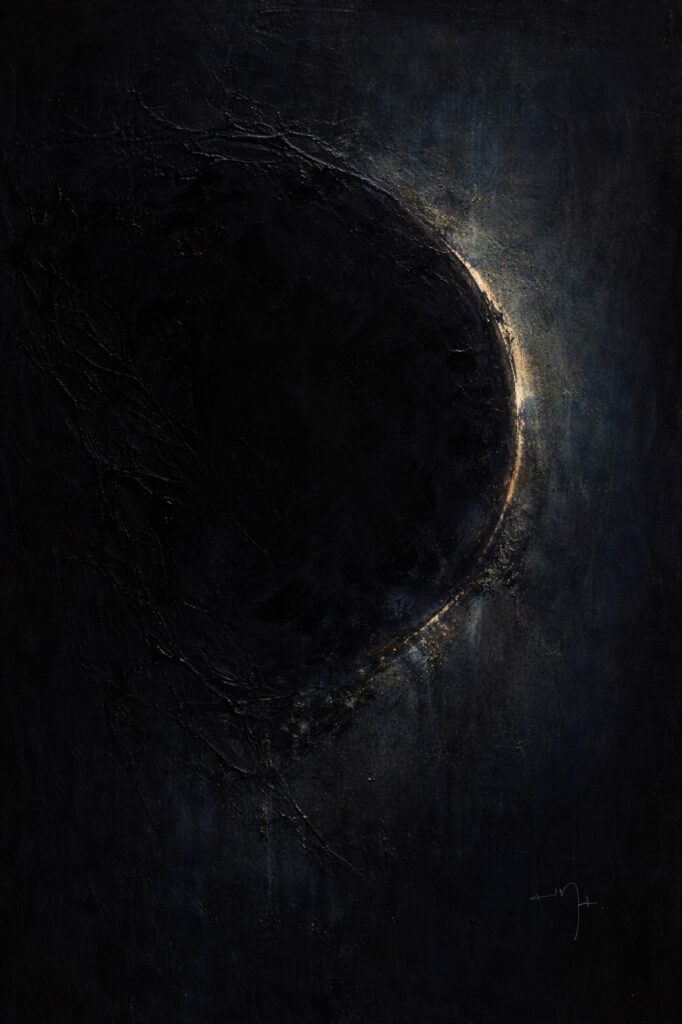
‘Zona de umbra’, mixed media. Juan A. Esteban, 2026.
It does not seek to represent the eclipse: it seeks the umbra, the instant in which light is almost annulled and survives as an edge.
It is not a witnessed eclipse. It is the umbra: the instant in which light is almost annulled without disappearing, surviving as an edge, as a wound. I was not interested in competing with the precise recording of the phenomenon; I was interested in that threshold experience where the shadow weighs heavy and something, in the depths, continues.
I draw a distinction from the aforementioned, as equating them would be disingenuous. The Crucifixions affirmed a fact within a theological order where impossibility functioned as proof. My painting affirms nothing regarding the heavens, and no one will look to it to understand the nature of the August eclipse.
Where they coincide, six hundred years apart, is in the fact that neither of them records. Painting was never merely that, not even when it appeared to be. What it does with an eclipse, then and now, is use it to render something else visible: in the fifteenth century, the breakdown of the entire universe in the face of a death; in a contemporary studio, the weight of a darkness that one can almost touch.
On Wednesday, we shall all point our mobile devices at the sky, and the recordings will be exact. They will register the position, the duration, the corona. And we shall continue, moreover, to paint, as we have done for centuries.
On open conversation
This text intersects with a line of enquiry I pursue here: the difference between what an image records and what it makes visible. The eclipse of the Crucifixion is an extreme case, because the astronomical impossibility was known; it was written in the manuals and not only did it not prevent the representation, but it provided its foundation. I incorporate a work of my own at the end, Zona de umbra, not as an illustration but because the problem compelled me to paint it. If anyone wishes to intervene from the perspectives of art history, astronomy, medieval exegesis, or the practice of painting, this notebook remains open.
Sources
Luke 23:44-45. Critical text: SBL Greek New Testament (2010) and Tyndale House Greek New Testament (2017). Regarding the textual variant: Bruce M. Metzger, A Textual Commentary on the Greek New Testament, 2nd ed., Deutsche Bibelgesellschaft / United Bible Societies, 1994; and the textual note of the NET Bible on Luke 23:45.
Augustine of Hippo, Letter 199 to Hesychius.
Thomas Aquinas, Catena Aurea in Lucam, commentary on Luke 23:44-46.
Johannes de Sacrobosco, De sphaera mundi, Paris, ca. 1230-1231. Reference edition: Lynn Thorndike, The Sphere of Sacrobosco and Its Commentators, University of Chicago Press, 1949.
Schwarz, Martin. “Illuminating the Crucifixion Eclipse in the Vie de Saint Denis”. Codex Aquilarensis (2025).
Labrador González, Isabel M. and José M. Medianero Hernández. “Iconología del Sol y la Luna en las representaciones de Cristo en la cruz”. Laboratorio de Arte 17 (2004), pp. 73-92. DOI: 10.12795/LA.2004.i17.03.
Ferber, Stanley. “Crucifixion Iconography in a Group of Carolingian Ivory Plaques”. The Art Bulletin.
Index of Medieval Art, Princeton University. “The Iconography of Darkness at the Crucifixion” (2018).
Museotik / Basque Government. Record for Christ Crucified, José de Ribera. Diocesan Museum of Sacred Art, Vitoria-Gasteiz; deposit linked to the Provincial Council of Álava.
Museo Nacional Thyssen-Bornemisza. Record for the Crucifixion by an anonymous 15th-century Valencian artist. Interpretation of the motif: National Geographic Institute.
Patrimonio Nacional (general programme of the frescoes by Pellegrino Tibaldi in the Royal Library of El Escorial); Relojes de Sol de Madrid, Community of Madrid, pp. 510-512, for the identification of the scene of Dionysius the Areopagite in the Astronomy section.
Regarding the genealogy of the phrase aut Deus naturae patitur, aut mundi machina dissolvetur: Peter Comestor, Historia scholastica (12th century), and Johannes de Sacrobosco, De sphaera mundi.
Esteban, Juan A. Zona de umbra. https://juanesteban.art/zona-de-umbra/