
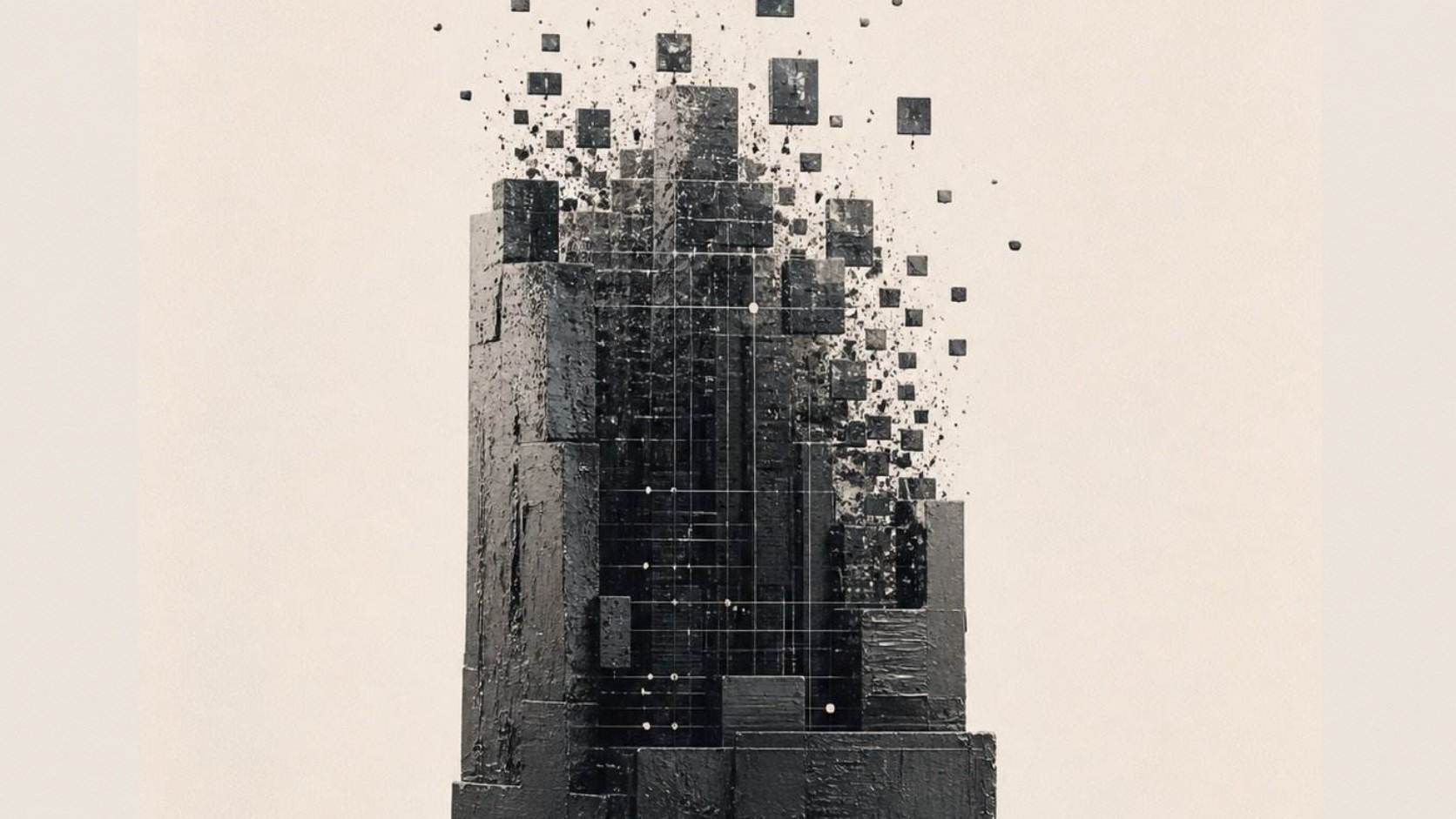
Foundation, one of the invitation-only tokenised art platforms within the Ethereum ecosystem, has gone offline indefinitely after failing to secure a buyer. The platform attributes this decision to a financial and operational reality that precluded the resumption of service with any guarantees. What follows is an assessment of the current situation, distinguishing between data-supported facts and reasonable inferences.
This closure is not an isolated incident. It is consistent with a market that the 2025 Art Basel/UBS report describes as being in general recovery ($59.6 billion in global sales, following two years of decline), albeit with segments where the adjustment has been abrupt and where the speculative foundation of 2021-2022 no longer finds support. That final assertion, as applied to tokenised digital art, is not an opinion: it is what the datasets from DappRadar, Chainalysis, and recent major sector reports demonstrate.
Macro and segments
Geographic concentration remains extreme. In 2025, according to UBS/Art Basel, the United States, the United Kingdom, and China accounted for 76% of the global art market value. In Europe, available data indicate growth in Switzerland, Austria, France, and Spain, with slower dynamics observed in Germany and Italy.
By sector, the 2024 auction series are conclusive. Old Masters fell by 25% to $803 million; Impressionist and Post-Impressionist art by 17% to $1.2 billion; Modern art by another 17% to $2.2 billion. Three of the four lots exceeding $10 million were European Old Masters. The adjusted reading, without extrapolation, is that the deceased artists segment remains supported by scarcity and provenance, within a market more volatile than it appeared two years ago.
El contemporáneo vivo presenta otro perfil. Las ventas de “Contemporary art” en subasta cayeron un 36% en 2024 hasta 1.400 millones, y la obra creada en los últimos veinte años se quedó en el 23% del valor del sector, frente al 34% de 2021. Por el lado de la demanda, la encuesta a HNWI publicada en 2025 sitúa en el 20% el peso de las compras directas a artistas en el gasto de los encuestados, y en el 66% la proporción que adquirió obra de creadores recién descubiertos. Conviene recordar el método: son datos de encuesta a coleccionistas de alto patrimonio, no del mercado en su conjunto. Con esa salvedad, lo que se observa es una recalibración hacia precios más contenidos, descubrimiento y trato directo, no un abandono del segmento.
Digital art and NFTs, without conflating terms
This is the area where lexical imprecision causes the most distortion. Digital art encompasses computational, generative, video, installation, and software art, as well as physical-digital hybrids. The NFT is, in essence, infrastructure for ownership and traceability on the blockchain, not an artistic medium. The distinction is significant because the data for each diverges.
DappRadar records a contraction in the Art NFT market from $2.9 billion in 2021 to $197 million in 2024 and $23.8 million in the first quarter of 2025. In the second quarter, volume fell by a further 51%, yet the number of sales grew by 400%. This series is consistent with a market that is more affordable and atomised, not one facing extinction. In parallel, there are signs of institutional absorption: the MoMA, Centre Pompidou, and LACMA have incorporated digital and/or blockchain works into their programmes and collections (as noted by Art Basel in its report on digital art and NFTs); Christie's raised $728,784 in its first auction dedicated to AI-generated art, with 37% of registrants being new to the house and 48% being millennial and Gen Z bidders. The data are as cited; the reasonable inference is that the canonisation phase is beginning and that the digital ecosystem is surviving the collapse of the NFT, albeit in a displaced form.
Foundation: what is falling and what is not
The front-end, discovery, services, and curation guarantee may fail. On-chain ownership of minted works does not automatically fail, as the token resides in the contract rather than the website. Two points warrant clarification. First, depending on the specific minting model (shared contract or collection-based), the portability of the asset to other marketplaces may vary. Second, the persistence of the associated file (the image, video, or metadata) depends on the storage method: IPFS with platform-managed pinning, Arweave, or proprietary infrastructure. Should the platform cease to maintain the pinning, files may become inaccessible even if the token persists. For authors, this renders traceability and archiving a personal, non-delegable task, which should be resolved before the associated infrastructure expires.
Tezos and the question of the future
Tezos, con OBJKT como mayor marketplace, tiene una propuesta orientada a costes bajos y a comunidades menos especulativas; la propia Tezos Foundation reportó ventas récord en su vertical de arte y cultura en 2025. A la vez, el grueso histórico del NFT se ha minteado en Ethereum, y Solana y Polygon ganan peso. Sobre esa base, decir que Tezos será “el” futuro del arte digital es inferencia que va por delante de la evidencia. Decir que es uno de los entornos más coherentes para un nicho menos especulativo es inferencia que la evidencia sí apoya.
AI: tool and category
The 2025 Adobe survey of 16,000 creators indicates that 86% already utilise generative AI, primarily for editing and enhancement (55%), asset generation (52%), and ideation (48%). This figure should be interpreted without extrapolation: the sample is biased towards creators already integrated into the Adobe ecosystem, which inflates the results. Nevertheless, the order of magnitude remains consistent with other recent sector studies. As an artistic market category, AI-art remains modest in added value (the dedicated Christie’s auction raised 728,784 dollars; an Ai-Da work exceeded one million at Sotheby’s), yet it possesses institutional visibility and increasing media attention.
UNESCO provides the macro context: digital income now accounts for 35% of creators' earnings (compared to 17% in 2018), and the organisation projects potential losses of 24% in music and 21% in audiovisual sectors by 2028 due to generative AI. Only 12% of countries have updated their copyright legislation to address AI-generated content. The quantified portion pertains to the projected loss and the regulatory figure; the reasonable inference is that the productivity of AI arrives before the rules that govern it, and that this asymmetry tends to concentrate value in those who control the infrastructure.
Economic peripheries and the myth of the NFT as a bridge
La idea de que el NFT habría democratizado el mercado del arte para creadores del Sur Global no está respaldada por los datos disponibles. Esto no equivale a “está refutada”, pero sí la deja sin sustento empírico significativo. Lo que Chainalysis sí documenta es la utilidad del cripto en mercados emergentes, pero como infraestructura monetaria: pagos, ahorro, remesas. Reporta un crecimiento interanual del 52% en África subsahariana, con Nigeria entre los líderes globales en adopción, y avance de stablecoins en América Latina. Es información sobre adopción cripto, no sobre coleccionismo artístico. Las brechas que sí afectan al arte digital están en otras variables: competencias digitales esenciales (67% de la población en países desarrollados frente al 28% en países en desarrollo, según UNESCO) y movilidad internacional (96% de los países desarrollados apoyan la movilidad saliente, frente a solo el 38% que facilita la entrante desde países en desarrollo).
Digital euro
According to the ECB, the preparation phase concluded in October 2025 and, should European legislation progress in 2026, issuance could occur in 2029. The project is explicitly designed as a daily means of payment, complementary to cash and private solutions, rather than as an investment or store of value. By design, it does not resolve the bottlenecks of digital art (technical provenance, preservation, rights, licensing, sustained cultural demand). This is an interpretation of the design documented by the ECB, not speculation.
Collecting and an unmeasured metric
The 2025 UBS/Art Basel survey of HNWIs records an average allocation of 20% of wealth to art (compared to 15% in 2024) and an 84% stated optimism. Concurrently, the total market recorded 40.5 million transactions in 2024 (+3%), with dealers generating less than 250,000 dollars in turnover seeing sales growth, and 44% of buyers being new to the dealers (50% for the smallest ones). The tension between the aggregate figure and the transactional base suggests that recent market expansion is driven more by low entry points and turnover than by a redistribution of economic weight. This is an inference, albeit a well-supported one.
Alongside this, an asymmetry warrants declaration: the WHO estimates 1.3 billion people live with significant disability, approximately 16% of the global population. Sectoral data regarding artists with disabilities is scarce in market terms, though much more robust regarding access, cultural policy, and employment. This asymmetry is, in itself, a datum: what is not measured is rarely valued. The observable transition points toward a shift from a welfare model to one of cultural rights, professionalisation, and accessibility, yet the market curve has not yet captured this transition.
Synthesis with confidence levels
The most robust data points: the conventional market continues to concentrate value in high net worth and three geographies; contemporary living art is undergoing price recalibration and remains dependent on discovery; the Art NFT market has collapsed in added value, without disappearing in terms of sales volume.
Medium confidence: the phase of institutional absorption of digital art, beyond mass minting, appears to be consolidating; AI as a tool is now transversal to creative workflows, despite the bias in the surveyed samples.
Low confidence or subject to verification: that Tezos will become the stable centre of the next digital art cycle; that recent institutional openness, including the interpretation that Venice is treating so-called protocol art as a subject rather than a laboratory eccentricity, marks a sustained shift in cultural validation; that the entry of AI into the market will redistribute value rather than concentrate it further.
Open limitations
No existe una base pública única que separe limpiamente, a escala global, artistas vivos y fallecidos a la vez que distingue entre mercado primario y secundario y entre países desarrollados y no desarrollados. Los datos sobre periferias, discapacidad y arte digital están mucho mejor medidos en términos de acceso, política cultural y adopción tecnológica que en ingresos artísticos comparables con los grandes centros. La consecuencia honesta no es “no pasa nada”, sino “el sistema todavía mide mal a los creadores periféricos”.
Foundation closure
What the closure of Foundation makes visible is not new: a more rigorous selection phase, a distinction that must be maintained between digital art and NFTs, and a market that is not sustained by euphoria and has yet to find another narrative. The operational question, for both authors and institutions, is no longer whether platforms such as Foundation will endure, but rather what proprietary infrastructure (traceability, archiving, rights, cultural demand) is being built to ensure independence from their survival.
Sources
[1] Foundation — https://www.foundation.app/
[2] Art Basel / UBS: The Art Market 2025 — https://www.ubs.com/global/en/our-firm/art/art-market-research.html
[3] Art Basel: The Art Market 2025. Auctions — https://theartmarket.artbasel.com/the-art-market-2025/auctions
[4] Art Basel: Survey of Global Collecting 2025 — https://theartmarket.artbasel.com/survey-of-global-collecting-2025/channels
[5] Art Basel: Digital Art and NFTs — https://www.artbasel.com/stories/digital-art-nfts-crypto
[6] Art Basel: Tezos at Art Basel Miami Beach — https://www.artbasel.com/stories/mint-your-own-nft-at-art-basel-miami-beach
[7] DappRadar — https://dappradar.com
[8] Chainalysis: Global Crypto Adoption 2025 — https://go.chainalysis.com/2025-global-crypto-adoption-webinar.html
[9] UNESCO: Creators face projected global revenue losses — https://www.unesco.org/en/articles/creators-face-projected-global-revenue-losses-24-2028-new-unesco-report-shows
[10] Adobe Max 2025: Creators Survey — https://news.adobe.com/news/2025/10/adobe-max-2025-creators-survey
[11] European Central Bank: Digital Euro — https://www.ecb.europa.eu/euro/digital_euro/progress/html/index.es.html
[12] WHO: Disability — https://www.who.int/health-topics/disability