
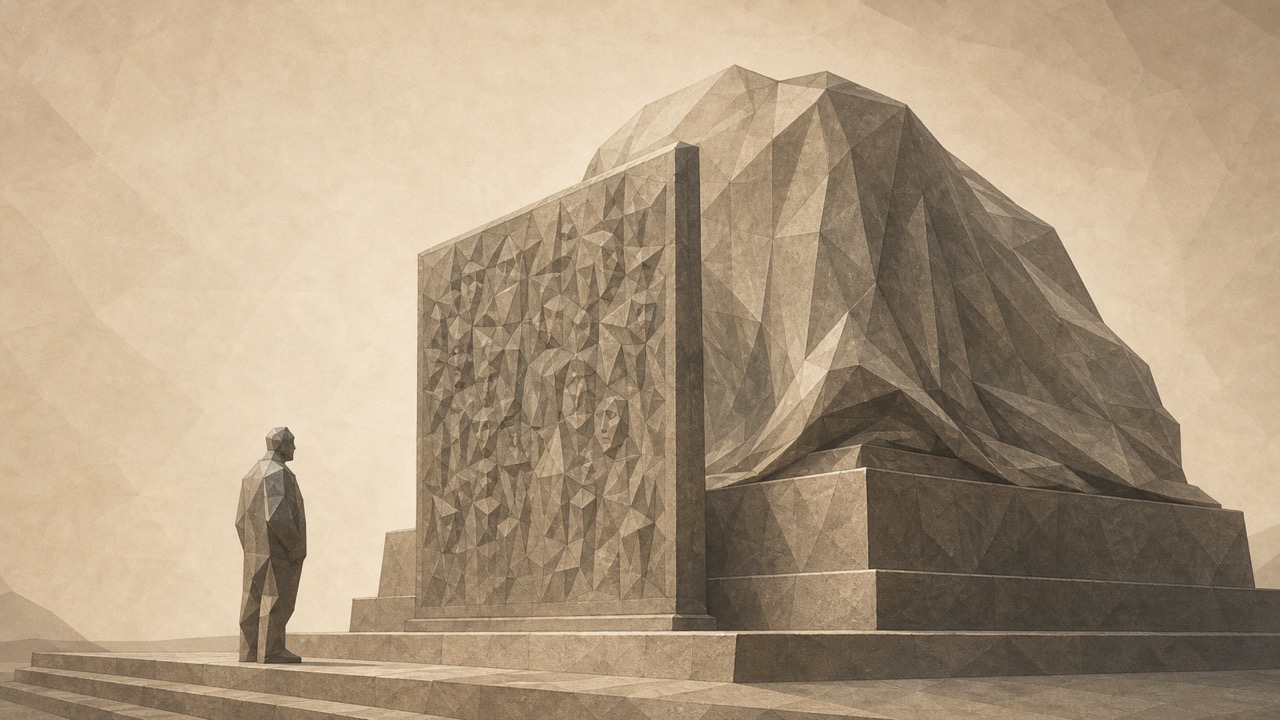
In May 2026, an as-yet-unpublished novel by Olga Tokarczuk had already been read, judged, and half-condemned. Not through its pages, which were unavailable and would not be until the autumn, but through a few translated fragments of a conversation in which the author spoke about the use of artificial intelligence. Before a single reader of the book existed, there was already a public interpretation of how it had been written and a verdict on its legitimacy.
What Tokarczuk recounted at the Impact’26 conference in Poznań was specific and fairly unremarkable: that she had used a language model for research during the preparation of the novel, and she gave as an example a query about which songs characters might have danced to decades earlier. Research, fact-checking: the kind of query once put to an encyclopaedia or an archivist. From this, someone extracted a fragment, translated it, trimmed it, and the trimmed version began to circulate in a different form: the Nobel laureate is writing her novel with artificial intelligence.
On 19 May, the author expressly denied this in a statement through her publisher: she had not written the book with AI or with anyone's help, and had only used those tools for preliminary research and fact-checking. The denial did not undo the story. Two days later, pieces were still being published that presented as a confession what the author had just denied.
Between the work and its audience, a chain was interposed that arrived before the work itself: a fragment of an oral talk, its selection and translation by third parties, an inference about the working method, a moral judgement on that inference, and headlines that fixed that judgement as fact. For weeks, an auxiliary discourse about the novel took the novel’s place.
When the book is published, it will not reach a reader with a clean slate. It will reach someone who already believes they know how it was written, and who will open the volume searching for clues to confirm or refute a narrative formed without the book in front of them. The text will have to compete with its own dossier, and the dossier arrived first.
Those who issued the verdict could not have read the novel, because it could not be read. They were judging a representation of it composed of a fragment taken out of context and an inference about its process. And that representation, not the work itself, is what many readers will carry in their minds when they finally open it.
It happened to a Nobel laureate, with a publisher behind her and the means to issue a denial within a day, and even so the denial did not reach every distorted version. It is worth considering what happens to whatever lacks that backing: the film released already wrapped in its viral verdict, the book whose tone is decided in the first reviews before anyone reads it in full, the exhibition people visit having already read the thread explaining what they ought to think of it. In all these cases, the same displacement operates: an explanation of the work precedes it and occupies the space where it was to be received. We no longer encounter the work first and judge later; we receive the judgement and then, if at all, we look, with the judgement already in place.
I have written previously about the difference between looking first and studying later, and about what is lost when that order is inverted. This case takes the inversion a step further. It is not that we study the work before seeing it: we receive its accusation, its defence, and its verdict before we are able to read it. The interpretive framework no longer accompanies the experience; it precedes it and threatens to replace it.
What is weakened is a condition we once took for granted: that the first contact with a work is with the work itself. That one might form an impression of one's own before being handed one ready-made. Such a reading without a prior dossier may never have been entirely pure, but mediation takes on a different intensity when the narrative surrounding a work consolidates before the thing it describes even exists publicly.
I do not know whether this controversy will benefit or harm Tokarczuk's novel, and nothing can yet be said regarding its content or its quality. What I believe has been lost, and not only for this novel, is quieter: the possibility of a book reaching someone the way books once did, with no antecedent other than its title and its opening sentence. Now books arrive preceded. And sometimes, as in this instance, they arrive preceded by the narrative of a book that no one has read, defending itself against a reading that could not yet have occurred.
About the open conversation
This text starts from an episode in May 2026: statements by Olga Tokarczuk regarding the use of artificial intelligence to research her unpublished novel, misrepresented on social media as if she had admitted to writing it with AI, and her express denial, which did not prevent headlines to the contrary from continuing to be published. I am interested in the operation that this case reveals: that a discourse about a work (a fragment, a translation, an inference, a judgement) arrives before the work itself and takes its place, so that reception takes shape around a polemical representation rather than the text. It continues a reflection I began in 'Look first, study later', carrying it to the point where the dossier precedes the work itself. If anyone would like to weigh in from literary criticism, the sociology of reception, or the experience of publishing, this notebook remains open.
Sources
Statement by Olga Tokarczuk released through her publisher on 19 May 2026, in which she denies having written her novel (then unpublished, scheduled for autumn 2026) with artificial intelligence or with the assistance of another person, and clarifies that she used language models only for preliminary research and fact-checking, verifying their responses. https://lithub.com/olga-tokarczuk-has-responded-to-the-controversy-over-her-reputed-use-of-ai/
Reconstruction of the talk at the Impact’26 conference (Poznań) and the subsequent controversy, Notes from Poland, 21 May 2026. https://notesfrompoland.com/2026/05/21/polish-nobel-literature-laureate-tokarczuk-sparks-controversy-after-admitting-using-ai/
Initial piece regarding the circulation of the translated fragments, later updated to incorporate the author's denial (Literary Hub). https://lithub.com/nobel-laureate-olga-tokarczuk-apparently-used-ai-to-write-her-latest-novel/
An example, cited to illustrate the distortion (not as a source for the facts), of a piece published on 21 May 2026 which, following the denial, continued to present the episode as a confession of writing with AI. https://www.infobae.com/cultura/2026/05/21/la-premio-nobel-olga-tokarczuk-confeso-que-esta-escribiendo-su-nueva-novela-con-ia-y-hay-polemica/
This text refers to the anticipatory reception of the case; it asserts nothing regarding the content or quality of the novel, which is not yet published, nor does it express an opinion on the legitimacy of using AI for research.