
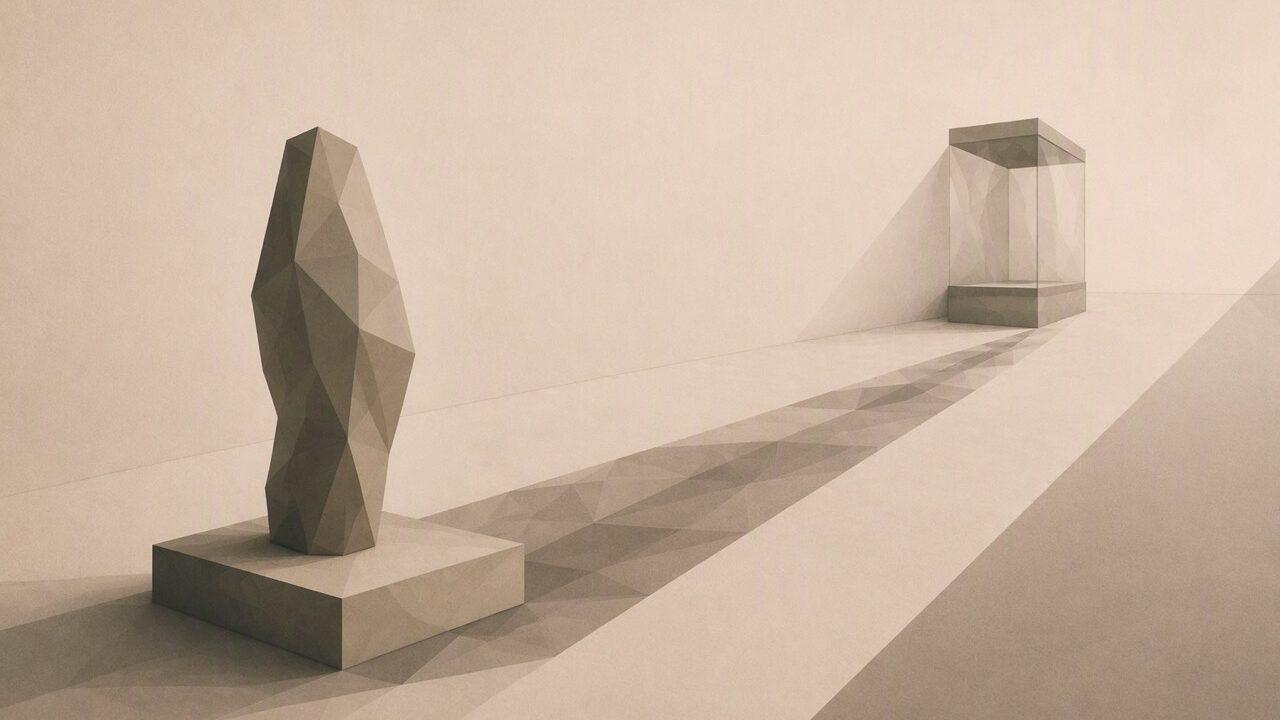
In recent years, we have witnessed a development that seemed unthinkable a generation ago: the return of objects. In 2021, France returned twenty-six works from the royal treasury of Abomey to Benin, which had been seized as spoils in 1892. In 2022, Germany signed the transfer to Nigeria of the one thousand one hundred and thirty Benin Bronzes identified in its public museums, and the initial pieces were flown to Abuja in December of that year. The Parthenon Marbles remain in London, yet even there, where a 1963 Act prevents the British Museum from disposing of its collections, there is now discourse regarding loans and partnerships that, twenty years ago, no one would have articulated aloud.
Whether these objects should be returned is a subject of intense political and moral debate, yet that is not the discourse I wish to initiate here. I am interested in a prior, more quiet question, which the act of restitution exposes and which almost no one formulates: what is it, precisely, that returns. We assume that the object returning is the same as the one taken, and I am not certain that it is.
A Benin Bronze was cast for a royal altar, to fulfil a function within a court and a cult. For over a century in a European display case, it was not that: it was an ethnographic specimen, then a masterpiece of African art, then a symbol of looting and debt. When it returns to Nigeria, it does not return to being what it was. The court for which it was created no longer exists in the form that necessitated it; the world that gave it meaning is not waiting for it intact on the other side of the journey. It returns, but it returns to a different place, and above all, it returns as something else: it is now also the object that was away and has returned. That history—of having been torn away and restored—has remained attached to it and can no longer be removed.
This is not an argument against restitution. It is the opposite of an argument: it is an observation that the question “is it the same object?” has no physical answer. Materially, yes, it is the same bronze, the same atoms that departed from Benin. However, a cultural object is not merely its matter, just as a painting is not merely its canvas. It is the matter plus the network of meaning that sustains it: why it was made, who recognises it, what history it carries, and in what narrative it is inscribed. And that network has changed entirely. The object that returns carries everything that occurred while it was away, and that has transformed it without altering a single gram of its matter.
There exists a classic argument that relies precisely upon this ambiguity to defend the retention of objects in their current locations. It was formulated by eighteen of the world's major museums in 2002, in a declaration concerning 'the importance and value of universal museums': major collections—they assert—serve not the citizens of one nation, but those of all; an object in the Louvre or the British Museum belongs to a heritage of humanity and, from that position, is accessible to all. The object, within this logic, no longer belongs to Benin or to Greece: it belongs to the world, and the encyclopaedic museum is its legitimate home. It is a serious argument, and also a self-interested one, and both simultaneously. Serious because it is true that the object, through circulation, became imbued with meanings it did not possess on its original altar. Self-interested because the party wielding it is, coincidentally, the party in possession of the object.
Yet, observe what that argument inadvertently concedes, which is my point: it admits that the object is no longer what it was. That its passage through the world transformed it, that today it signifies things it did not signify before, that it is “of humanity” precisely because it ceased to be only what it once was. Proponents of retention and proponents of restitution agree, without realising it, on the same premise: that the object changed. They disagree on what to do with that change, not on whether it occurred.
And it is here that restitution conveys something that transcends the logistics of moving crates. Returning an object is not rewinding history to the period before the looting, as if the intervening time had not existed. That is impossible: the century in the display case occurred, and it occurred in reality. Restitution is something else, more difficult and more honest: it is the recognition that the object now possesses a longer and more wounded biography, which includes the displacement and the return, and the decision that this biography should continue in the place from which it originated rather than in the place that took it. One does not restore a previous state. One chooses where the history of the object shall continue to unfold from this point forward.
This is why what returns is never what departed, and that is of no consequence, for neither is what remained what it once was. No object traverses a century of history without history traversing it in turn. What restitution brings to the fore, beyond justice or reparation, is a truth regarding objects that we tend to overlook before any work in any gallery: that they are not static things with a fixed identity, but knots of meaning that time does not cease to retie. An object is, also, everything that has befallen it. And sometimes, what has befallen it is to have departed and to have returned.
On open conversation
This text continues my inquiry into the ontology of the artistic object: what a work is beyond its materiality, and how time and circulation transform it without physical contact. Restitution serves here as a limiting case for a broader question concerning the identity of the work. I have deliberately avoided taking a position in the political debate surrounding each specific dispute. Should anyone wish to intervene from the perspectives of museology, heritage law, postcolonial studies, or the philosophy of art, this notebook remains open.
Sources
Sarr, Felwine and Bénédicte Savoy. Rapport sur la restitution du patrimoine culturel africain. Vers une nouvelle éthique relationnelle. Ministry of Culture, France, November 2018.
Federal Foreign Office of Germany. Joint Declaration on the Return of Benin Bronzes and Bilateral Museum Cooperation, 1 July 2022.
Musée du Quai Branly-Jacques Chirac. “Restitution de 26 œuvres à la République du Bénin”, 2021.
British Museum Act 1963, section 5 (legislation.gov.uk); House of Lords Library, “Elgin Marbles: UK government assessment of loaning the sculptures to Greece”, 11 December 2023.
“Declaration on the Importance and Value of Universal Museums” (2002).
Cuno, James. “Culture War: The Case Against Repatriating Museum Artifacts”. Foreign Affairs 93(6), 2014.
Appiah, Kwame Anthony. “Whose Culture Is It, Anyway?”, in Cosmopolitanism: Ethics in a World of Strangers, 2006.