
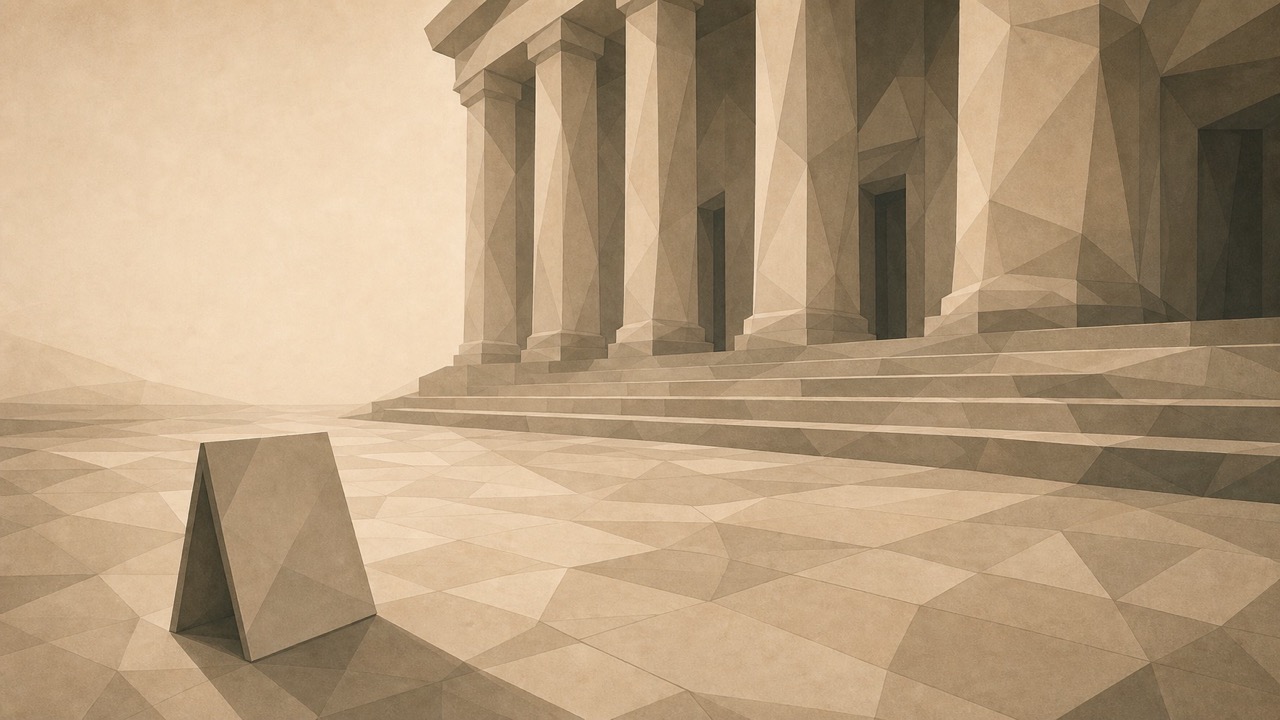
There is a detail in this story that explains it entirely, and it is prudent to begin with it. On 24 July, a United States executive order mandated the installation of placards warning visitors to the National Museum of American History that its exhibitions required renewal and directing them to other locations to find accurate information regarding the country's history. The placards are not placed inside the museum. They are placed on the pavements leading to it.
This is not an aesthetic choice. It is that no other course of action was possible. The Smithsonian is not an agency of the executive branch: it is a trust institution created by Congress in 1846 and governed by a Board of Regents of seventeen members, which includes the Chief Justice, the Vice President, three senators, three representatives, and nine citizens appointed by joint resolution of Congress. No president possesses the authority to dictate what is exhibited in its galleries. They do, however, possess authority over the grounds administered by the National Park Service. That is to say: over the pavement.
I recount this as it represents one of the clearest instances I have observed of a distinction I have been examining for some time, which in the research I share with Adolfo Cortés García appears broken down into three components—the decomposition being his contribution. Legitimacy is one thing: the recognised right to be present in a field and for one's actions to count as a candidate. Authority is another: the position from which one certifies according to the norms of the field. And power is something else entirely: the effective capacity to ensure that a statement circulates or does not. It is customary for these to coincide. When they are separated, the composition of each becomes clearly visible. We developed this distinction while considering the art world; here, I apply it to another institution that also produces public statements regarding the nature of things, and a national history museum does so quite obviously.
Here, the three components are separated in an almost didactic manner and distributed among three distinct subjects. Authority over what a display case states rests with the Board of Regents and the museum's leadership, by law. Legitimacy rests with the curators and historians, by virtue of competence accredited before their peers. And the power to exert pressure rests with someone who possesses neither of the former. As that power cannot become authority, it is exercised where it can reach: on the pavement, in the budget, in official correspondence. The sequence is documented and merits reading as what it is: an escalation. In March 2025, an executive order mandated the removal of what it termed improper ideology from Smithsonian properties. In August of that year, a letter announced an internal review of museums and exhibitions. In December, another requested materials: wall texts, educational resources, exhibition proposals, budgets, object lists, and internal manuals. In July of this year, a 162-page report arrived, and three weeks later, the order for the placards.
The report warrants close reading, for its central accusation is not that the museum is lying. It is that it tells the wrong story in the wrong tone. It maintains that the museum's management has adopted an ideological framework that no longer treats American history as a shared national heritage to be taught or celebrated, but as a political instrument for division; and that, to the extent that a story is told there, it is not one of the country's victory of liberty and genius, but one of regret, tragedy, and shame.
And now I must concede something, for if I do not, this text is worthless. That accusation is not absurd. A national museum does indeed construct a narrative. It is not a neutral warehouse of objects: it selects, orders, prioritises, and omits, and those decisions are interpretive and therefore debatable. Anyone who claims that a national history museum only displays facts has either never worked in one or is being disingenuous. The discussion regarding what narrative a public institution tells about its own country is legitimate, necessary, and should not discomfort anyone working in culture.
The problem is not that the narrative is being discussed. It is who is discussing it and with what instruments. A historian who challenges an exhibition hall writes an article, publishes, argues, and other historians respond: that is a discussion, and it functions because both parties submit to the same rules of evidence. A power that challenges an exhibition hall by demanding budgets, lists of objects, and internal manuals, and subsequently orders signs to be placed on the street warning that there is no reliable information inside, is not discussing. It is shifting the issue from the terrain where it might be lost to another where it cannot.
That shift has a consequence that extends beyond this case. A power that acts without legitimacy or authority does not merely impose or withdraw recognition without having evaluated anything: it also hinders the subsequent detection of error. A false statement issued by the competent authority is correctable, because it was issued on the terrain where the rules of evidence govern and can be refuted there. A sign on the pavement is not refutable with an article, because it does not belong to that game. The visitor who reads the warning before entering is not offered an argument they can examine: they are provided with a prior distrust that no exhibition hall will be able to undo, because it is not formulated in terms that admit a response. Correction requires that the statement and its challenge share a common ground, and the operation consists precisely in removing the issue from that ground.
The museum director responded before a Congressional subcommittee in a manner I find exemplary precisely because of how little defensive it is. She stated that she takes the concerns raised seriously and that, where they can improve, they will do so. At the same time, she maintained that the report does not fairly characterise the entirety of the museum's work, that the institution does not take sides in the country's political debates, and that telling the complete history is not anti-American, but a form of respect. The Secretary of the Smithsonian expressed a similar sentiment internally: that there is always room for improvement and that the report is not a fair characterisation. Neither response denies that anything can be reviewed. Both refuse to accept the framework.
There is a precedent for how this ends when it ends poorly, and it comes from the Smithsonian itself. In 1994, the National Air and Space Museum prepared an exhibition on the Enola Gay and the end of the Second World War that included the historiographical debate surrounding the atomic bomb. Veterans' associations and members of Congress applied pressure through hearings, funding cuts, and calls for resignation. The exhibition was cancelled on 30 January 1995. Five months later, another opened in its place, and the description provided by the Smithsonian's own archives is among the most eloquent I have read on this matter: it contained no interpretation, no graphic images, and no melted objects. Only the fuselage, with basic data regarding the aircraft and its restoration.
That is the end of the road, and it is not the censorship of specific content. It is a museum that ceases to interpret. When interpretation becomes costly, the rational exit for any institution is to cease doing so: place the object, place the technical label, and remain silent. And a museum that does not interpret is not a more neutral museum. It is a warehouse with visitors. The American Historical Association formulated it this year with a phrase that says it better than I can: patriotic history celebrates a nation's great achievements and also helps to grapple with the less grand and more painful parts, and both are part of a shared past.
The placards, should they be installed, will remain outside the building on public ground, signalling that the contents within are not to be trusted. This is the precise image of a power that cannot gain entry. And, for that very reason, it is also proof that authority over the narrative within remains where it ought to be. What will determine the outcome is not the executive order: it is the endurance of those working inside before they begin to remove interpretation from the galleries of their own accord to avoid complications. That aspect does not appear in any official document, yet it is what dictates the result.
On open conversation
This text applies to the Smithsonian case a distinction I explore in my research on recognition, which I share with Adolfo Cortés García: the separation between the legitimacy to exist within a field, the authority to certify according to its standards, and the power to determine whether something circulates or not. The decomposition is his contribution, and we formulated it with the art world in mind; a history museum puts it to the test in a different arena, and I am interested to see if it holds.
Furthermore, a question remains that our work does not answer and which this case clearly poses: what occurs when an institution removes interpretation in advance, without being ordered to do so, to circumvent conflict. It is not censorship and it leaves no documentary trace. This is not a text about American politics, but about what happens when power cannot transform into authority and acts where it can reach. It concedes without reservation that a national museum constructs a narrative and that this narrative is legitimately debatable: the question is with what instruments it is debated. If anyone wishes to intervene from the fields of museology, public history, institutional management, or conservation, this notebook remains open.
Sources
White House. Executive Order 14416, Restoring Trust in the Smithsonian Institution, 24 July 2026. And Executive Order 14253, Restoring Truth and Sanity to American History, 27 March 2025.
White House Domestic Policy Council. Saving America’s Story: How Ideological Capture at the Smithsonian Institution’s National Museum of American History Erases Our Heritage, 4 July 2026.
Anthea M. Hartig. Written testimony before the Subcommittee on Delivering on Government Efficiency, Committee on Oversight and Government Reform of the House of Representatives, 21 July 2026.
Reuters, 8-9 July 2026: internal memorandum from the Secretary of the Smithsonian, Lonnie G. Bunch III.
National Coalition Against Censorship. NCAC Decries White House Policy Council Report Castigating the Smithsonian, 13 July 2026.
Associated Press, 24 July 2026: coverage of the executive order and its institutional framework.
20 U.S.C., Chapter 3, §§ 41-43, and Smithsonian Office of General Counsel, regarding the legal nature of the institution and the composition of the Board of Regents.
Smithsonian Institution Archives: cancellation of the Enola Gay exhibition (30 January 1995) and description of the replacement exhibition (28 June 1995).
American Historical Association and Organization of American Historians, 2026 statements.
Cortés García, Adolfo, and Juan A. Esteban Ruiz. Recognition and Surplus. Zenodo, 2026. https://doi.org/10.5281/zenodo.21630455