
Background. This page documents my trajectory in digital art, blockchain infrastructure, and collecting since 2021. The research published on this site is built upon that trajectory.
The appraisal protocol (2021)
In October 2021, with the global tokenised art market at its expansionary peak—following the sale of Everydays: The First 5000 Days by Beeple for 69 million dollars at Christie’s in March of that year—I developed, alongside Fernando Carmona, the first professional appraisal protocol for native digital artwork applied in Spain. It was commissioned by Afundación, the social outreach division of Abanca.
The protocol integrates three dimensions that traditional appraisal did not consider as a unified system: rigorous artistic analysis, technical evaluation of digital provenance (token, network, smart contract, marketplace, storage model), and market positioning. The methodology concludes with a documented economic valuation.
It remains active. It has been applied subsequently to other cases. It persists as a document for internal use between Kripties and the institutions that commission it.
It is the methodological foundation that this research series articulates conceptually under the triadic framework of provenance, persistence, and recognition.
The public position (2021-2022)
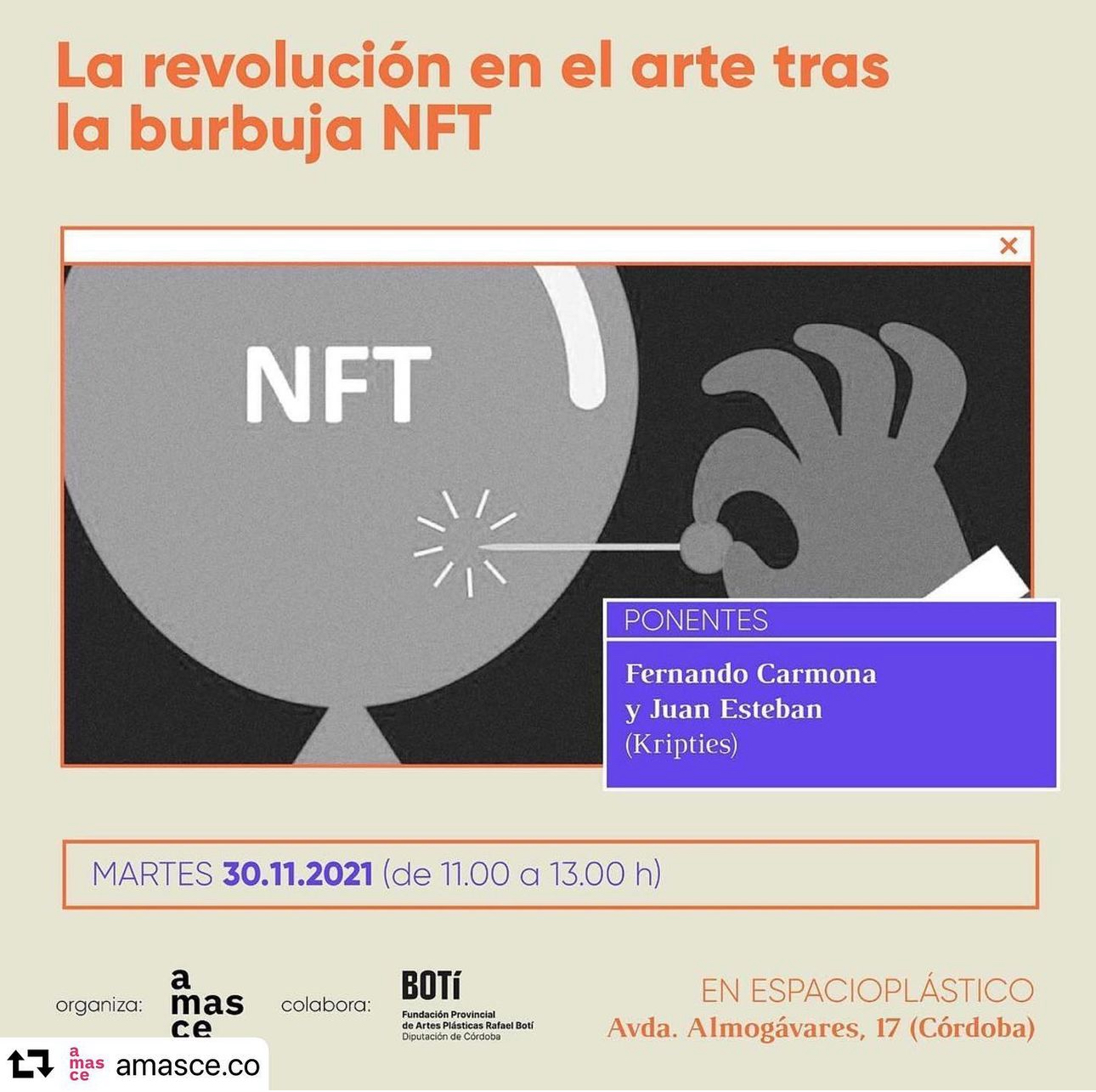
Plástico, Córdoba, 30 November 2021. Organised by AMASCE with the collaboration of the Fundación Provincial de Artes Plásticas Rafael Botí (Diputación de Córdoba). I argued, alongside Fernando Carmona—art historian and cultural manager at the Museo Thyssen Málaga—that the significant transformation of digital art would commence after the bursting of the speculative bubble, not during its expansion. The contribution was part of a series focused on analysing emerging phenomena and anticipating cultural and technological shifts. Coverage: Diario Córdoba.
Innovative Meetings – Club Euronova Breakfasts. December 2021. Business forum. Contribution regarding the necessity of applying artistic—not merely technological—criteria in the curation of digital work. Recording available on YouTube.
Academic contribution at ESIC Málaga. January 2022. Extension of the position to the university sphere of cultural management.
Samsung Digital Art Awards. December 2022. First edition of the awards convened by Samsung Spain and Portugal, aimed at Spanish and Portuguese artists in audiovisual format, Net Art, digital photography, and digital plastic work. I served on the jury alongside Javier Mariscal, Javier Arrés—a pioneer of cryptoart in Spain—and Fernando Carmona. The selected works were exhibited in a hotel circuit (Hotel Bless Madrid, Hotel Only Málaga, Hotel Barcelona). Coverage: Revista AD (Condé Nast).
Practice as a collector
The Esteban-Ruiz Collection, a personal collection I have maintained as a private collector since 2021, is transdisciplinary and brings together both digital work and work in other media. A significant portion is comprised of work by international artists acquired on global platforms (Foundation, Transient, KnownOrigin, OBJKT on Tezos, among others). It is constructed with curatorial criteria, without the intention of commercialising the works.
This practice has generated sustained relationships with artists across the globe and direct operational experience with the functioning, closure, and reconfiguration of platforms. Entry I of this series documents one of those cases.