
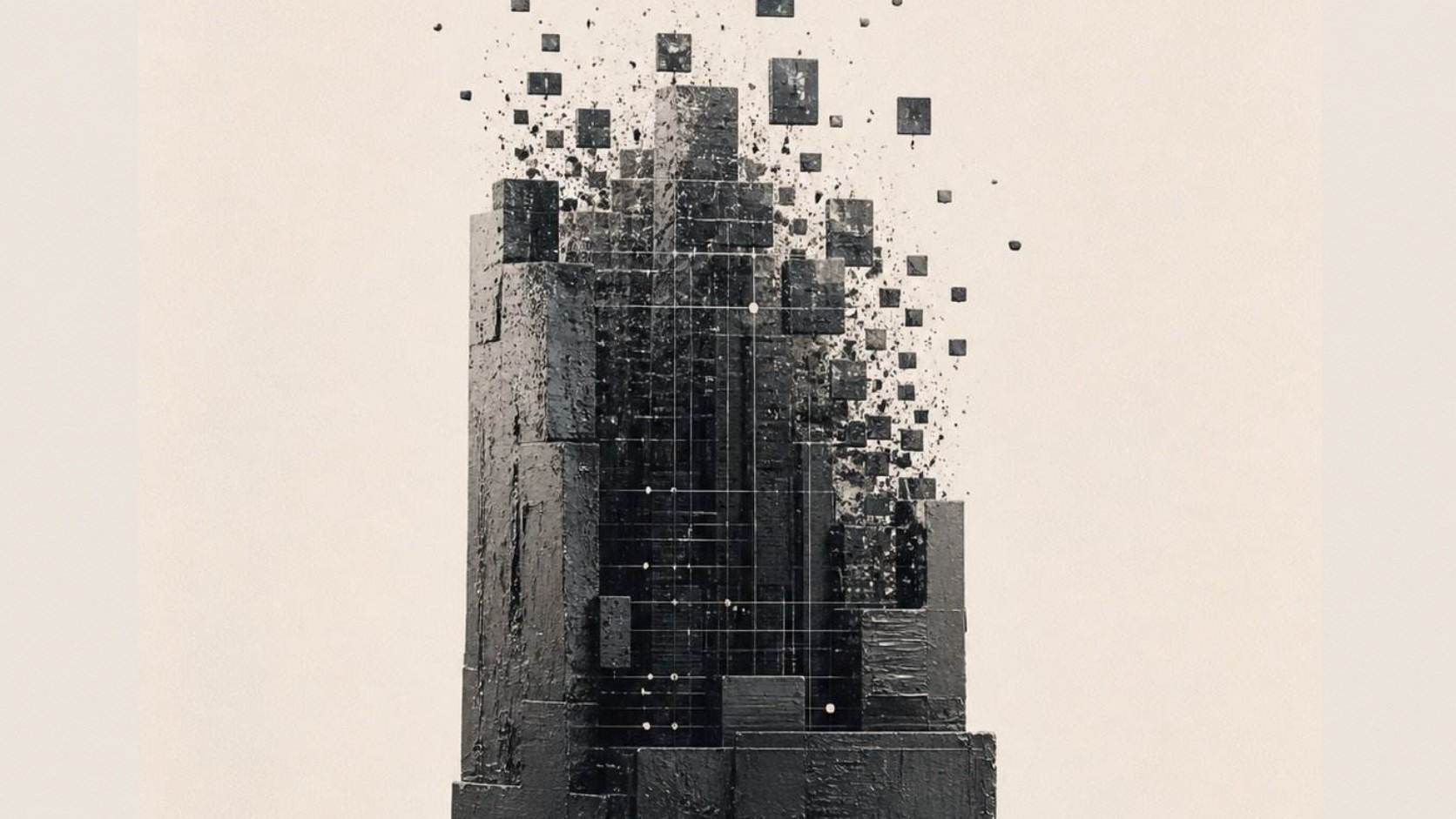
Foundation, one of the invitation-only tokenised art platforms within the Ethereum ecosystem, has gone offline indefinitely after failing to secure a buyer. The platform attributes this decision to a financial and operational reality that precluded the resumption of service with any guarantees. What follows is an assessment of the current situation, distinguishing between data-supported facts and reasonable inferences.
The closure is not an isolated incident. It is consistent with a market that the 2025 Art Basel/UBS report describes as being in general recovery: 59.6 billion dollars in global sales, following two years of decline. However, there are also segments where the adjustment has been abrupt and where the speculative foundation of 2021-2022 no longer finds support. That final assertion, applied to tokenised digital art, is not an opinion: it is what the series from DappRadar, Chainalysis, and the main recent sector reports demonstrate.
Macro and segments
Geographic concentration remains extreme. In 2025, according to UBS/Art Basel, the United States, the United Kingdom, and China accounted for 76% of the global art market value. In Europe, available data indicate growth in Switzerland, Austria, France, and Spain, with slower dynamics observed in Germany and Italy.
By sector, the 2024 auction series are conclusive. Old Masters fell by 25% to $803 million; Impressionist and Post-Impressionist art by 17% to $1.2 billion; Modern art by another 17% to $2.2 billion. Three of the four lots exceeding $10 million were European Old Masters. The adjusted reading, without extrapolation, is that the deceased artists segment remains supported by scarcity and provenance, within a market more volatile than it appeared two years ago.
Living contemporary art presents a different profile. Sales of contemporary art at auction fell by 36% in 2024 to 1.4 billion, and work created in the last twenty years remained at 23% of the sector's value, compared to 34% in 2021. On the demand side, the survey of HNWIs published in 2025 places the weight of direct purchases from artists at 20% of the respondents' expenditure, and 66% as the proportion that acquired work from newly discovered creators. The data comes from a survey of high-net-worth collectors, not the market as a whole. With that precision, what is observed is a recalibration towards more contained prices, discovery, and direct engagement, not an abandonment of the segment.
Digital art and NFTs, without conflating terms
This is the area where lexical imprecision causes the most distortion. Digital art encompasses computational, generative, video, installation, and software art, as well as physical-digital hybrids. The NFT is, in essence, infrastructure for ownership and traceability on the blockchain, not an artistic medium. The distinction is significant because the data for each diverges.
DappRadar records a contraction in the Art NFT market from $2.9 billion in 2021 to $197 million in 2024 and $23.8 million in the first quarter of 2025. In the second quarter, volume fell by a further 51%, yet the number of sales grew by 400%. This series is consistent with a market that is more affordable and atomised, not one facing extinction. In parallel, there are signs of institutional absorption: the MoMA, Centre Pompidou, and LACMA have incorporated digital and/or blockchain works into their programmes and collections (as noted by Art Basel in its report on digital art and NFTs); Christie's raised $728,784 in its first auction dedicated to AI-generated art, with 37% of registrants being new to the house and 48% being millennial and Gen Z bidders. The data are as cited; the reasonable inference is that the canonisation phase is beginning and that the digital ecosystem is surviving the collapse of the NFT, albeit in a displaced form.
Foundation: what is falling and what is not
The front-end, discovery, services, and curatorial guarantee are falling. On-chain ownership of minted works does not automatically fall, because the token resides in the contract and not on the website. Two nuances are necessary. First, depending on the specific minting model (shared contract or by collection), the portability of the asset to other marketplaces may vary. Second, the persistence of the associated file—the image, the video, the metadata—depends on how it has been stored: on IPFS with pinning managed by the platform, on Arweave, or on proprietary infrastructure. If the platform ceases to maintain the pinning, the files may become inaccessible even if the token continues to exist. For authors, this makes traceability and archiving a personal, non-delegable task, which should be resolved before the associated infrastructure expires.
Tezos and the question of the future
Tezos, with OBJKT as its largest marketplace, has a proposal oriented towards low costs and less speculative communities; the Tezos Foundation itself reported record sales in its art and culture vertical in 2025. At the same time, the historical bulk of NFTs has been minted on Ethereum, and Solana and Polygon are gaining weight. On that basis, to say that Tezos will be the future of digital art is an inference that runs ahead of the evidence. To say that it is one of the most coherent environments for a less speculative niche is an inference that the evidence does support.
AI: tool and category
Adobe's survey of 16,000 creators in 2025 estimates that 86% already use generative AI, with primary use in editing and enhancement (55%), asset generation (52%), and ideation (48%). The sample is biased towards creators already connected to the Adobe ecosystem, which skews the figures upwards. Even so, the order of magnitude is consistent with other recent sector studies. As an artistic market category, AI-art is still small in added value: the dedicated Christie’s auction raised 728,784 dollars; a work by Ai-Da exceeded one million at Sotheby’s. However, it possesses institutional visibility and increasing media attention.
UNESCO provides the macro context: digital income now accounts for 35% of creators' earnings (compared to 17% in 2018), and the organisation projects potential losses of 24% in music and 21% in audiovisual sectors by 2028 due to generative AI. Only 12% of countries have updated their copyright legislation to address AI-generated content. The quantified portion pertains to the projected loss and the regulatory figure; the reasonable inference is that the productivity of AI arrives before the rules that govern it, and that this asymmetry tends to concentrate value in those who control the infrastructure.
Economic peripheries and the myth of the NFT as a bridge
The idea that the NFT would have democratised the art market for creators from the Global South is not supported by the available data. This does not equate to a refutation, but it does leave it without significant empirical backing. What Chainalysis does document is the utility of crypto in emerging markets, but as monetary infrastructure: payments, savings, remittances. It reports a year-on-year growth of 52% in sub-Saharan Africa, with Nigeria among the global leaders in adoption, and the advancement of stablecoins in Latin America. This is information about crypto adoption, not artistic collecting. The gaps that do affect digital art lie in other variables: essential digital skills (67% of the population in developed countries compared to 28% in developing countries, according to UNESCO) and international mobility (96% of developed countries support outbound mobility, compared to only 38% that facilitate inbound mobility from developing countries).
Digital euro
According to the ECB, the preparation phase ended in October 2025 and, if European legislation progresses in 2026, issuance could occur in 2029. The project is explicitly designed as a means of daily payment, complementary to cash and private solutions, not as an investment or store of value. By design, it does not resolve the bottlenecks of digital art: technical provenance, preservation, rights, licences, sustained cultural demand. This is a reading of the design documented by the ECB, not speculation.
Collecting and an unmeasured metric
The 2025 UBS/Art Basel survey of HNWIs records an average allocation of 20% of wealth to art (compared to 15% in 2024) and an 84% stated optimism. Concurrently, the total market recorded 40.5 million transactions in 2024 (+3%), with dealers generating less than 250,000 dollars in turnover seeing sales growth, and 44% of buyers being new to the dealers (50% for the smallest ones). The tension between the aggregate figure and the transactional base suggests that recent market expansion is driven more by low entry points and turnover than by a redistribution of economic weight. This is an inference, albeit a well-supported one.
Alongside this, an asymmetry warrants declaration: the WHO estimates 1.3 billion people live with significant disability, approximately 16% of the global population. Sectoral data regarding artists with disabilities is scarce in market terms, though much more robust regarding access, cultural policy, and employment. This asymmetry is, in itself, a datum: what is not measured is rarely valued. The observable transition points toward a shift from a welfare model to one of cultural rights, professionalisation, and accessibility, yet the market curve has not yet captured this transition.
Synthesis with confidence levels
The most robust data points: the conventional market continues to concentrate value in high net worth and three geographies; contemporary living art is undergoing price recalibration and remains dependent on discovery; the Art NFT market has collapsed in added value, without disappearing in terms of sales volume.
Medium confidence: the phase of institutional absorption of digital art, beyond mass minting, appears to be consolidating; AI as a tool is now transversal to creative workflows, despite the bias in the surveyed samples.
Low confidence or subject to verification: that Tezos will become the stable centre of the next digital art cycle; that recent institutional openness, including the interpretation that Venice is treating so-called protocol art as a subject rather than a laboratory eccentricity, marks a sustained shift in cultural validation; that the entry of AI into the market will redistribute value rather than concentrate it further.
Open limitations
There is no single public database that cleanly separates, on a global scale, living and deceased artists while distinguishing between primary and secondary markets and between developed and developing nations. Data on peripheries, disability, and digital art are much better measured in terms of access, cultural policy, and technological adoption than in artistic income comparable to the major centres. The honest conclusion is not that nothing is happening, but rather that the system still measures peripheral creators poorly.
Foundation closure
What the closure of Foundation makes visible is not new: a tougher selection phase, a distinction that must be maintained between digital art and NFTs, and a market that is not sustained by euphoria and has yet to find another narrative. The operational question, for authors and institutions, is no longer whether platforms like Foundation will endure, but what proprietary infrastructure—traceability, archive, rights, cultural demand—is being built so as not to depend on their endurance.
Sources
[1] Foundation — https://www.foundation.app/
[2] Art Basel / UBS: The Art Market 2025 — https://www.ubs.com/global/en/our-firm/art/art-market-research.html
[3] Art Basel: The Art Market 2025. Auctions — https://theartmarket.artbasel.com/the-art-market-2025/auctions
[4] Art Basel: Survey of Global Collecting 2025 — https://theartmarket.artbasel.com/survey-of-global-collecting-2025/channels
[5] Art Basel: Digital Art and NFTs — https://www.artbasel.com/stories/digital-art-nfts-crypto
[6] Art Basel: Tezos at Art Basel Miami Beach — https://www.artbasel.com/stories/mint-your-own-nft-at-art-basel-miami-beach
[7] DappRadar — https://dappradar.com
[8] Chainalysis: Global Crypto Adoption 2025 — https://go.chainalysis.com/2025-global-crypto-adoption-webinar.html
[9] UNESCO: Creators face projected global revenue losses — https://www.unesco.org/en/articles/creators-face-projected-global-revenue-losses-24-2028-new-unesco-report-shows
[10] Adobe Max 2025: Creators Survey — https://news.adobe.com/news/2025/10/adobe-max-2025-creators-survey
[11] European Central Bank: Digital Euro — https://www.ecb.europa.eu/euro/digital_euro/progress/html/index.es.html
[12] WHO: Disability — https://www.who.int/health-topics/disability