
On 12 January 2021, Adobe began blocking Flash content from running in Flash Player, after support ended on 31 December 2020. Many works, animations and projects stopped being accessible in their usual environment, even though the files still existed. Not every file disappeared, nor every way of running them, but ordinary access through browsers and the official player was cut off.
This is the most common way to lose a digital work. It does not break: it is left without an environment.
Obsolescence is not a single phenomenon
The physical medium, the drive, the operating system, a library, an account, a domain, or an API may disappear. The file may also continue to function while the screen, sound, or latency change to such an extent that the work no longer behaves as intended. The diagnosis must identify the point of failure before selecting a strategy.
The response: emulation
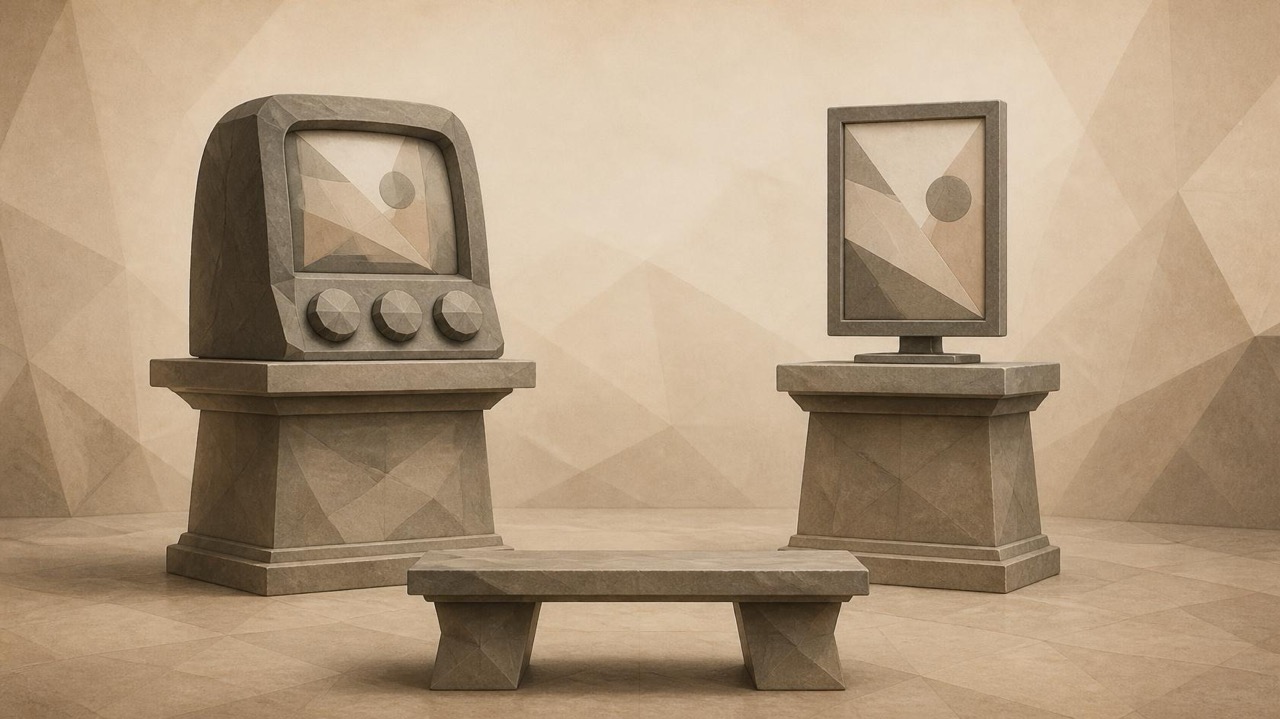
One solution is emulation: creating a program on current equipment that mimics the legacy environment, allowing the original work to function without modification. For Flash, there is Ruffle, an emulator that enables the viewing of many such works. But it does not necessarily reproduce every function: the code, video, network connection, or precise timing may fail.
The precedent: Seeing Double
The question of whether an emulated work is the same work was raised in public more than twenty years ago. Between March and May 2004, the Guggenheim in New York organised Seeing Double: Emulation in Theory and Practice. It exhibited works in their original version alongside their emulated version so that the public could compare them.
The best known was The Erl King, by Grahame Weinbren and Roberta Friedman, an interactive video work from the early 1980s that operated on hardware that was already obsolete and software written by the artists themselves. Emulation allowed it to run on 2004 equipment and its behaviour compared with that of the original system.
It was not a neutral emulation
The technical report for The Erl King demonstrates that the solution did not consist simply of running the entire legacy system without changes. The project rejected a full object-code emulation because of its difficulty and combined interpretation of the Pascal software with emulation of external devices. The case is valuable precisely because it demonstrates that ‘emulation’ may involve decisions of translation and reconstruction.
What it resolved and what it did not
The exhibition tested the possibility of preserving part of a work's behaviour without retaining all of its original equipment. The public comparison did not demonstrate a universal equivalence: it made it possible to observe differences and discuss whether they were acceptable. It was a decisive precedent for digital art conservation and opened the way to the strategy many museums use today.
But it also showed the limits. Emulation preserves the logic of the work, but not necessarily everything that was perceived: the feel of the controls, the response speed, the appearance of the monitor, and the relationship between the body and the machine. And it does not solve the conservation of peripherals or of the external services the work depends on. I have not found on the exhibition's official page what the artists thought of the result.
Choosing between several strategies
Emulation is not always the answer. It may be appropriate to store the original equipment, migrate formats, rewrite a component, replace hardware, or reinterpret the work. Strategies may also be combined: the original as a reference, an emulated version for study, and an authorised version for exhibition.
The choice must weigh identity, experience, viability, and rights. Each intervention requires preserving the original when possible, documenting tools and parameters, recording differences, and establishing who authorised the change.
Behaviour or experience
In my view, Seeing Double poses the correct question and leaves the most difficult one open. Conserving a digital work is not about preserving a file or a machine, but the conditions that allow the work to occur again. In the framework I proposed in Art as Structural Surplus, a work is defined by the reorganisation it produces in the person who encounters it. Emulation may reproduce the behaviour, but it does not guarantee the reproduction of that reorganisation. Sometimes it is preserved, sometimes it is not, and this must be verified work by work, comparing it with what it once was.
This is why documentation is as important as technique: a video of the work in operation, the artist's statement on what is essential, and the record of each intervention. I develop this in the guide on obsolescence.
About the open conversation
This text separates data from my interpretation and does not constitute legal advice. If you work in digital conservation or own work made with obsolete technologies and wish to clarify a point or discuss this reading, this notebook remains open: write to me.
The author's relationship with the cases
I hold digital work in my collection, the Esteban-Ruiz Collection, but none of the works cited in this text. I have no relationship with the museums or the artists mentioned.