
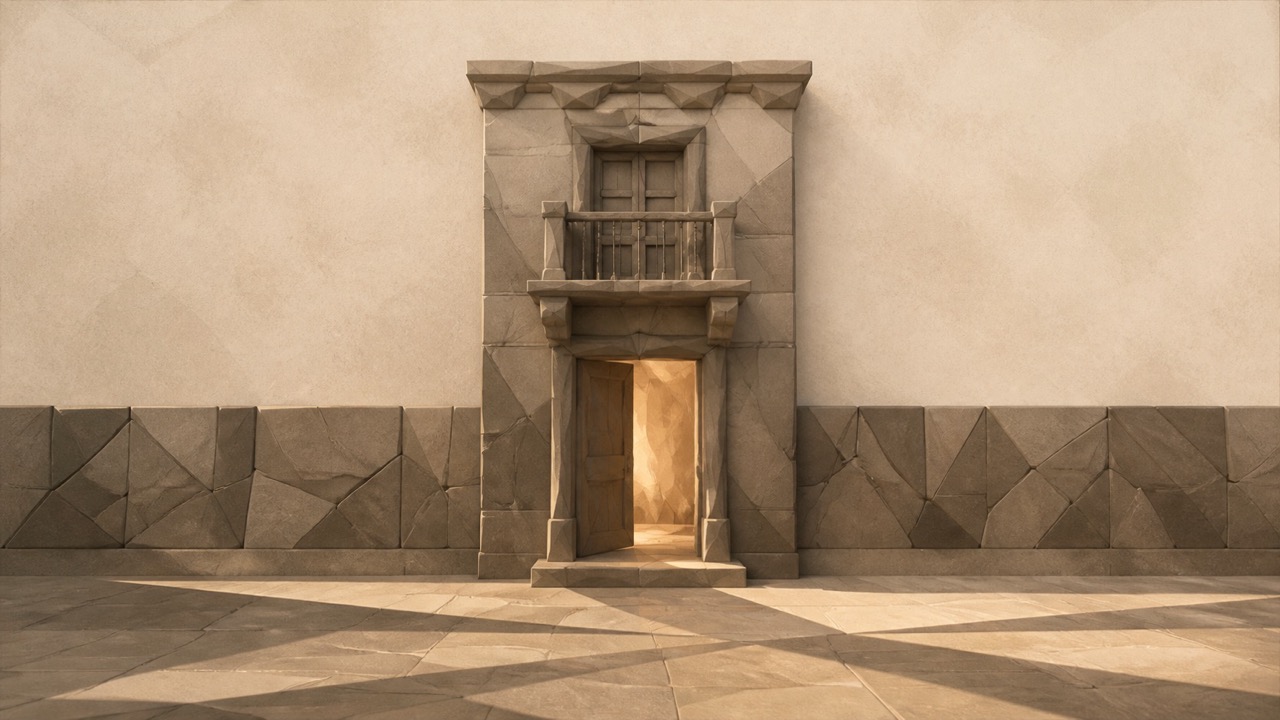
In March 2007, a collective entered an empty municipal building on Calle Nosquera, in the historic centre of Málaga, and began converting it into a cultural space. Nineteen years later, La Casa Invisible continues to announce activities there, while the City Council has accumulated two rulings that support its decision to recover the property. Between one date and the other, there was a protocol signed by four public institutions, a one-year temporary authorisation, two municipal reports with differing conclusions regarding a potential direct award, a file that did not result in a concession, and several years of litigation.
The conflict is almost always recounted as a clash between community culture and property legality, and that version is convenient for both parties. It allows the City Council to summarise nineteen years of political relations as an occupation without title. It allows the collective to present a negotiation that was never concluded as if it had generated a stable right to the building. The documents I have been able to consult draw a less simple history: there was institutional recognition and genuine negotiation, and a lasting title was never signed.
I chair Kripties Fundación, a non-profit entity dedicated to social inclusion through art, although I sign this text in an individual capacity. From that position, that of someone convinced that a cultural organisation requires clear rules, sufficient continuity and enforceable responsibilities, it is difficult to accept that a city should maintain one of its most visible cultural conflicts for nearly two decades under a regime of provisionality, political gestures and half-finished files.
From occupation to protocol
La Casa Invisible situates its origin in March 2007, in an occupation of the municipal property at Nosquera 9-11, with an entrance also on Calle Andrés Pérez, which the collective presents as an act of civil disobedience in the face of a lack of sociocultural facilities and the abandonment of the building. The exact day does not appear in the documentation located, and this account of the origin is that of the collective itself.
On 17 January 2011, a protocol of intent was signed between the Málaga City Council, the Regional Government of Andalusia, the Málaga Provincial Council, the Reina Sofía National Museum Art Centre, and three associations linked to La Casa Invisible. The copy disseminated by the collective includes a temporary authorisation for occupation for one year and a roadmap for regularising the use of the building. I have not located the document in the municipal electronic office, nor an express extension of the authorisation after 17 January 2012.
That protocol carried considerable political weight. It brought together three levels of administration and a national museum, recognised certain interlocutors and opened a path to regularisation, so that the subsequent period can hardly be described as simple informal tolerance. But a roadmap and a one-year authorisation are not equivalent to a concession, and when the year ended, a stable solution remained pending.
In March 2012, the municipal Culture department drafted a report in favour of granting a concession to the Fundación de los Comunes, and the file was submitted in April for processing. On 12 April, a municipal legal report, which appears among the documents published by the collective, considered the justification of public interest required for a direct award to be insufficient. The two departments of the same City Council were asking different questions. Culture valued what the project contributed to the city; the legal services questioned whether that was sufficient to hand over the building to a specific entity without opening a procedure to others. That difference already contained the entire subsequent conflict.
On 28 September 2015, a municipal meeting announced a file once again. According to La Casa Invisible, a direct award was then proposed, conditional upon a declaration of municipal public utility and a basic rehabilitation project, requirements that the collective claims to have met. The concession, in any case, was never formalised.
Recovery and litigation
Subsequent agreements reversed the direction of the file. The Local Government Board adopted them on 16 February and 22 June 2018, and 5 November 2021. According to the transparency report of the Municipal Urban Planning Management for the fourth quarter of 2021, the last one dismissed the appeal for reconsideration by the Fundación de los Comunes against the June 2018 agreements and concluded the procedure for the ex officio recovery of the property.
The passage of time did not work in the collective's favour. The Regulation on Assets of Local Entities declares public domain assets imprescriptible and allows city councils to recover their possession themselves at any time; the one-year period from the occupation only applies to heritage assets. According to the information published regarding the 2024 ruling, the court referred to the building as a social facility under municipal ownership. If that classification is that of the inventory, nineteen years of use do not generate any right over the property.
I have not located the full text of the 2018 agreements on the municipal website, nor the minutes that would allow each step to be reconstructed. The press attributes several reasons to the City Council: the lack of a valid title, the exceptional nature of the direct award, safety issues, activities without a licence, and difficulties in inspecting the building. Some also appear in reports on the rulings, but as long as their text or the administrative file is not published, they must be read as arguments from one party reported by the press.
La Casa Invisible maintains the opposite. It asserts that it fulfilled the agreed conditions, that its public interest was accredited by the activity carried out and by the municipal reports themselves, and that the transfer process was interrupted by a political decision. It attributes the turn of events to a plenary motion in 2017, the text and exact date of which I have not located. Its statements from October 2022 and April 2024 insist that the file could not be closed while ignoring the previous negotiation.
In January 2024, a municipal order to cease activities open to the public due to a lack of a licence also became known. The decree and its date do not appear among the sources I have been able to consult. The collective responded that the courtyard had been adapted to safety requirements and that the City Council itself had organised activities there in previous years. These are allegations from one party, which do not replace the licence nor prove that all subsequent activity met the requirements.
On 20 March 2024, the Contentious-Administrative Court number 4 of Málaga dismissed the appeal by the Fundación de los Comunes. Málaga Hoy, on 4 April, and the subsequent statement from the collective agree that the ruling considered the recovery of possession by the administration to be valid and denied that a right to direct award existed. On 13 November 2025, the Second Section of the Contentious-Administrative Chamber of the High Court of Justice of Andalusia dismissed the appeal. According to El Español de Málaga, which published it on 8 December, the judgment confirmed the agreements of 2018 and 2021, supported the City Council's interest in recovering the property, imposed costs on the appellants and was still subject to appeal.
I have not located the text of either of the two rulings in the CENDOJ, their ECLI identifier, the appeal case number or any subsequent resolution regarding a potential appeal in cassation. For this reason, I do not attribute to the courts any reasoning more precise than that published by those sources. That there are two rulings favourable to the City Council summarises what is known, without allowing for the reconstruction of their foundations or the assertion that the litigation has concluded.
As of 4 November 2026, the La Casa Invisible website was announcing programming for October and November. This confirms announced activity, without stating anything about a title or potential enforcement actions. Nor have I located a public source documenting an eviction, a new transfer or a subsequent final judicial resolution.
Competition, transfer and right of first refusal
The underlying issue is legal rather than cultural. Concessions for public domain assets are granted, as a rule, through a procedure open to other interested parties. Law 33/2003, on the Assets of Public Administrations, reserves direct award for cases provided for by law or for duly justified exceptional circumstances, and the state regulation on local assets requires prior tendering for concessions of private use. In Andalusia, this framework is completed by Law 7/1999, on the Assets of Local Entities of Andalusia, and by its 2006 regulation, which apply in preference to non-basic state regulations.
Andalusian law also offers a path distinct from the concession. Its article 41 allows for the free and temporary transfer of patrimonial assets to private non-profit institutions of public interest for purposes that benefit the inhabitants of the municipality. Article 78 of the Andalusian regulation develops this path for private non-profit entities whose activities are considered to be of general or public and social interest. On that basis, Málaga approved in 2014 an ordinance for the transfer of municipal properties to associations and non-profit entities, which are distributed through open calls. Seville approved two instructions in 2021: one for free temporary transfers of patrimonial assets and another for direct and free demanial concessions to non-profit entities with a declaration of general or public-social interest. I have not located any decision explaining why the Nosquera case was never channelled through the Málaga ordinance, or if it was ruled out due to the characteristics of the building or its legal classification.
The cultural relevance of an entity may form part of that motivation, yet it does not, in itself, grant the building it already occupies. An administration must explain why that organisation is the appropriate recipient, what general interest it satisfies, what obligations it assumes, and why the chosen path respects equality among potential applicants. Furthermore, if it opts for competitive bidding, the procedure may be designed to value local roots, continuity, openness, cultural production, and social return. A competition that ignored nineteen years of work would also manufacture inequality, albeit under the guise of procedure.
The state regulation, applicable on a supplementary basis in the absence of prevailing regional regulation, contemplates a mechanism that attempts to reconcile initiative and competition. Its article 88 recognises a right of first refusal for the initial petitioner if they participate in the tender and their economic proposal does not deviate by more than 10% from the one selected. I have not verified that this mechanism is applicable to the case in Andalusia. It serves, in any case, to show that the competitive procedure can recognise prior initiative without converting it into an automatic award.
There are also models for measuring the contribution of such a project. Barcelona leases municipal premises and facilities to non-profit entities in exchange for a periodic community balance sheet, a self-assessment of its internal democracy, its roots in the neighbourhood, its social impact, and its care for people and the environment, which the entity presents before requesting renewal. Since 2016, Zaragoza has managed the Harinera ZGZ through a partnership between the City Council, a neighbourhood association, and an artistic collective. The legal avenues and municipal programmes, with their deadlines and risks, are explained in the guide ‘How a public space is assigned to an artistic collective’.
The two known judgments place the City Council in a stronger legal position today than that of the collective, but this advantage does not erase its political responsibility for the duration of the conflict. For years, it signed, reported, conditioned, and negotiated again. If it considered a direct concession impossible, it was incumbent upon it to close that path clearly and offer, if it deemed appropriate, an alternative procedure. If it considered it possible, it was incumbent upon it to complete it with enforceable conditions. Maintaining an institutional expectation for years and subsequently describing the result as a simple absence of title is a poor way to govern.
The collective, for its part, cannot treat the recognition received as an indefinite substitute for a title. Cultural autonomy requires resources, but also rules that allow for accountability regarding safety, access, works, financing, and the use of the building. Managing a common good does not exempt one from public oversight when the asset is public. A community institution gains legitimacy when it accepts that its continuity may be justified by verifiable criteria, in addition to its history and its capacity for mobilisation.
Moving beyond provisional status
Nineteen years of provisional status have material effects. They hinder the financing of rehabilitation, the planning of investments, the contracting of insurance, and the determination of who is responsible for improvements. They also deteriorate public discourse: each inspection is interpreted as harassment, each activity as proof of legitimacy, and each delay as confirmation of bad faith. Disagreement ceases to revolve around a management model and begins to be organised around immediate survival.
Málaga loses out with this reduction. The city needs to decide what role it reserves for autonomous cultural spaces, how it measures their public utility, and which properties it is prepared to make available to citizen initiatives. Tolerating an occupation for years until wear and tear facilitates eviction is a poor response. Consolidating by seniority any occupation that has generated valuable activity would be another.
Comparison with other cases helps to see the options. In Turin, a collective of artists evicted in 2019 from an occupied historic building obtained a space in a municipal villa the following year through a temporary concession that another association already held. The title was modest and precarious, but it was a title, and it allowed them to formalise, plan, and apply for grants.
A defensible public solution for La Casa Invisible requires four express decisions.
The first is to publish the essential file: agreements, reports, inspections, resolutions, and judgments, with the appropriate personal data protections. Today, a municipal conflict can only be reconstructed from the copies disseminated by one of the parties and the press.
The second is to define the future of the property. If the City Council is to recover it, it must explain its destination, its schedule, its budget, and its management model. Recovering possession without a verifiable public project would turn legality into an administrative end without cultural policy.
The third is to evaluate the La Casa Invisible project using public criteria: activity, access, governance, safety, sustainability, local roots, and cultural interest. The result may be favourable or unfavourable, and its value depends on it being separated from the mere seniority of the occupation.
The fourth is that, if there is a desire for continuity in that building or another, a legal title with a term, obligations, inspection, financing of works, grounds for resolution, and accountability must be used. A political agreement only serves its purpose when it ends up converted into a legal relationship that both parties can fulfil and enforce.
La Casa Invisible has demonstrated programming capacity, local roots, and continuity, merits that deserve a serious public evaluation and which are not sufficient to establish an acquired right over Nosquera 9-11. The City Council has judicial backing to recover the building, and that backing allows it to act without demonstrating that it has constructed a better cultural alternative or that nineteen years of indecision were inevitable.
Málaga has preferred to manage ambiguity for too long.
An open conversation
This article distinguishes between documents, party positions, journalistic information, and interpretation. If you possess the full judgments, the unpublished municipal agreements, or a resolution subsequent to 4 November 2026, you may write to me.
The author's relationship to the cases
I live in the province of Málaga and I chair Kripties Fundación, a non-profit entity dedicated to social inclusion through art. I write in an individual capacity, as an artist and independent researcher, not on behalf of the Foundation. I maintain no economic or professional relationship with La Casa Invisible, the Fundación de los Comunes, or the Málaga City Council regarding this matter.
Sources
- La Casa Invisible, documents of the assignment process.
- La Casa Invisible, statement of 27 October 2022.
- La Casa Invisible, statement of April 2024.
- La Casa Invisible, programme, consulted on 4 November 2026.
- Málaga Municipal Urban Planning Department, report of the Transparency Commission for the fourth quarter of 2021.
- Málaga Hoy, 4 April 2024, regarding the judgment of 20 March 2024.
- El Español de Málaga, 8 December 2025, regarding the judgment of 13 November 2025.
- Law 33/2003, on the Assets of Public Administrations, art. 93.
- Royal Decree 1372/1986, Regulation on the Assets of Local Entities, arts. 1, 5, 70, 78, 82 and 88.
- Law 7/1999, on the Assets of Local Entities of Andalusia, art. 41.
- Decree 18/2006, Regulation on the Assets of Local Entities of Andalusia, art. 78.
- Málaga City Council, ordinance on the transfer of properties to non-profit associations and entities (BOP of Málaga, 12 December 2014).
- Seville City Council, instruction on the temporary transfer of heritage assets.
- Barcelona City Council, Community Balance Sheet.