
Author: Juan A. Esteban
-
What we cannot know about the price
On the invisible boundary between building reputation, manipulating the market, and defrauding. Every so often, a scandal of forgery or fraud traverses the art press and reactivates a comfortable suspicion: that the entire market is a fabrication, that prices are smoke, that behind every figure there is a hand pulling the strings.…
-
Working for the love of art
The expression is so common that we no longer hear it: working for the love of art. It literally means working for free. It describes with uncomfortable precision how a significant portion of the cultural sector is sustained, including the work of many foundations. I say this from an organisation with a constrained budget, which knows at close quarters the temptation of paying in...
-
What we choose to remember
We tend to speak of heritage as if it were a natural category: there are things that, quite simply, deserve to be preserved. An ancient building, a masterpiece, an archaeological site. As if the value resided in the object, waiting to be recognised, and conservation consisted only of not allowing that which is already valuable in itself to be lost. The discipline...
-

Politics is not in the painting
On why the critique of contemporary art is played out in infrastructure and not in the message. There is a very widespread, and very comfortable, idea regarding what renders art political: that it is so by virtue of its subject. A work would be political if it denounces, if it represents a conflict, if it takes a side, if it carries…
-

Art and Good Conscience
Participatory projects currently occupy a large part of cultural programming and certainly a large part of what a foundation like the one I direct does: workshops with communities, collaborative works, processes that include those who are usually left out. They are applauded, almost by default, with a vocabulary we already know—inclusive, collaborative, transformative, committed. In...
-
The laughter that opens and the laughter that closes
On humour, art, and the temptation to always believe it to be on the side of good. In times of tension, a reasonable hope is repeated: that we require more humour. That in the face of dogma, the trench, and angry solemnity, laughter might return to us some air, some distance, some shared humanity. I share the impulse. But I have learned…
-

The empty chair
On 7 July, The New York Times published a report with a headline that sounds like retribution: the revenge of the philosophy graduates. Artificial intelligence laboratories are hiring philosophers. Not as an ornamental gesture: Google DeepMind and Anthropic each have at least half a dozen, there is a constitution of twenty-three thousand…
-
The impact we claim to have
Regarding a phrase that the world of culture repeats about itself with a conviction that is rarely examined: art transforms lives, culture is a driver of social change, mediation includes, coheres, repairs. I have said it myself. It is, in other words, in the mission of the foundation I preside over. And precisely...
-
Cooling the room, warming the world
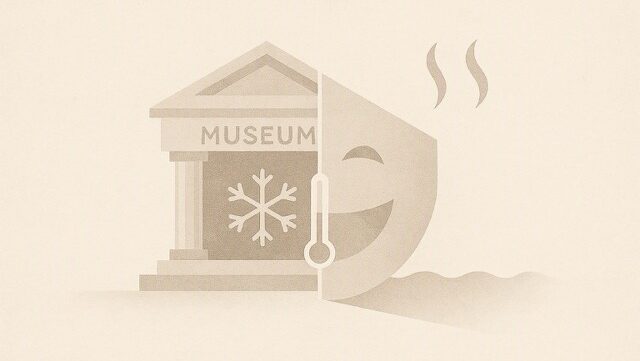
On the paradox of preserving art on a warming planet, and who can afford it. Imagine the perfect room. Twenty-one degrees, fifty per cent relative humidity, without a single fluctuation. The work hangs in ideal conditions, protected from light, from dust, from time. For decades, that stability was the unquestionable ideal of the…
-
The festival that does not fit in the frame
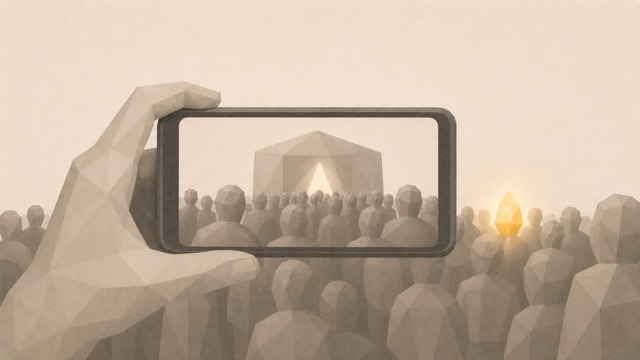
On experience converted into content, and the rest that escapes it. There is a question that the cultural industry has already answered without formulating it: the contemporary festival is not designed solely to be experienced, but to circulate. Recent research states this bluntly. The consumer of experiences seeks, beyond the moment, shareable narrative material…