
Executive summary
The history of art may be read as a history of the social organisation of creative time. Before being a 'genius', the artist requires duration, concentration, materials, space, mediations and a means of subsistence. In the long historical duration, that time has been financed by very different regimes: religious cult, court, nobility, commercial bourgeoisie, state academies, gallery market, teaching salary, grants, residencies or rents. Each of these regimes has opened formal possibilities while closing others. From the ritual dependency described by Walter Benjamin to the network logic of contemporary capitalism analysed by Boltanski and Chiapello, the question is not whether art is materially conditioned or not, but what type of conditioning purchases time, which compresses it and which converts it into a standardised commodity. [1]
The romantic thesis according to which poverty intensifies genius persists as a partial myth. There are indeed studies that show that scarcity can increase novelty in limited tasks of improvisation or 'ingenuity' under restriction; but the most robust evidence regarding financial scarcity shows something else: economic worry reduces cognitive bandwidth, impairs executive functions and pushes one to concentrate on immediate urgency. That is exactly the opposite of the long, discontinuous and often seemingly unproductive time that a great deal of artistic creation requires. In parallel, sectoral evidence regarding artists in the United Kingdom, the USA, Australia and Ireland shows multiple job-holding, irregular income, dependence on family networks and an effective reduction of the time available for practice. [2]
From the point of view of art theory, this compels a shift in the question. It is not advisable to ask whether the market 'kills' or 'stimulates' genius in the abstract, but under what conditions of heteronomy and temporal autonomy a work is produced. Bourdieu helps to dismantle the illusion of the all-powerful genius; Becker shows that every work is collective action; Adorno warns that commodification not only sells works, but transforms the criteria of production and reception; Abbing explains why the extremely high symbolic value of art can structurally coexist with impoverished artists. The practical result is compelling: if a society desires ambitious, diverse and non-homogenised art, it must protect creative time that is not entirely subordinated to immediate sale, the algorithm or continuous self-exposure. [3]
Theoretical framework
In Benjamin, the problem of productive time appears indirectly but decisively. When the work moves from cult value to exhibition value and when technical reproduction emancipates the work from its ritual dependency, it is not only the reception that changes, but the entire economy of production: the work ceases to be anchored in a unique location and authority, and begins to be designed for reproducibility, circulation and, ultimately, for other social and political rhythms. In that transition, what 'withers' is the aura, but the temporality of artistic practice is also modified: more exposure, more circulation, more seriality, less ritual singularity. [4]
Bourdieu and Becker allow us to correct the romantic myth of the isolated creator. Bourdieu maintains that discovering the “rules of art” shatters the illusion of the omnipotent creative genius because the value of a work is produced within a field of institutions, hierarchies, and struggles for legitimacy. Becker, for his part, describes “art worlds” as cooperative networks involving suppliers, distributors, critics, audiences, and infrastructure. In other words: talent matters, but the possibility of converting it into an enduring work depends on a material and social ecology. [5]
Adorno adds the critical dimension of the commodity and the culture industry. In Aesthetic Theory, he insists that the work participates in the commodity form and that the culture industry calculates subjective effects and manages empty leisure. It is not merely a matter of art being sold; it is that the market and cultural administration can demand consumability, standardisation, emotional availability, and rapid satisfaction, diminishing the possibility of slow, negative, or formally risky work. This intuition connects with Boltanski and Chiapello: flexible capitalism incorporated “artistic critique”—autonomy, creativity, rejection of hierarchy—and reconverted it into an ethic of permanent initiative, mobility, and self-entrepreneurship, but “at the cost of material and psychological security.” [6]
Hans Abbing takes the discussion to the economic heart of the problem. His central thesis is paradoxical and useful: art has extremely high symbolic value, but precisely that sacralisation coexists with a “denial of economics” that favours low incomes, an oversupply of aspirants, and poorly paid or entirely unremunerated work. In other words, the prestige of art does not guarantee income; sometimes it hinders it, because it legitimises sacrifice and naturalises the idea that the artist “works for passion.” This helps explain why the discourse of the genius often conceals its material infrastructure: family wealth, parallel employment, a partner, debt, a studio, assistants, grants, or public protection. [7]
Historical genealogy of productive time
In pre-modern regimes, artistic time was conditioned by ritual, the Church, and the court. Benjamin notes that the work of art emerged in connection with ceremonial objects whose primary function was not to be viewed, but to exist within a magical or religious usage; hence, singularity and aura were anchored in tradition and rite. During the Renaissance, the Church and princely courts purchased time and magnificence, yet they did so by directing iconographies, calendars, and scales. Julius II was one of the great patrons of Renaissance art; Michelangelo’s tomb project involved a contract for 10,000 ducats and five years of execution, and the Pope himself subsequently diverted the artist to the Sistine Chapel ceiling between 1508 and 1512. Patronage, therefore, protected time and resources, but not full autonomy: it purchased grandeur in exchange for obedience, courtly prestige, and symbolic service. [8]
Absolute monarchy reinforces this logic in a state-driven key. Under Louis XIV, Colbert proclaimed that the time had arrived for private patrons to cede to the King the direction of the intellectual and artistic life of the realm. The French Académie Royale, and later the Académie de Rome, institutionalised training, hierarchy, and official legitimacy. The artist gains institutional continuity, commissions, and a career, but at the cost of a rigid aesthetic normativity. Creative time ceases to depend solely on the Church or a noble family and becomes administered by state apparatuses of taste. [9]
The Dutch Republic of the 17th century introduced a decisive change: urban, mercantile, and bourgeois growth permitted a more open market for paintings destined for middle-class homes and civilian buyers, not merely churches and courts. That market expanded themes, formats, and specialisations—landscape, still life, domestic scenes—but also intensified competition, the necessity for constant production, and dependence on saleable niches. Greater autonomy regarding official commissions arrived alongside greater exposure to commercial risk. Rembrandt's bankruptcy illustrates this ambivalence well: after declaring insolvency in 1656, he had to surrender almost all his possessions, and Hendrickje Stoffels and Titus founded a company where he appeared as an employee to protect the income from future commissions against creditors. [10]
In the 19th century, the modern art market was consolidated. Academies and public salons remained decisive for reputation, but artists began to depend increasingly on dealers, critics, and new bourgeois collectors. The Metropolitan itself summarises that the French and English academies were the most significant professional societies of the 19th century, while Smarthistory explains that the Impressionists sought alternative spaces—studios, dealer-patron galleries—to sell outside the Salon system. That opening expanded margins for formal innovation, but shifted power towards new mediations: visibility, promotion, bourgeois taste, the gallery circuit, and stylistic branding. Time is no longer purchased solely by commission; it is purchased, increasingly, through the promise of the market. [11]
The twentieth and early twenty-first centuries saw the overlap of three models: public support, the global market, and the digital platform. The American New Deal of 1933–1943 employed artists, musicians, writers, photographers, and actors with public funds on an unprecedented scale; in 1935, Federal Project No. 1 was approved as an arts employment programme. Internationally, the 1980 UNESCO Recommendation and its subsequent developments insist that the vigour of the arts depends on the well-being of artists, calling for measures in social security, income, employment, taxation, and freedom of expression. However, the digital era has reintroduced a new heteronomy: the platform economy and the attention economy exert pressure towards continuous publication, audience management, self-exposure, and fragmented monetisation. [12]
Empirical evidence and biographical cases
Available data converge on a simple conclusion: precariousness steals creative time. In the largest survey of visual artists in England, 68% held additional jobs; only 20% stated they were able to dedicate as much time to their practice as they desired; 80% identified a lack of financial return and 62% a lack of time as the primary obstacles to sustaining an artistic career. The report itself summarises the spiral: as art income is low, artists accept other jobs to make ends meet; those jobs reduce the time available for practice; and that reduction affects creativity and productivity. [13]
In the 2025 US National Survey of Artists, one-third of artists dedicated only between 1 and 8 hours per week to eligible artistic activities; the largest group fell between 9 and 20 hours; only 9.35% exceeded 40 hours. The same report found that 10.91% had held 3 or more jobs in the previous 12 months, and that nearly half of that subgroup had sustained 4 or more. This is not, therefore, an anecdotal exception, but a labour structure of portfolio work and temporal dispersion. [14]
Income policies reveal the reverse: when material ground is protected, more time appears. In Ireland, the evaluation of the Basic Income for the Arts programme found that, in the first six months, its beneficiaries dedicated an additional 3.5 hours per week to their creative practice, reduced work in other sectors by 3 hours, and were 12 percentage points more likely to be able to sustain themselves through artistic work alone; furthermore, they improved in life satisfaction and various indicators of anxiety, depression, and material deprivation. In New York, the Creatives Rebuild New York programme showed an extremely fragile baseline—85% of artists with household incomes below 50,000 dollars, 62% without emergency savings, 46% depending on gig work—and its preliminary findings indicate sustained improvements in savings, debt repayment, capacity to cover bills, and psychological well-being. [15]
The notion that “necessity is the mother of invention” can only be defended with great caution. There are experimental studies that find greater novelty in certain creative tasks under conditions of salient scarcity; however, other research, including a recent meta-analysis and the well-known Science study on poverty and cognitive function, shows that financial scarcity tends to reduce cognitive performance and planning capacity. For long-term artistic endeavour, this matters enormously: situational inventiveness is one thing; the sustainability of the creative process is quite another. [16]
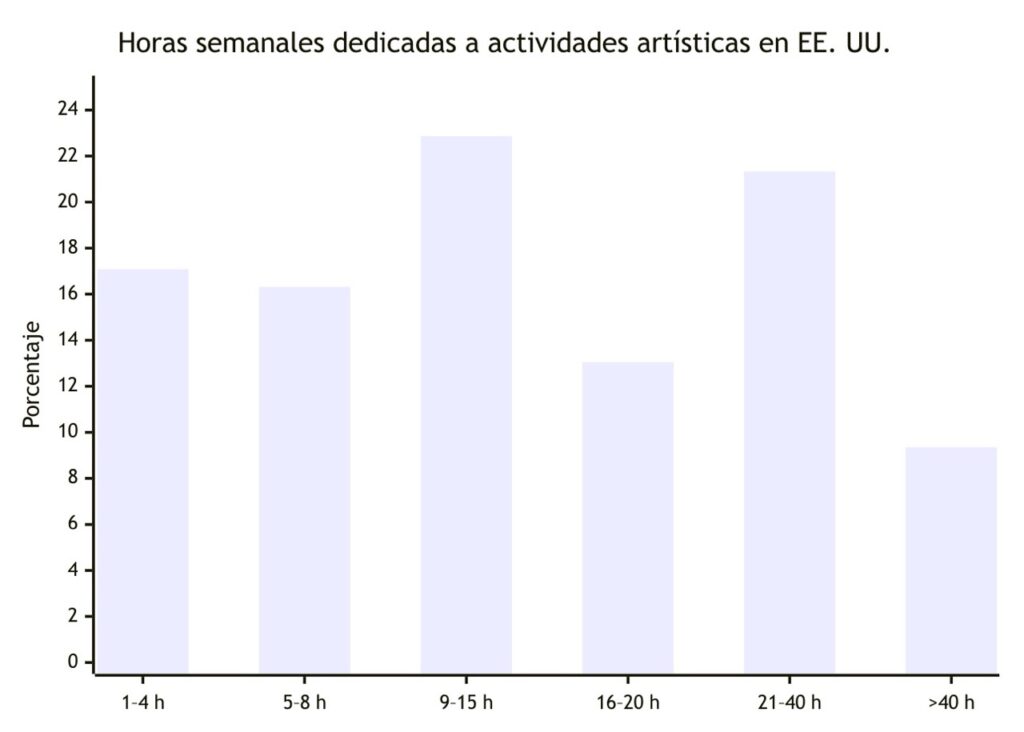
The previous chart synthesises the distribution of hours from the 2025 National Survey of Artists; the density in average dedication brackets and the small fraction above 40 hours suggest that even among those who identify as artists, full-time practice is a minority pursuit. [17]
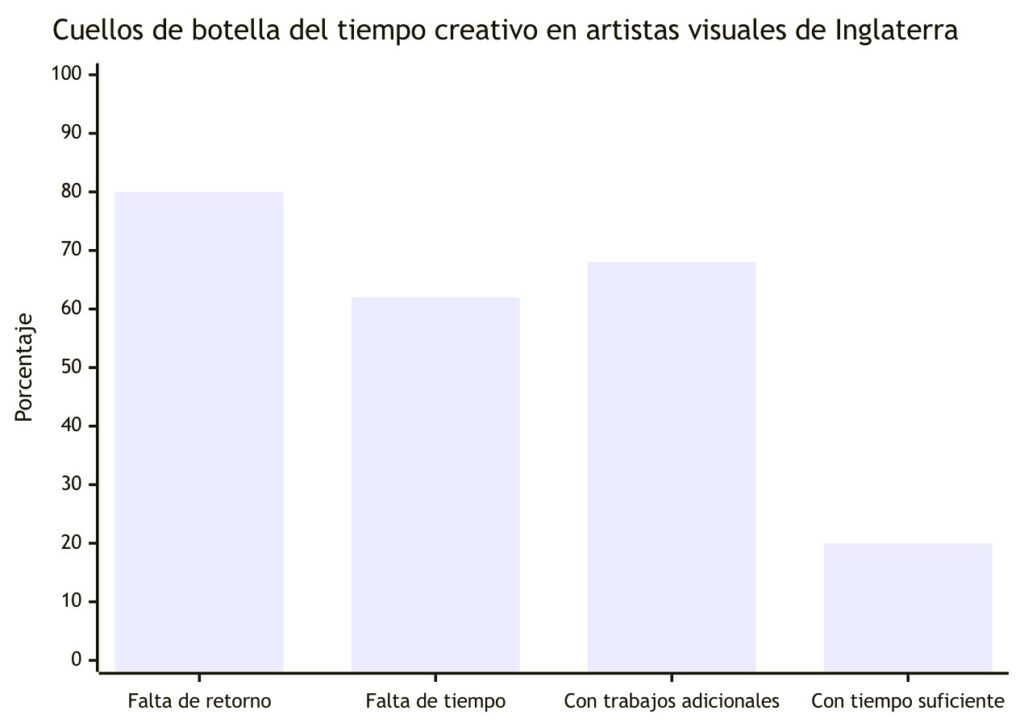
The second chart summarises the English survey on visual artists: precariousness appears not only as an income problem, but as a loss of available time. Perhaps the most telling figure is the last: only one-fifth feel they have the time they require. [18]
Biographical cases help to clarify these tensions:
Michelangelo displays the classical face of high patronage: enormous contracts, access to materials, papal protection, and the concentration of time, but also project diversions, dependence on the Pope, and monumental obligations. The Sistine Chapel ceiling was not born of abstract freedom, but of a combination of power, conflict, and extraordinary funding. [19]
Artemisia Gentileschi illustrates the mobility of talent within courtly networks. The National Gallery of Art summarises that she moved from Rome to Florence to “further her profession” and secure the patronage of the Medici: her career depended less on an impersonal market than on her ability to negotiate protection, commissions, and reputation. [20]
Rembrandt represents the bourgeois market model in its most ambiguous version: great fame, civil commissions, and an open urban market, but also extreme volatility and bankruptcy. That his family had to establish a company to safeguard the income from new commissions reveals that the market can reward mastery without stabilising the artist's life. [21]
Hokusai allows us to see the serial pressure of the publishing market with clarity. The British Museum recalls that, for fifty years, publishers commissioned him to illustrate scenes of daily life, stories, anthologies, and manuals; in the ukiyo-e woodblock system, the publisher coordinated engraving, printing, distribution, and sales, and owned the woodblocks which were equivalent to material copyright. Formal brilliance emerges here within a highly organised and scheduled industry. [22]
Goya transitioned from the court workshop to the modern artist with increasing critical density. The Prado highlights that, as a royal painter, he was obliged to supply portraits of the royal family for institutions and individuals, and that the appointment of First Painter to the King was the ultimate prize of an official career; years later, in 1826, he still returned to Madrid to attend to his royal pension. Security, yes; but at the price of sustained representational servitude. [23]
Vincent van Gogh is perhaps the clearest example of “invisible infrastructure.” The Van Gogh Museum states that, without Theo, Vincent would have struggled to become an artist and that his brother provided him with unconditional financial and emotional support. The myth of the misunderstood genius often recalls the lack of a market, but forgets that there was a fraternal income sustaining the time required for the work. [24]
Tarsila do Amaral shows how class privilege can be transformed into artistic time. The MoMA describes her as being raised in the Francophile environment of the Brazilian bourgeoisie and notes that at the age of 34 she was able to move to Paris to study at the Académie Julian and with Lhote, Gleizes, and Léger. Her case demonstrates that the freedom to “invent Brazil” in a modernist key rested, in part, on an already guaranteed material foundation. [25]
Amrita Sher-Gil confirms a similar pattern from South Asia: a cosmopolitan background, aristocratic origins, and transnational cultural capital. Britannica notes that she was born in Budapest, the daughter of a member of an aristocratic Indian family from the Punjab and a Hungarian opera singer; the Tate adds her training at the École des Beaux-Arts in Paris. Her innovation did not stem from destitution, but from the capacity to circulate between aesthetic worlds. [26]
Jacob Lawrence is an exemplary case of public support. The Phillips Collection notes that in 1938 he began working for the WPA Federal Art Project and that in 1940 he obtained a grant from the Rosenwald Foundation to produce The Migration Series. Here, public and philanthropic policy did not replace the work: it purchased the time necessary to produce it. [27]
El Anatsui embodies a distinct path to sustainability: the long-term teaching position as a foundation for experimentation. His official biography notes that from 1975 he taught at the University of Nigeria, Nsukka, for over four decades. Such institutional stability did not stifle innovation; it rendered it compatible with long-term material research until his global recognition. [28]
Cecilia Vicuña makes the relationship between exile, precariousness, and form visible. Her own official biography indicates that she has lived in exile since the coup against Allende, and the Tate explains that she received a British Council grant, was unable to return to Chile, and terms part of her work “precarious art” due to its fragility and vulnerability. In this instance, precariousness is not a romantic condition, but a historical and political experience that is converted into poetry. [29]
Yayoi Kusama illustrates the contemporary form of the tension between repetition and the market. The Tate highlights her continuity in self-presentation, and the MoMA recalls that in 1969 she founded Kusama Enterprises, a commercial channel that sold clothing, handbags, and even cars featuring her aesthetic of polka dots and repetitive patterns. Her work reveals that repeatable stylisation can simultaneously be an artistic language, a brand, and a machine for visibility. [30]
Support models and policies
| Model | How it protects time | Primary advantages | Primary risks | Typical effect on creative time |
| Religious or courtly patronage | Purchases time, materials, and scale through commission | Stability, ambitious works, concentration of resources | Iconographic dependence, censorship, symbolic service to power | High, but heteronomous |
| Open market for sales and galleries | Monetises finished work or reputation | Greater relative thematic freedom, possibility of autonomy from the State | Volatility, competition, need for a legible and repeatable style, visibility cycles | Variable; can liberate or fragment |
| Grants and project subsidies | Temporary funding for research or production | Allow for risk, experimentation, and market discontinuity | Brevity, bureaucracy, evaluation via open calls, intermittency | Medium-high, but discontinuous |
| Basic income or guaranteed income for artists | Ensures subsistence without conditioning every formal decision | Reduces financial anxiety, increases practice hours, improves autonomy | Fiscal cost, definition of eligibility, political risk of reversal | High and transversal |
| Residencies | Isolate work time and space for a period | Concentration, research, networks, mobility | Short temporality, unequal access, potential reputational pressure | High, but episodic |
| Parallel teaching or non-artistic work | Purchases time indirectly via external salary | Stability, labour rights, lower dependence on sales | Fatigue, fragmentation, reduction of creative hours and energy | Medium or low, depending on workload |
| Family or partner support | Informal private subsidy | Flexibility and quiet continuity | Reproduces class, gender, and wealth inequality | High for those who have it; exclusionary for the rest |
The table synthesises historical and contemporary findings. Renaissance and monarchical patronage purchased time at the cost of symbolic obedience; the Dutch and modern market expanded relative freedom, yet introduced competition and serialisation; grants and residencies protect time, albeit in a fragmentary manner; guaranteed incomes demonstrate direct effects on hours of practice and material viability; and parallel employment remains the dominant mechanism for survival, even when it compresses creation. In the sources reviewed, the best results regarding creative time appear when there is a stable income floor combined with specific support, mobility, social protection, and fair remuneration standards. [31]
Based on this evidence, the most robust policies to protect creative time are few, yet quite clear. First, establish a base income or a guaranteed income for artists and cultural workers, as it is the mechanism that acts directly upon available hours, financial anxiety, and autonomy of choice. Second, complement this base with multi-year grants rather than project-based funding, to prevent the artist from living in a state of permanent application. Third, legally recognise the atypical employment status of the artist with portable social security, adapted taxation, and the effective right to contracts and fair remuneration. Fourth, reinforce residencies, subsidised studios, and support for care and mobility, because creative time depends not only on money, but also on space, rest, and logistics. Fifth, intervene in the digital economy by demanding fair remuneration and transparency from platforms, as visibility is not equivalent to sustainability. [32]
It is advisable to include a measure that is often underestimated: paying for the labour, not merely the work. The guidelines of Artists’ Union England explicitly oppose 'fee-based opportunities' because they exacerbate the disadvantage faced by freelance and precarious workers, and their fee tables acknowledge that artistic activity cannot be calculated as if the entire year were billable: even their estimates of 1,152 'optimal' annual billable hours start from the assumption of time that is invisible, unpaid and not reducible to immediate delivery. In simple terms: a serious art policy must also purchase the time for experimentation, administration, trial, error and care. [33]
Chronology
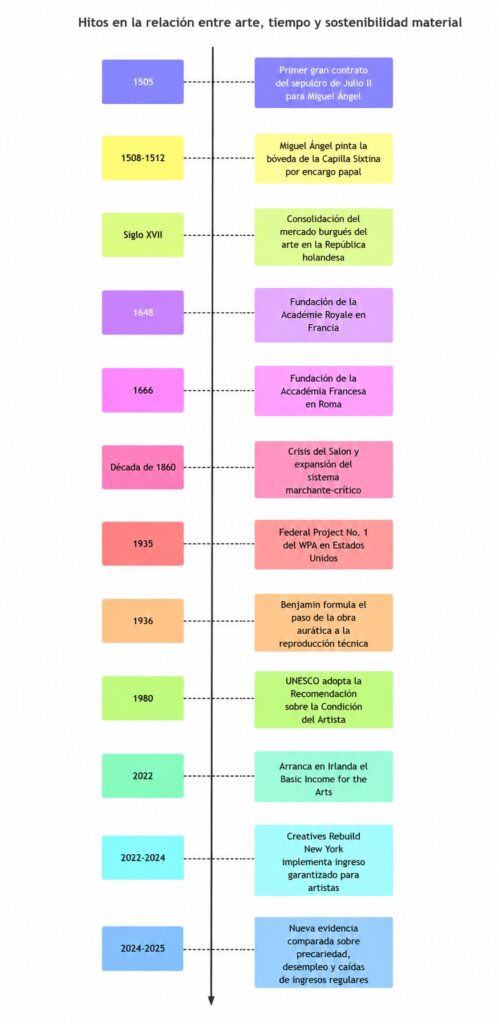
The chronology gathers milestones in which not only the status of art changed, but also the way of financing or expropriating creative time: from the monumental contract and the State academy to the modern market, from the reproducible work to the social protection of the artist, and from there to current experiments in income and the pressure of the attention economy. [34]
Conclusions
The central conclusion is twofold. First: artistic genius is never purely internal; it is always materially mediated. The work requires a regime of time. Sometimes this time is purchased by the pope, the king, the collector, the publisher, the university, the family, the union, or the State; at other times it is stolen from rest, health, or employment unrelated to art. But it is never free. Becker and Bourdieu help to state this with precision: the genius does not disappear, but ceases to be an ahistorical miracle and appears as a high point within a field, a network, and an infrastructure. [35]
Second: the market is not simply an enemy of art, but it is a frequent enemy of the time that art requires. It can open relative freedom with respect to the State or the Church; it can reward innovation; it can finance entire careers. However, it also tends to demand legibility, brand repetition, continuous output, and, today, permanent presence on platforms. When this occurs, the market ceases to be a means of circulation and becomes a device of temporal compression: it compels one to produce visibility before producing truth, to sustain a persona before a process, to repeat a signature before exploring form. [36]
For this reason, if one desires a cultural policy oriented not only towards supply but towards the very possibility of the work, the variable that must be protected is not an abstract notion of “creativity,” but the socially guaranteed time to create. Evidence from Ireland and New York suggests that when material anxiety is reduced, artists dedicate more hours to their practice, decrease their dependence on unrelated work, and recover their capacity for risk, research, and care. This is not a surprise; it is the empirical confirmation of something that art history has known for centuries: great works are rarely born from mere economic urgency. They are born, rather, when someone—a patron, a public institution, or a political community—decides that the short-term unproductive time of art deserves to be sustained. [37]
Limitations and open questions
Empirical evidence regarding creative working hours is not yet globally standardised. In the sources reviewed, there is robust data for the United Kingdom, the US, Australia, Ireland, and certain specific programmes, but no homogeneous global series by discipline and region; when such data is absent, it must be considered unspecified.
Neither is there a simple metric of 'genius' that allows for a strong and universal correlation with a funding model. What can be measured with greater confidence is something prior and decisive: income, material security, multiple job-holding, financial anxiety, available time and conditions of production. The most promising future research would not be to attempt to quantify genius, but to better study which institutional arrangements produce sufficient time so that genius, when it appears, is not destroyed by necessity.
See also: The hand that funds.
Sources
[1] [4] [8] https://web.mit.edu/allanmc/www/benjamin.pdf
[2] [16] https://academic.oup.com/jcr/article-abstract/42/5/767/1855952
[3] [5] https://books.google.com/books/about/The_Rules_of_Art.html?id=liZjQgAACAAJ
[6] https://archive.org/download/adorno-la-sociedad/Adorno_Theodor_W_Teoria_estetica_ES.pdf
[7] https://library.oapen.org/bitstream/id/92339cef-c1e9-41fe-ade8-8dc95a67b948/340245.pdf
[9] https://www.metmuseum.org/essays/french-decorative-arts-during-the-reign-of-louis-xiv-1654-1715
[10] https://smarthistory.org/the-dutch-art-market-in-the-17th-century/
[11] https://www.metmuseum.org/essays/the-salon-and-the-royal-academy-in-the-nineteenth-century
[12] https://www.archives.gov/exhibits/new_deal_for_the_arts/
[13] [18] https://www.artscouncil.org.uk/sites/default/files/download-file/Livelihoods%20of%20Visual%20Artists%20Summary%20Report.pdf
[14] [17] https://assets.ctfassets.net/nslp74meuw3d/1FxhovRk97PySgDmnXrKsn/3c6a1929323da20b58731be6c3e209e5/National_Survey_of_Artists_-_Findings_Report_October_2025_.pdf
[15] [32] [37] https://assets.gov.ie/278306/10ae2240-851a-4411-af8d-064e21c322ca.pdf
[19] [31] https://www.metmuseum.org/essays/the-papacy-and-the-vatican-palace
[20] https://www.nga.gov/stories/articles/exceptional-emotion-artemisia-gentileschis-mary-magdalene-ecstasy
[21] https://www.rijksmuseum.nl/en/stories/dutch-masters/story/rembrandt-rijn-10
[22] https://www.britishmuseum.org/hokusai-resources
[23] https://www.museodelprado.es/en/the-collection/art-work/portrait-of-king-charles-iv/dc08afaa-8985-4457-8c5f-cc3cf2fff2dc?searchid=cca91a77-b731-4869-3d70-5af07f4b00c9
[24] https://www.vangoghmuseum.nl/en/art-and-stories/stories/brotherly-love
[25] https://www.moma.org/artists/49158-tarsila-do-amaral
[26] https://www.britannica.com/biography/Amrita-Sher-Gil
[27] https://lawrencemigration.phillipscollection.org/about-jacob-lawrence
[28] https://elanatsui.art/biography
[29] https://www.ceciliavicuna.com/biography
[30] https://www.tate.org.uk/art/artists/yayoi-kusama-8094/introduction-yayoi-kusama
[33] https://www.artistsunionengland.org.uk/rates-of-pay/
[34] https://www.metmuseum.org/art/collection/search/334655
[35] https://books.google.com/books/about/Art_worlds.html?id=jXDyRK2EL5YC
[36] https://smarthistory.org/artists-in-and-against-the-museum