
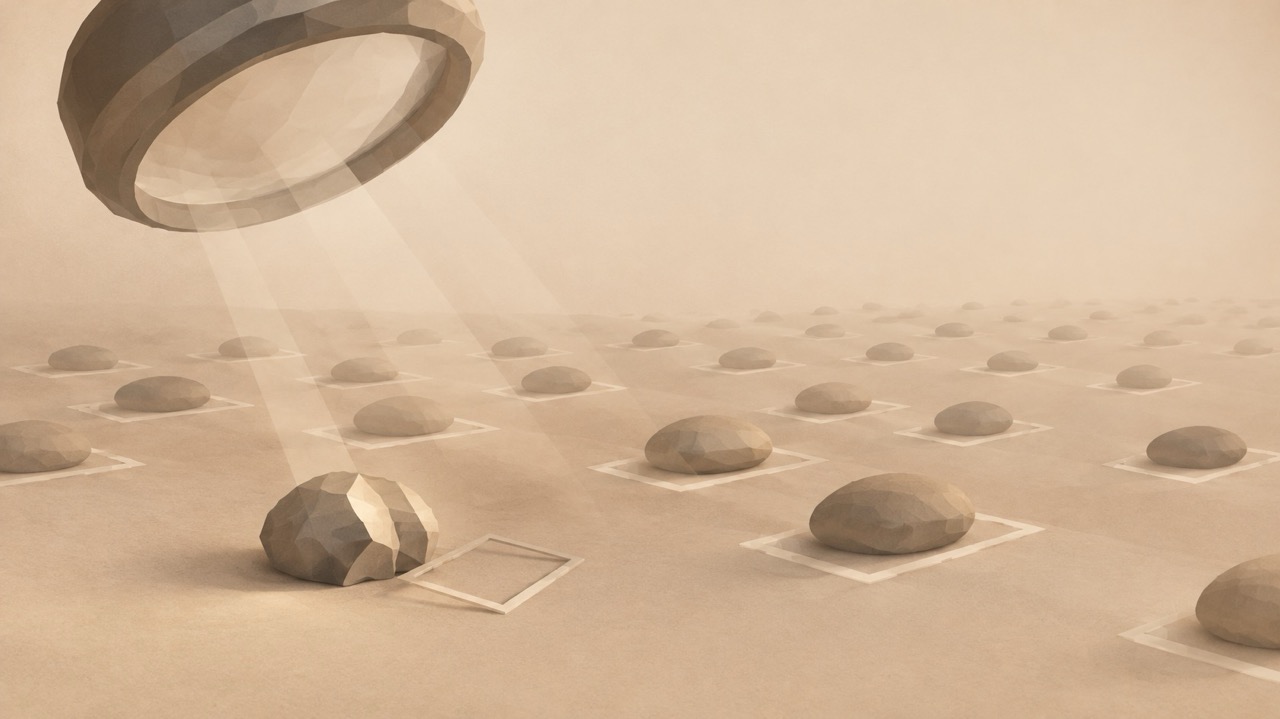
Simon Weckert designed a garment whose pattern prevents, under certain conditions, some computer vision systems from registering the wearer as a person. The body remains visible to anyone looking. The interruption occurs in the automatic classification.
Digital Camouflage was presented at Ars Electronica in 2025 and the artist's current entry dates it to 2026. Both references can coexist: one documents the exhibition; the other, the version that Weckert maintains today. The artist states that the pattern was developed and tested with detectors from the YOLO family. He also sets limits on the result: it depends on the model, distance, angle and lighting. He does not claim that the garment neutralises a specific governmental system.
This caution allows the work to be examined as a situated test. Without it, it would be reduced to an invisibility product impossible to audit.
Two perspectives on the same surface
A person sees a shirt with saturated shapes. The detector processes regularities, proposes boxes and assigns classes with a degree of confidence. If the combination of contours, textures and proportions deviates from what has been learned as a 'person', the box may disappear even though the body remains whole in the image.
Algorithmic surveillance is not a single gaze. It chains optics, compression, architecture, training data, confidence thresholds and organisational rules. A camera produces a signal; a model classifies it; an institution decides what consequences to attribute to that output. A failure in one link does not necessarily render the others useless. That a detector does not draw the 'person' box does not prevent the video from being kept, movement from being tracked, a face from being recognised by another system or the recording from being analysed later.
For this reason, it is advisable to distinguish between person detection, facial recognition, cross-camera re-identification and behaviour analysis. Weckert's garment acts upon a specific task. Presenting it as a general defence against surveillance would induce a false sense of security.
The piece is linked to Kottbusser Tor, in Berlin, where the artist situates the debate on systems capable of classifying behaviours in public space. His critique does not need to exaggerate the efficacy of the shirt. It suffices to show that an infrastructure presented as objective observation depends on vulnerable categories and thresholds.
CV Dazzle after Viola-Jones
Adam Harvey presented CV Dazzle in 2010 as a master's thesis at New York University. The hairstyles, make-up and accessories altered the contrast zones and spatial relationships expected by the Viola-Jones facial detector, then included in OpenCV.
Harvey maintains a warning that is uncommon in works promising technical resistance. Viola-Jones fell into disuse in the security sector between 2013 and 2016, and the original designs, conceived between 2010 and 2013, ceased to be effective.
The warning is part of the documentation. It prevents a historical image from circulating as current advice and turns the expiry into public information. A computational camouflage is designed against an architecture, a body and an environment. When the detector changes, the technical solution may revert to being mere make-up or a pattern. The strategy continues only through new tests.
Obsolescence does not eliminate the interest of CV Dazzle. The piece made visible that automatic recognition does not find a face as someone looking does: it extracts features and contrasts them with a formal repertoire. Its subsequent failure confirms how dependent it was on that repertoire.
Local efficacy and artistic duration
An adversarial work has at least two lives. During the first, it may pass a technical test. During the second, it remains as a configuration capable of reorganising the way an infrastructure is understood.
The first result is measurable, although it demands more documentation than usual. The second does not depend on the same pattern continuing to function years later. Digital Camouflage may lose efficacy against future versions of YOLO and still preserve the scene it proposes: a person present to passers-by and absent from an automatic description.
Not every detector failure is art. The interest appears when the configuration forces the separation of states that surveillance had merged: being present, being visible, being detected and being identified. The technique provides the initial event; the subsequent elaboration decides whether the work leaves a question more lasting than its vulnerability.
My research into structural surplus sets a demanding test here. If the piece is exhausted by fulfilling the function of evasion, it expires with the patch. If the function opens a difference that other works, debates and institutions can revisit, the technical update does not conclude the artistic event.
Showing the classification
Niveles de opacidad, by Roma Blanco, Juan Ignacio Cabruja, Andrés Di Martino and Lourdes Rivadeneyra, works from a different position. The installation, presented in Buenos Aires as part of Presente Continuo, allows the translation that an artificial vision system makes of the body to be observed and altered. It is based on a survey of cameras carried out by Amnesty International Argentina around the National Congress.
The available public documentation does not identify the model, the dataset or the complete procedure. It does not allow one to claim that the installation evades real-world systems. According to the exhibition presentation, it renders classification visible and makes it manipulable. Resistance begins by acknowledging that an inference exists, which categories it utilises and what decision it may trigger.
The three cases outline a sequence without yet forming a conclusive trend: attacking a facial detector; confusing a body detector; exposing algorithmic translation. The technology and tactics change. The dispute over the categories with which an infrastructure describes public space persists.
Documenting an adversarial work
Promotional demonstrations often show a success. A useful test must include the complete framework:
- Exact architecture and version of the model.
- Weights used and date of download.
- Resolution, optics and compression.
- Distance, angle and lighting.
- Number of trials and success rate.
- Comparison with control garments or patterns.
- Failed examples.
- Confidence threshold.
- Code, seeds and transformations applied to the design.
It must also specify what it does not prove. Deceiving an open-source detector does not demonstrate that the same garment functions against a commercial or police system. Achieving the disappearance of a bounding box does not prevent other forms of analysis. A work may critique institutional opacity without claiming a protection it does not offer.
Weckert and Harvey integrate the limit into their presentations. The former restricts the scope of his trials; the latter publishes the expiration of his designs. That documentary responsibility is as significant as the pattern itself.
The machine learns another way to detect. The work is subjected to another test.
On the open conversation
This text opens a line of the Notebook on art and artificial vision, distinct from that dedicated to generated images. It may be read alongside The disappearing model and the guide to documenting the creative process. If you are aware of Spanish or Latin American works that operate against automatic classification and publish their method, you may write to me.
The author’s relationship to the case
I maintain no relationship with the artists or institutions cited. The Esteban-Ruiz Collection does not contain works by these authors.