
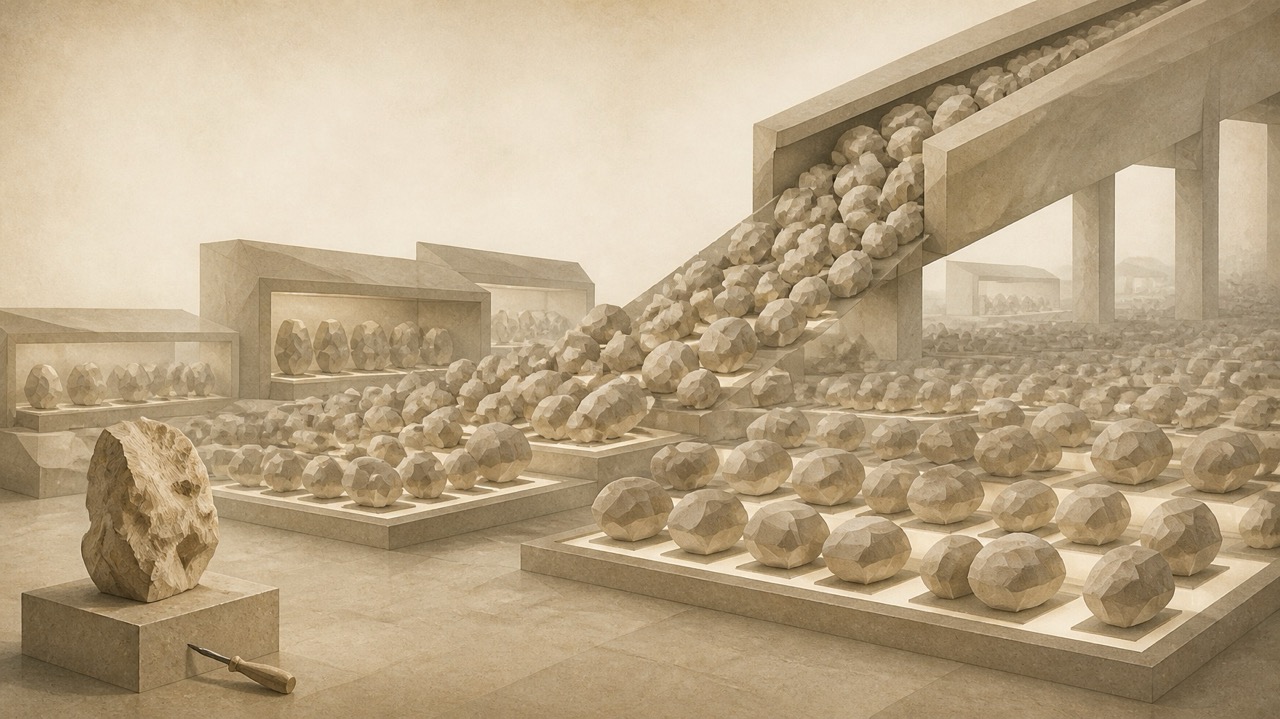
An image generated by artificial intelligence may fail to meet the requirements for protection as a work and yet supply a cover. A text may lack sufficient creative human contribution and still take the place of a commission. A composition may have no legally recognisable author and yet enter a music library, accompany an advertisement or compete to be heard.
Legal classification and economic functioning do not necessarily coincide. The law asks whether the result expresses sufficient free and creative human decisions to receive protection. Whoever commissions a service may ask whether the material fulfils the required function at an acceptable cost, speed and quality.
The European Parliamentary Research Service placed this distance at the centre of a report published on 21 October 2026. The document describes a criterion that is consolidating across various jurisdictions: content produced entirely by AI, with minimal or non-existent human intervention, does not typically reach the threshold required by copyright law; AI-assisted creations may be protected when they incorporate substantial human creativity, assessed on a case-by-case basis. At the same time, such outputs may compete directly with human works for attention and revenue, reduce their visibility and limit the economic opportunities of those who create.
That is the problem I address here. Not whether a machine can become an author, a question I develop in ‘Authorship and works made with AI under Spanish law’, but what happens when something that the law does not recognise as a protected work circulates as a functional substitute for a human creation.
The lack of protection for the result does not protect those who work.
The law classifies; the market replaces
The European framework does not set a percentage of human intervention that automatically transforms a result into a work. Originality requires that a person's free and creative decisions can be identified as reflected in the result. A general instruction followed by the acceptance of the first output hardly demonstrates, by itself, that contribution. Extensive intervention does not guarantee protection by accumulation either: what matters is whether the selection, arrangement, editing or transformation express human creative decisions.
That is why the assessment is individual. A creation may combine protected and non-protected elements. The use of a generative tool does not exclude human authorship, but neither does it make an author of someone who merely requests and accepts an output. The European report recalls that it will be for the courts and, where appropriate, the legislator to specify the threshold in borderline situations.
That an output is not protected as a work does not mean it is legally innocuous or that it can be used freely in any circumstance. It may reproduce protected elements, affect trademarks, designs, image rights, personal data or trade secrets, or be subject to contractual conditions. The absence of copyright on the result does not eliminate other rights nor does it make lawful what infringes the rights of others.
Legal classification allows one to determine whether a protected work exists and who may exercise rights over it. It does not reveal how many commissions have been transformed, which fees have fallen, how a platform orders content, what visibility a work loses or who captures the savings. Those are questions about labour, distribution and infrastructure.
The European Artificial Intelligence Act does not close that distance either. Its Article 53 requires providers of general-purpose models to have a policy to comply with Union copyright law and, in particular, to identify and respect reservations made in accordance with Article 4.3 of Directive 2019/790. It also obliges them to publish a sufficiently detailed summary of the content used to train the model, in accordance with the AI Office template. These are obligations relating to the development and provision of the model. They do not grant copyright over its outputs, they do not declare every use of protected materials lawful and they do not guarantee that the hiring of creative labour will be maintained. The difference between training, protection of the result and working conditions is explained in ‘Artificial intelligence and copyright in Europe: what has been decided in 2026’.
Protecting a work against certain uses remains necessary. It is not sufficient to protect the material conditions that allow it to be created.
A synthetic result can perform functions for which creative work was previously hired: illustrating a news item, producing an advertising image, preparing a voice-over, generating ambient music, drafting a description, translating a first draft or multiplying variations for a catalogue.
Not all those tasks will disappear nor does every use of AI replace a person. The International Labour Organization considers the transformation of jobs more likely than their complete elimination. In the cultural and media sectors, however, it identifies high exposure in occupations such as writing, journalism and translation, in addition to risks of displacement, loss of income and reduced demand for certain profiles. Tasks of supervision, correction and system management may also grow.
Change does not necessarily manifest as an overt dismissal. It may appear as a commission that ceases to be offered, a reduced budget, the obligation to deliver more pieces within the same timeframe, or the conversion of a creative task into the mere revision of generated materials. This may particularly affect entry-level roles through which professional craft, judgement, and networks are acquired.
A report requested by the European Parliament's Committee on Culture and Education and published in September 2026 identifies risks to creative labour, professional skills, cultural diversity, market saturation and decision-making capacity. Among its priority recommendations are protecting entry-level jobs and core skills, strengthening the rights of creators and improving transparency and labelling. The concern is not merely about preserving existing positions. If the tasks through which a person learns a profession disappear, the possibility of developing future career paths is also narrowed.
Herein lies the central asymmetry: a result may be too lacking in human input to receive protection, yet sufficiently functional to substitute for human labour.
Substitution does not require artistic equivalence. A media outlet, a company, or an institution may consider two materials interchangeable because both fulfil a function, even if they acknowledge differences in quality, context, or cultural value. Those in need of a secondary image, background music, or a descriptive text may seek sufficiency rather than excellence. Defending the superiority of human creativity in the abstract does not address that economic decision.
Human creation does not always compete against superior synthetic production. It may compete against an output considered sufficiently useful, immediately available, and nearly free in its marginal cost.
Value does not disappear: it shifts
If a result lacks sufficient human authorship, copyright over the output does not arise solely from that fact, according to the prevailing understanding in the European Union. This does not prevent value from being produced and concentrated around it.
A platform may monetise subscriptions, computing capacity, speed, personalisation, and integration with other services. A company may reduce costs or increase volume. An intermediary may control the interface, the recommendation, and access to the public. Value may be concentrated in the infrastructure without taking the form of an exclusive right over every image, text, or sound produced.
The question of 'who owns the work?' remains pertinent when a protected work exists. In other cases, it may obscure the primary economic relationship. It is prudent to ask who controls the conditions of production, who decides on distribution, what data feeds the system, who assumes the errors, and what portion of the savings reaches those performing the remaining work.
The reduction of cost per unit does not equate to a wider distribution of value. It may increase the number of contents while simultaneously concentrating revenue among providers, platforms, and rights holders with the capacity to negotiate licences or integrate their own systems. The European Union Intellectual Property Office has documented the emergence of a market for high-quality content licences for training and considers the effective possibility of reserving rights a condition for its development. It also warns that there is no single solution for exercising those reservations.
This introduces another inequality. A large catalogue can negotiate, signal, and control its materials with greater capacity than an individual artist, a small media outlet, or an institution with limited technical resources. The guide ‘How to reserve your rights against data mining’ explains the available mechanisms and their limits. Even when the reservation works, the problem of the competing result remains: controlling the use of a work during training and competing with the system's production are related, yet distinct, issues.
I propose calling synthetic surplus a hypothesis, not a legal category: a scalable supply of images, texts, sounds, and videos whose production no longer depends on the labour time required to create each unit.
The hypothesis relates to Structural Surplus, but is not to be confused with it. Structural surplus describes conditions in which a portion of cultural production and labour remains outside stable mechanisms of recognition, funding, and circulation. It predates generative AI. Synthetic production may intensify it by introducing more materials into the same limited space of attention, budget, and legitimation.
The sequence is straightforward:
- There is already more cultural production than there is capacity to fund, exhibit, and attend to it.
- AI reduces the time and marginal cost of producing certain forms.
- Supply increases without a necessary growth in demand, budgets, or attention.
- Platforms retain a decisive position in selection and visibility.
- Abundance may coexist with a greater concentration of income and opportunities.
We do not yet know the intensity with which this effect occurs in each sector. Independent data, comparable series, and sufficient access to information from platforms and providers are lacking. The European Parliament's report on the cultural and creative sectors identifies precisely the absence of independent monitoring and effective enforcement mechanisms as obstacles to designing policies.
AI does not, by itself, create the structural surplus of culture. It may expand its scale, accelerate its production, and shift the point of scarcity. If producing a form costs less, scarcity does not disappear: it concentrates in visibility, trust, selection, distribution, and remuneration.
A cultural policy that looks beyond authorship
Museums, universities, administrations, foundations, and cultural centres already use AI for communication, translation, documentation, mediation, design, and administrative tasks. Their responsibility does not end with checking whether the resulting material has copyright. Before incorporating synthetic production, they should be able to answer:
- Whether a professional commission has been substituted or transformed.
- What savings are obtained and what costs of revision, correction, and supervision arise.
- Which tool and provider are used and under what conditions.
- What materials are introduced into the system and what rights, confidentiality duties, or data protection rules affect them.
- What human intervention is retained and how it is documented.
- When the public must be informed of the artificial or manipulated nature of the material, including applicable transparency obligations.
- Who is responsible for errors, biases, false attributions, or misuse.
- The effects of such usage on accessibility, linguistic diversity and territorial representation.
- The obligations arising from public procurement, subsidies, collective agreements or the applicable professional contract.
An institutional AI policy should incorporate responsible procurement. It is insufficient to merely authorise tools and prohibit the entry of sensitive data. It must also record which tasks are automated, which profiles are no longer being hired, which are being transformed and who performs the additional work that automation conceals. ‘Museums and artificial intelligence: use is advancing faster than governance’ elaborates on this institutional governance framework.
In publicly funded programmes, transparency should extend to tools, providers, costs, purchasing criteria, displaced commissions and the assessment of labour and cultural impact. This is not to impede any usage, but to prevent a budgetary reduction from being automatically presented as innovation and to ensure that the cost shifted onto professionals, the public or infrastructure does not remain invisible.
The European report leaves open the possibility of exploring specific rights for certain non-original, computer-generated outputs. Before expanding ownership over synthetic production, it is necessary to understand what problem is intended to be solved and who would benefit.
A new exclusivity could incentivise investment, yet it might also reinforce the position of those who already control models, computing power and distribution. Granting rights over large-scale produced outputs does not guarantee remuneration for those who created the training materials, nor does it provide better conditions for cultural labour. It could increase the volume of appropriable assets without correcting the concentration that governs their circulation.
Cultural policy requires data that currently appears fragmented. It would be necessary to measure, at a minimum:
- The volume and type of synthetic content utilised in each sector.
- Tasks that are automated, assisted or newly created.
- Commissions that have been displaced or transformed.
- The evolution of fee structures.
- Work related to selection, correction, verification and supervision.
- The comparative position of human and synthetic content in search engines and recommendation systems.
- The distribution of revenue.
- The usage, providers, costs and purchasing criteria of public institutions.
Measurement alone will not resolve the relationship between human creation and AI. It will, however, allow for the distinction between productivity, substitution, concentration and professional change, rather than grouping them under a single narrative of innovation or threat.
Before creating rights over synthetic outputs, it is necessary to know who produces them, who distributes them, what work they displace and who captures the value. The primary void may not lie in the ownership of the result, but in the lack of information regarding its effects.
The question of whether an artificial intelligence can be an author has dominated the debate because the law requires the classification of the result and the assignment of powers. Yet, legal classification does not halt circulation. Content may fall outside copyright and enter the market fully; it may not be a protected work and yet substitute an image, a piece of music or a text that previously required human labour.
Defending creation cannot be limited to reserving authorship for individuals. It also requires observing the conditions under which synthetic outputs acquire visibility, occupy catalogues, lower the cost of services and redistribute income. The issue is not granting rights to a machine. It is determining what obligations correspond to those who industrially produce, distribute and utilise materials capable of competing with human works.
The law can determine what merits protection. It cannot, by itself, guarantee that what it protects will continue to find the material conditions to exist.
About the open conversation
This text distinguishes between the legal framework described by the sources, the documented risks and my hypothesis regarding the synthetic surplus. It does not constitute legal advice, nor does it maintain that all AI usage substitutes human labour.
I am developing the research Structural Surplus, to which the interpretive hypothesis proposed in this article is related. I have no economic or professional relationship with the institutions and organisations cited.
If you work in creation, cultural procurement, research or public policy and wish to clarify a point or discuss this reading, write to me.
Sources
- European Parliamentary Research Service, Copyright and artificial intelligence-generated outputs: Protectability of outputs and competition with human-created works, 21 October 2026.
- European Parliament, AI in Cultural and Creative Sectors: Opportunities, Challenges and Legislative Limitations in the Audiovisual, Publishing and Music Streaming Sectors, September 2026.
- Regulation (EU) 2024/1689 on Artificial Intelligence, particularly Article 53.
- Directive (EU) 2019/790 on copyright and related rights in the Digital Single Market, particularly Articles 3 and 4.
- International Labour Organization, Generative AI and the media and culture industry, 27 February 2025.
- International Labour Organization, Generative AI and jobs: A 2025 update, 20 May 2025.
- European Union Intellectual Property Office, Development of Generative Artificial Intelligence from a Copyright Perspective, 12 May 2025.