
In the 2024-2025 hydrological cycle, Doñana received 675 litres of rainfall per square metre, against a historical average of 530. March accounted for 287.2, 42.6% of the annual total. The marshland flooded almost entirely for the first time since 2010, retaining water for 157 days, whereas the average is 79.
It followed more than a decade of below-average rainfall and the severe droughts of 2022 and 2023. The report Estado de la biodiversidad de Doñana 2025 (State of Doñana Biodiversity 2025), which the Doñana Biological Station (EBD-CSIC) presented in February 2026, records improvements in vegetation, bird breeding, amphibians and aquatic insects.
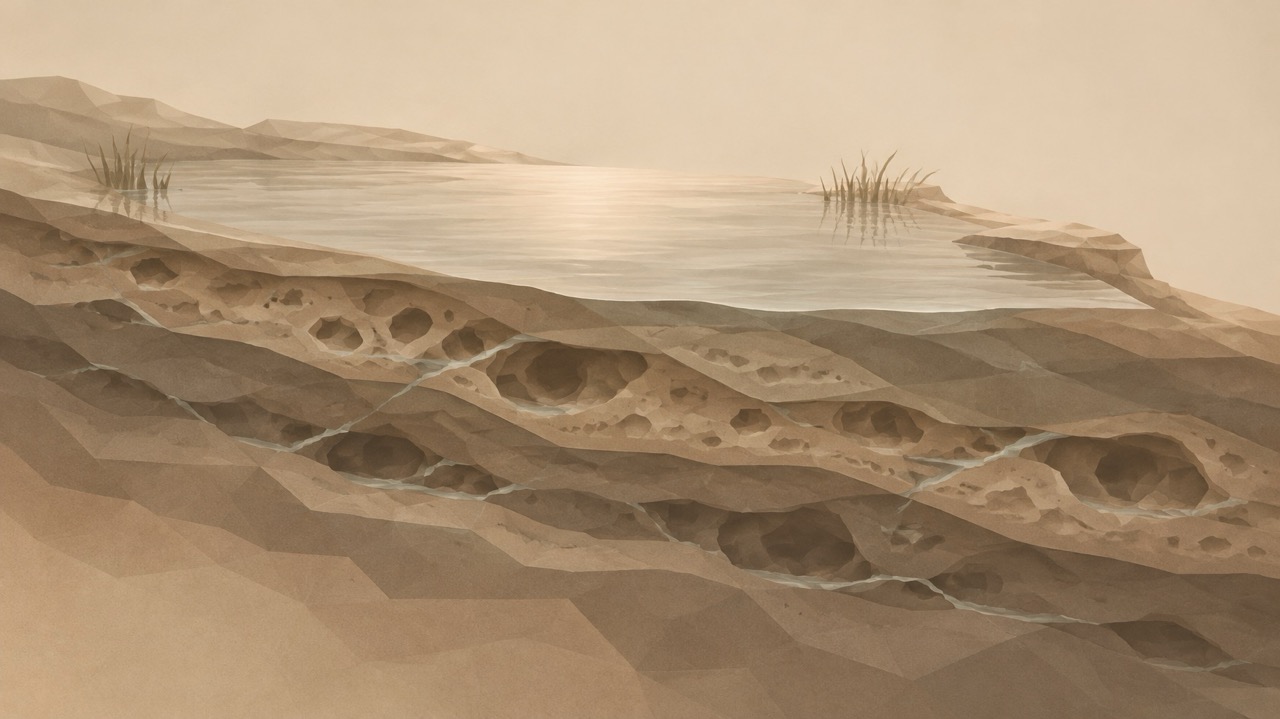
The same report prevents that recovery from being read as a general diagnosis. The temporary lagoons depend more on the aquifer, only some of them flooded, and many are still colonised by terrestrial vegetation. Rain filled the marshland in weeks; the subsoil responds on a different timescale.
Two water systems
The marshland receives water from streams, rainfall, and the river, and its surface can change within a few weeks. The lagoons depend primarily on the groundwater level. A wet year produces a visible surface response without repairing years of aquifer depletion.
Figures for flooded lagoons vary. The official annual balance communication cites 53% with water, while other information based on the same report provides lower percentages depending on the moment or the set of lagoons considered; without specifying the denominator, no single figure is reliable. The firm fact is that the lagoons recovered significantly less than the marshland.
The Biological Station links the terrestrial vegetation occupying the temporary basins to a long-term trend and groundwater extraction. This change is not undone by the return of water for one year: the vegetation, the soil, and a lagoon's connectivity can hinder its recovery even if rainfall increases.
Birds: a good year within a long-term decline
In January 2025, approximately 178,900 wintering waterbirds were counted, far from the historical average of nearly 280,000 and even further from the over 600,000 recorded in the late eighties and early nineties. The greylag goose population fell to around 3,500 individuals, the lowest in the series.
Reproduction improved compared to 2024 for many species, although over twenty years the trend remains negative for a significant portion of them. The two scales are compatible: a good cycle increases nests and survival without reversing the cumulative loss of habitat and abundance.
Furthermore, the effects were uneven. Intense rainfall favoured aquatic organisms and marshland productivity, while highly concentrated episodes harmed sensitive species. The quantity of water, in isolation, reveals little regarding its ecological quality or its distribution throughout the year.
Three water bodies at risk
In 2019, the Guadalquivir River Basin Authority declared the Almonte, Marismas, and La Rocina groundwater bodies at risk of failing to achieve good quantitative status; the latter, also due to its chemical status. The declaration activates water legislation instruments, but it does not equate to the aquifer recovering.
The conservation report that Spain submitted to UNESCO in January 2026 keeps overexploitation among the main concerns. Doñana has been a World Heritage site since 1994, and its conservation depends on a territory broader than the protected area: crops, water abstraction, urban supply, watercourses and land-use planning.
The Marco de Actuaciones para Doñana (the Doñana Framework of Actions) brings together measures for restoration, the purchase of water rights, the reduction of pressures and the transformation of the territory. Its public figures distinguish between budget, funds mobilised, measures begun and measures completed, and none of these categories equates to money spent or to ecological improvement. Monitoring should publish the investment committed and the investment paid, the wells closed, the hectares restored, the rights acquired and the changes in aquifer levels.
The politics of the wet photograph
A full marshland conveys normality. The deterioration of the aquifer lacks a comparable image: it occurs underground, is measured in series, and is slow to respond. This discrepancy causes a rainy year to lower political pressure precisely when there is scope to recover reserves and reduce extractions.
Rain recharges the aquifer and may stabilise it or initiate slow improvements, without allowing the problem to be considered resolved. What matters is the amount of recharge, the location, the duration, and the volume of extraction.
If recovery depends solely on a succession of wet years, Doñana is at the mercy of what no administration controls. What can be governed are water abstraction, uses, restoration and monitoring.
One hundred and fifty-seven days of water are welcome news. They also provide an opportunity to measure whether the subsoil begins to respond before the marshland dries out once more.
On the open conversation
This text opens a line in the Cuaderno on natural heritage and sustainability. If you work in hydrogeology or follow the Marco de Actuaciones, and can contribute series of aquifer levels or data on budget execution, you can write to me. This notebook remains open.
The author’s relationship to the case
I maintain no professional or financial relationship with the cited institutions. I write from Andalusia as a citizen.
Sources
- CSIC, "The 2025 rains provide a respite for Doñana", 5 February 2026.
- EBD-CSIC, exceptional flooding of the marshland, July 2025.
- MITECO, groundwater bodies declared at risk.
- BOE, announcement of the 2019 declaration.
- MITECO, Marco de Actuaciones para Doñana.
- UNESCO, conservation report submitted by Spain, 30 January 2026.