
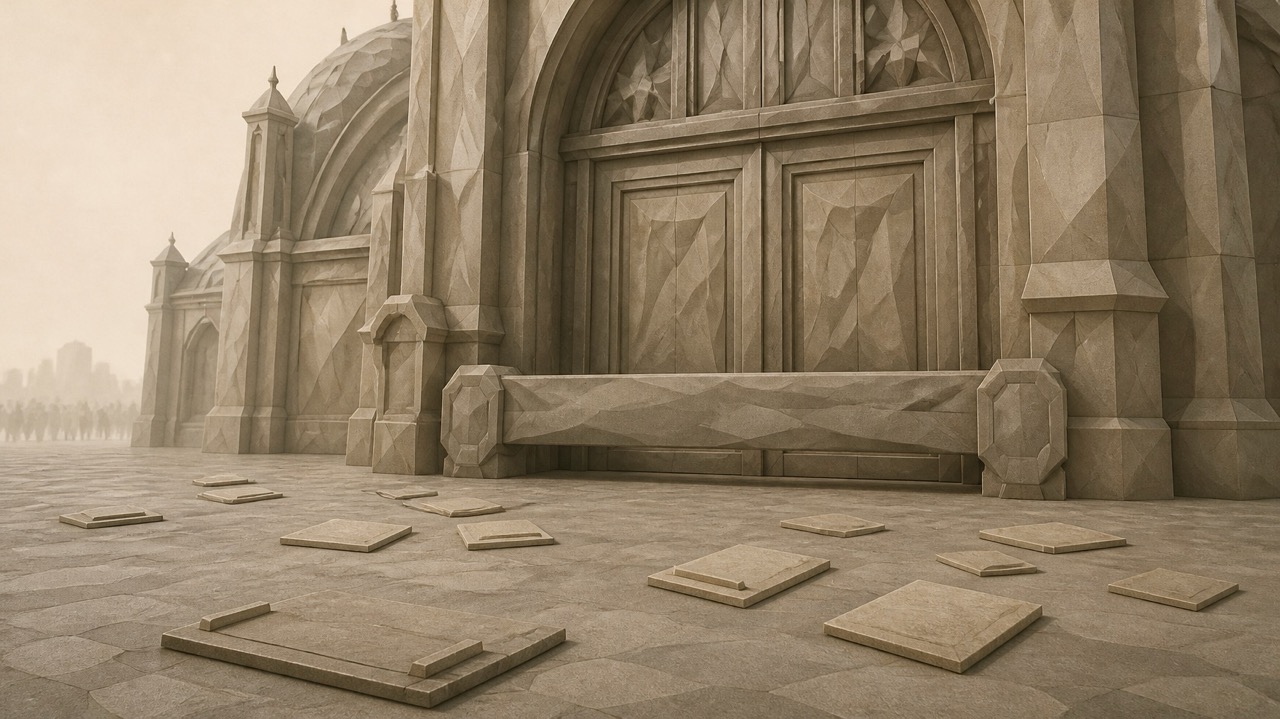
Art Basel Paris announced on 22 October 2026 that its fifth edition would conclude at 19:00 on Friday the 23rd. The fair would not open on Saturday the 24th or Sunday the 25th, its final two scheduled days. In the message sent to galleries and guests, the organisation alluded to potential demonstrations in Paris and the safety of visitors, exhibitors, partners, staff, and artworks.
The decision did not cancel the entire fair. By that time, the Tuesday opening for guests and the professional days on Wednesday and Thursday had already taken place, and Friday remained the only day for general access. According to Art Basel, the fair brought together 211 exhibitors from 41 countries and territories at the Grand Palais. The closure therefore had an uneven impact: the professional and commercial core had been able to operate, whereas the public holding tickets for the weekend lost their days of attendance.
Beyond the anecdote, an international fair is usually presented as a temporary venue that condenses works, galleries and buyers from different countries. In reality, it requires a city capable of sustaining it: transport, security, workers, hotels, catering, assembly, cleaning, energy, public space and predictability. When a mobilisation interrupts these conditions, the city ceases to function as a background and appears within the event.
A preventive closure, not a condemnation of the protest
The closure was decided in light of the mobilisations announced for the weekend following the protests of 17 October, which in several locations resulted in confrontations, looting, and material damage. Published reports linked the movement to conditions in education, the cost of living, and the state of public services. I have not located a single call to action that would allow for a homogeneous programme to be attributed to the participants as a whole, nor is it appropriate to conflate social protest with the violent acts that occurred during some mobilisations.
On 24 October, a new day of protests took place. In Paris, the route initially proposed between Bastille and Nation was replaced by another between Porte d’Italie and Porte de Vincennes after the Police Prefecture alleged risks to public order. Participation estimates once again differed between authorities and trade unions. Such discrepancies do not affect the fact that matters here: the fair's organisation took its decision before knowing how the marches would unfold, based upon an anticipated risk.
There is no basis for presenting the decision as proven hostility from Art Basel towards the right to protest. A private fair has security obligations regarding the people, works and equipment it brings together. Nor is it appropriate to demand that a commercial organisation replace the authorities in assessing public order. The relevant question is different: what the closure shows about the way a cultural institution processes a conflict situated outside its programme.
The statement reduced a complex political situation to operational categories: risk, security and alteration of visit plans. It is understandable. An organisation needs to decide on schedules, access, personnel, transport of works and responsibility towards third parties. But that translation also eliminates almost everything that motivated the mobilisation. The city appears before the fair mainly as a source of uncertainty.
Not all days were equal
Art Basel Paris does not distribute its days in the same way. The early opening and professional days concentrate gallerists, collectors, advisors, institutional representatives and the specialised press. General access comes later. This sequence is not exceptional: it is part of the habitual functioning of large fairs, where the most relevant operations can be concluded before the opening to the public.
In the 2026 edition, the professional days were held and during the first few days sales of several million dollars were reported. The Art Newspaper reported, for example, that White Cube was offering a work by Julie Mehretu for 7.8 million dollars. Artsy noted at least two sales of 10 million. These figures come from information disseminated by galleries and market media; they are not equivalent to audited public records of the operations. They serve, even with that caution, to show the economic scale that surrounded the fair before the closure.
Meanwhile, the protests were linked to education, public services and the rising cost of living. The coincidence does not prove that the fair caused those conditions, that the protesters were targeting the art market or that sales depended directly on the cuts denounced. Turning the contrast into a causal relationship would be unsustainable.
It does, however, allow us to observe two economies coexisting in the same city. One mobilises large amounts around singular objects, specialised access and international recognition. The other demands resources for common living conditions. The distance between both does not appear in the fair's sales balance, but it is part of the material environment that allows it to be held.
The closure rendered another inequality even more visible. Those who gained access via invitation or professional accreditation retained the principal part of the event; those who purchased day tickets or planned to attend over the weekend were left outside. The organisation announced that it would contact the affected individuals, yet the sources consulted do not allow for a general description of the outcome of each refund or compensation.
The closure, consequently, did not simply suppress two identical days. It protected an event whose commercial centre had already occurred and reduced its public dimension. That does not demonstrate that the decision sought to preserve sales over visits. It is the objective effect of the prior distribution of the calendar.
The infrastructure the market rarely shows
A work arrives at a fair after passing through packaging, insurance, transport, customs, handling, assembly, lighting, surveillance and documentation. Working around it are gallery staff, installers, transporters, mediators, technicians, cleaning, restoration, communication, security and administration. Buyers and images of the stands occupy the public representation of the event; the infrastructure appears above all when it fails.
The fair also depends on goods it does not produce: passable streets, public transport, police presence, permits, electricity supply and hotel capacity. Even its promise of internationality is supported by a very specific location. The Grand Palais, the urban centrality and the cultural density of Paris are not an interchangeable backdrop. They are part of the value that Art Basel Paris offers to galleries, sponsors and visitors.
The fair itself described the city as an integral part of its artistic and cultural identity. Its public programme extended to nine locations and relied on students from the École du Louvre to inform visitors. That strategy recognises that the appeal of the fair exceeds its stands: it is nourished by museums, institutions, public spaces and creative communities in Paris.
For this reason, the closure cannot be interpreted only as the retreat of a bubble alien to the outside. The fair had already included the city in its proposal; the problem arises when the city acts in a way that is unforeseen for that idea. An institution can integrate streets, monuments and free programmes into its cultural expansion, but it lacks the same language to assimilate the social conflict that runs through those spaces.
The city then enters the fair in a different way: not as a brand, a route or cultural capital, but as a material limit.
Public programme and selective access
Large contemporary fairs do not present themselves solely as markets. They organise conversations, commissions, installations and public programmes; they collaborate with institutions and occupy urban spaces. This openness broadens access and allows works to be seen outside of immediate transactions. It also reinforces the local roots of an ephemeral commercial activity.
In 2026, Art Basel Paris scheduled free projects at various points throughout the city. Some artworks installed in public spaces were affected by the situation. The sculpture L’Élévation des Mondes, by Alicja Kwade, situated in front of the Grand Palais, was removed earlier than planned. The piece, composed of polished stone spheres sourced from various locations, had been conceived to remain until Sunday.
Its early dismantling condenses a tension that the general closure also reveals. The public programme takes the fair beyond the controls of the venue, but the work situated outside remains exposed to conditions that the institution does not govern in the same way. Spatial openness increases the relationship with the city and, at the same time, the vulnerability to what occurs within it.
It should not be deduced that public space is intrinsically hostile to art, nor that the presence of a protest turns any work into a target. The withdrawal responded to a preventive assessment. But the gesture shows that the promise of openness retains a threshold: when the environment ceases to be controllable, the work returns to the protected circuit.
This difference also affects the discourse of cultural accessibility. The free programme may broaden the audience, but the temporal structure of the fair continues to hierarchise access. The cancellation of the final two days did not erase the entire edition; it left the reserved portion intact and annulled a large part of the general encounter. The public did not disappear from the official narrative, although it did lose the opportunity to enter.
Risk is not distributed equally
The statement listed visitors, exhibitors, partners, staff and works under a single concern for safety. This enumeration brings together assets and subjects with different risks. A work may suffer insurable or irreparable damage. A gallery may lose sales and professional relationships. A worker may lose hours, income or face transport problems. A visitor may lose a ticket, a trip or an exceptional opportunity for access.
The consequences of the closure are also not the same for a large international gallery as they are for a small structure that has invested a substantial portion of its resources in participating. The cost of the stand, transport, accommodation, production, insurance and staff is concentrated before the fair opens. Two fewer days can reduce contacts and sales without proportionally reducing expenses.
The available public information does not allow for the quantification of these losses or for stating how they were distributed. It is advisable to avoid speculative figures. It can, however, be stated that a preventive closure shifts costs between actors with differing capacities to absorb them.
Something similar occurs outside the fair. A mobilisation can impose costs on mobility and economic activity; security restrictions and deployments also impose them. The right of assembly and the protection of people and property are not resolved by denying one of the terms. In France, as in other European systems, the authorities may order routes and restrictions for reasons of public order, but such measures must be subject to criteria of necessity and proportionality. This article does not evaluate the legality of the decisions adopted in Paris: it does not have the administrative file or the complete resolutions necessary to do so.
Legal caution does not eliminate the political question. Who may interrupt the normal circulation of the city, under what conditions and with what legitimacy? A fair cuts off streets, concentrates security, modifies flows and occupies spaces through permits. A demonstration alters those same elements from the collective exercise of a right. Presenting only one of the two occupations as an interruption naturalises the other.
Criticism inside and outside the stand
Contemporary art has for decades incorporated works on inequality, political violence, colonialism, labour and protest. Fairs can sell these works and offer them international circulation. There is no automatic contradiction between the critical dimension of a work and its presence in the market: artists require channels for funding and distribution, and the commercial context does not exhaust the content of what is exhibited.
The tension appears when a critique represented inside the stand is legible and manageable, while the effective conflict outside the venue prevents the device from continuing. The critical work can be transported, insured, catalogued and sold. The protest does not arrive as a representation, but as an alteration of operational conditions.
To say that the fair "cannot integrate" the protest does not mean that it should open during a dangerous situation or turn a mobilisation into a cultural programme. It means that both forms of critique occupy distinct positions. One can circulate as content; the other intervenes in the infrastructure that allows that circulation.
In ‘Art as an asset’ I analysed how the market converts certain forms of recognition into price and liquidity. The closure of Art Basel Paris allows us to observe the prior condition: for that conversion to occur, a sufficiently stable political and urban infrastructure is required. The market does not, by itself, produce the conditions of its apparent autonomy.
This dependency does not invalidate the fair, either. It situates it. Art Basel Paris was not a scandalous exception within a market normally separated from society. It was an especially visible case of an ordinary dependency.
After the closure
A responsible reading should distinguish between facts, effects and interpretations.
The fact is that Art Basel Paris concluded on Friday 23 October at 19:00 and remained closed on Saturday and Sunday in anticipation of further planned demonstrations. It is also documented that the edition brought together 211 exhibitors, that the professional days were held, and that the closure reduced general access to a single day.
The outcome was a curtailed fair, with disruptions for visitors, galleries, staff, artworks, and associated programmes. Its distribution was unequal, as the initial days did not serve the same function as the final ones.
The interpretation proposed here is that the closure rendered the fair's urban and political infrastructure visible. It does not demonstrate an intention to exclude protest, nor a causal link between the art market and social demands. It exposes something more fundamental: the international circulation of works and capital depends upon common conditions that typically remain outside the market's image.
The title of this article does not assert that protesters physically breached the Grand Palais. The city entered the fair because an external situation reorganised its calendar, its access, and its relationship with the public. The institution was able to close its doors, but it could not decouple its operations from the location that provided its value.
An open conversation
This text distinguishes the documented facts regarding the closure from the interpretations it proposes. If you participated in the fair, worked on any of its programmes, or can provide documentation regarding its effects, you may write to me.
Sources
- Art Basel, "Votre guide essentiel d’Art Basel Paris 2026", official information regarding galleries, venues, and the public programme.
- Art Basel, "Paris: Visitor Information", official information regarding visits and the status of the edition.
- Art Basel, announcement of the Art Basel Paris 2026 gallery list, 211 exhibitors from 41 countries and territories in the Galeries, Emergence, and Premise sectors.
- Gareth Harris, "Art Basel Paris to close early due to protests", The Art Newspaper, 22 October 2026.
- Arun Kakar, "Art Basel Paris 2026 to close early amid protests", Artsy, 22 October 2026.
- "Art Basel Paris is closing two days early to avoid issues related to Saturday’s protests", Finestre sull’Arte, 22 October 2026.
- Gabriel Mihai, "Paris protest puts cost of living and public freedoms in focus", Impact European, 24 October 2026.