
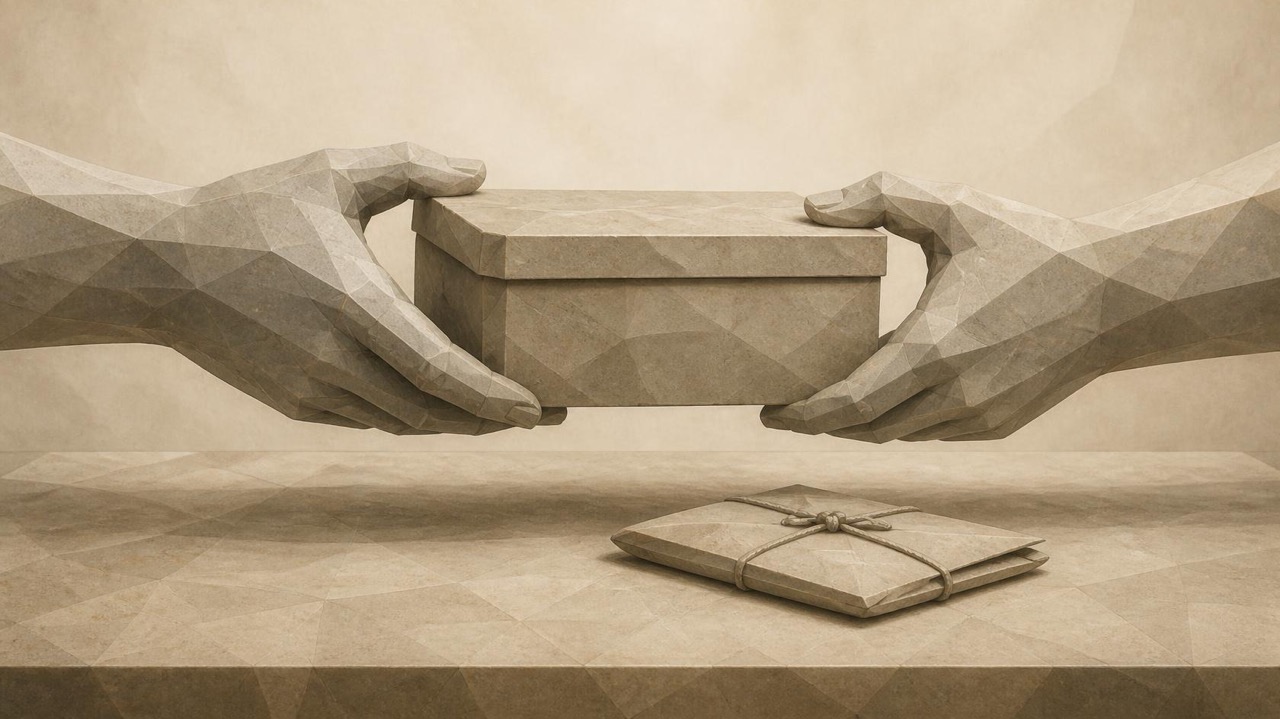
The file and the rights travel along different paths, and almost all conflicts arise from confusing them. A designer delivers the editable file of a catalogue and the client believes they may alter it at their discretion. An artist sells a digital work and the purchaser expects to receive the master. An illustrator shares the AI model they fine-tuned on their style and the recipient does not know whether they may use it.
What the law says
The Spanish Intellectual Property Act requires that each delivery and each assignment be interpreted according to the contract. Articles 43 to 45 limit the transfer to the rights, modalities, time, and territory agreed upon and require formalisation in writing. Receiving the medium or the file does not, in itself, transfer the exploitation rights, under Article 56.1. The transfer of rights must be agreed upon in writing, and is only valid for what has been agreed: which rights, for what uses, for how long, and where. A professional commission does not imply assigning everything, and the law does not mandate the delivery of source files simply because a job has been paid for.
The law contains no general rule mandating the delivery of source files because a commission has been paid. The obligation may arise from the contract, the agreed purpose, or specific circumstances, but it must not be confused with the assignment of rights. The absence of a clear clause shifts the conflict to the interpretation of the commission.
Editable, master, and final copy are not synonyms
An editable file allows the work process to continue: a file with layers, a video project, a publication layout, or a repository. A master is an approved, high-quality version from which derivatives are generated. The final copy is the file prepared for a specific use. Delivering one does not imply delivering the others.
The contract should name each element, its format, version, function, and date. It must also clarify whether fonts, linked images, plug-ins, libraries, models, data, passwords, or licences are included. Some resources cannot be redistributed even if they form part of the process.
The new case: fine-tuned models
Artificial intelligence has added a type of file. An adapter, such as a LoRA, contains the adjustments made to an AI model with a set of images, for example, an artist's work. However, it does not function alone: it requires the base model. And what may be done with it depends on the licence of that model, the data used, and the platform. Delivering an adapter without clarifying all of this is delivering a file that may not be usable, or may not be legally usable.
Which uses must be agreed upon
In addition to identifying the file, it is necessary to specify what the recipient may do:
- Archive and make backup copies.
- Modify or adapt.
- Print, publish, exhibit, or distribute.
- Deliver to another professional.
- Migrate to another format or environment.
- Reuse elements in different projects.
The delivery may include a limited licence without total assignment, or an assignment of specific rights. Moral rights are not transferred in the same way as exploitation rights. Third-party licences and personal data retain their own conditions.
The precedent: what museums ask for
Museums that acquire digital work have found a practical response. Their acquisition protocols, such as those of Matters in Media Art, expressly request source files where applicable, executables, dependencies, documentation, the rights being assigned, a copy for exhibition, and conservation conditions. Nothing is taken for granted: each element is named.
The limit is that those protocols bind only those who use them. The private market, where most commissions and sales happen, continues to operate with verbal agreements or invoices that do not state what is being delivered.
How to document the delivery
A manifest reduces ambiguities. It must list files and folders, sizes, formats, versions, checksums, necessary software, and licences. It is advisable to register separately what is delivered, what is not delivered, and what must be obtained from third parties. If a file is corrected, it is not overwritten silently: a new version is created and the history is preserved.
Naming each element
In my view, the problem is one of language rather than law: one says ‘the file’ or ‘the work’ as if they were the same as ‘the rights’. The museum's solution, naming each element separately, is what any commission or sale should replicate. I explain this in the guides on editable files, commissioning graphic design, and training a model with your own work.
About the open conversation
This text separates the data from my interpretation and does not constitute legal advice. If you commission design work, sell digital work, or work with adjusted models and wish to clarify a point or discuss this reading, this notebook remains open: write to me.
The author's relationship with the cases
There is no economic, professional, or collection-based relationship with the individuals, companies, and institutions cited.