
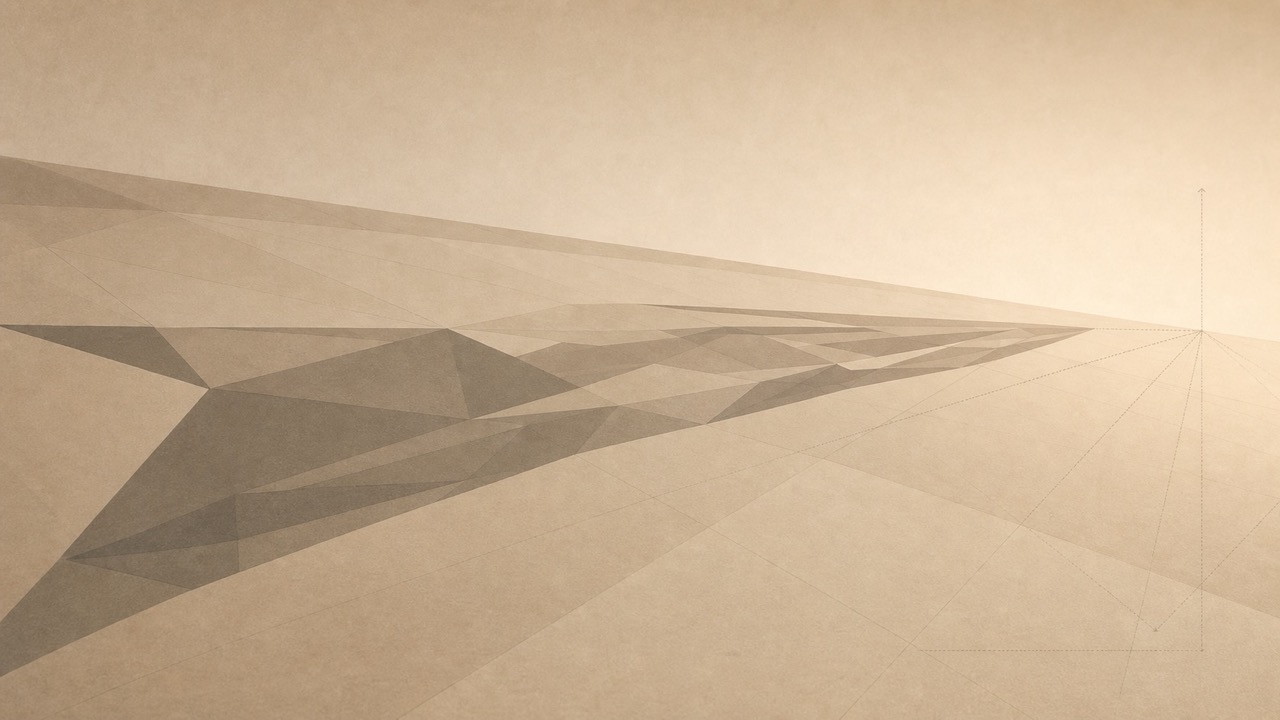
In the National Gallery in London hangs a painting from 1533 that almost everyone views incorrectly, and not through carelessness: it is because the painter arranged it so. It is The Ambassadors, by Hans Holbein the Younger. Two powerful, young, and wealthy men stand amidst the objects of their world: terrestrial and celestial globes, astronomical instruments, books, a lute, expensive carpets. Everything speaks of knowledge, commerce, and mastery of the world. And stretched across the floor, before their feet, lies an oblique, elongated blur that cannot be understood from the front. It appears as a smudge, an error, a splinter floating in the air.
It is not. It is a skull. Yet a skull painted in such a manner that it only recovers its form if the viewer steps to one side, presses themselves almost against the wall, and observes the painting obliquely, at a very acute angle. Then the blur resolves, the proportions align, and a sharp skull appears, gazing at you. This is the technique known as anamorphosis: an image calculated not to be viewed from the front, but from a lateral and eccentric point. Holbein incorporated two distinct perspectives into a single painting, with two observation positions that do not coincide.
When you view the painting from the front, as one views any portrait, the world of the ambassadors is in order: the faces, the instruments, the fabrics, everything coherent and legible. Yet the skull, death, is illegible, an optical residue that one cannot decipher. And when you move to the side so that the skull recomposes itself, the opposite occurs: death appears with absolute clarity, and in exchange, the ambassadors and their entire world become distorted, stretched, and unintelligible. There is no single location from which both things may be viewed correctly. Each position grants you one and denies you the other.
The conventional reading suggests the skull is a memento mori: a reminder of death inserted into the midst of a portrait of power and knowledge, to warn that all such things are transient. This is true, and the painting reinforces it with details: a crucifix half-hidden in a corner, a lute with a broken string, a book opened to a page concerning division, in the midst of the religious schism of 1533. Yet the memento mori is the theme, and the mechanism conveys more than the theme: that to see death one must lose sight of the world, and to see the world one must leave death out of focus. It is not a moral lesson; it is a physical condition imposed by the painting. Holbein did not paint it; he constructed it.
Because that skull is not hidden. Hidden is that which is covered and must be discovered; once you find it, it is in plain sight. Holbein's skull is always in plain sight; it is never concealed. It is reserved for another position, for a place in space that is not the one from which the portrait is contemplated. You do not have to discover it: you have to move. And in doing so, you lose what you saw before. The painting compels you to choose a location and teaches you that every location has a price, that to see one thing is to cease seeing another.
We tend to believe that there exists a correct point of view, the frontal, the neutral, the one that captures everything, and that the others are distortions. Holbein dismantles this notion without discourse, solely through optics. The perspective termed correct, that of the Renaissance, is also a point of view, one among others: it constructs a coherent world from a determined position, and from that position, there are things that cannot be seen. It is not that truth does not exist, nor that all gazes are of equal value. It is that no position gathers everything there is to see. To look is to situate oneself, and to situate oneself always leaves something outside the frame, or within it but illegible.
Almost five centuries have passed, yet the painting continues to pose the same silent question to the viewer—the one it puts to those who approach without knowledge and suddenly see the blur resolve into a skull: from where are you looking, and what are you missing by looking from there? There is no answer that remains valid forever, for as soon as you move to see what you were lacking, you begin to lose what you already possessed.
Holbein did not paint a skull within a portrait. He painted the fact that we never see from nowhere, but always from somewhere.
About the open conversation
This text begins with a verified optical fact, the anamorphic skull in Holbein's The Ambassadors, to reflect upon a subject that has occupied my research: that to look is to occupy a position, and that no single position encompasses everything there is to see. I distinguish what is demonstrated (the anamorphic mechanism, the two incompatible viewpoints) from what remains hypothetical (that the painting hung beside a staircase) and from what would constitute excessive interpretation (leaping from “all vision is situated” to “there is no truth,” a claim the painting does not make). Should anyone wish to contribute from the fields of art history, optics, perspective theory, or the philosophy of perception, this notebook remains open.
Sources
National Gallery, London, record and catalogue entry for The Ambassadors by Hans Holbein the Younger (1533); Technical Bulletin on the 1996-1997 restoration (determination of the shape of the skull by image analysis).
On the mechanism of the two incompatible viewpoints: University of British Columbia, 'Forms of Perspective'.
Regarding anamorphosis as extreme perspective and its precedents (Leonardo’s experiments, Codex Atlanticus, ca. 1490): D. Sherer, “Anamorphosis and the Hermeneutics of Perspective”.
The original placement beside a staircase and the direct influence of Leonardo upon Holbein are recorded as hypotheses, not as documented facts.