
A position on the emerging debate
The debate has been circling itself for three years; in recent months, it has begun to find a partial resolution. I propose a complete one.
The debate is this: who is the author of a work created with artificial intelligence? For three years, responses have oscillated between two poles, both of which are exhausted.
At one pole lies legal anthropocentrism. Copyright offices—led by that of the United States—demand a controlling human behind the work to grant it protection. Without a conscious human subject in command, there is no author and no protectable work. This position is administratively convenient yet philosophically impoverished: it reduces the question of authorship to a search for the finger that pressed the button.
En el otro polo, la coautoría por suma de partes. La obra de IA no tiene un autor único, sino varios: el programador del modelo, el dataset, quien escribe el prompt. Autoría distribuida. Es menos ingenua que la anterior, pero sigue atrapada en la misma pregunta: solo cambia «un autor» por «varios autores». Sigue buscando sujetos a los que asignar la obra.
Entre ambos polos, en los últimos meses, ha empezado a aparecer una tercera vía más interesante: volver a Alfred Gell. La antropología del arte de Gell (Art and Agency, 1998) tiene una virtud que el debate necesitaba: desactiva la exigencia de conciencia. Para Gell, un objeto tiene agencia no porque «piense», sino porque actúa dentro de una red de relaciones sociales: fascina, obliga, captura. La obra es una trampa que retiene la intención de quien la hizo y actúa sobre quien la mira. Aplicado a la IA, esto permite hablar de la agencia de la obra sin atribuirle una mente. Es un avance; entiendo por qué el campo se está girando hacia ahí.
Pero es una salida a medias. Gell resuelve un problema y hereda otro. Resuelve el de la conciencia: ya no necesitamos preguntar si la máquina piensa. Pero hereda una vulnerabilidad bien documentada en la propia antropología. La crítica clásica a Gell —formulada por Robert Layton, Howard Morphy y otros— es que su noción de agencia objetual es «una analogía llevada demasiado lejos»: los objetos no actúan, no cambian por sí mismos; hay un sujeto que atribuye agencia a la materia. La trampa de Gell solo funciona en la medida en que simula eficazmente una intención humana. Es decir: Gell desplaza el antropocentrismo, no lo supera. Lo mantiene por vía diferida. La obra de IA sería una trampa porque imita bien lo que haría un humano.
Furthermore, there is something else, which is decisive. Gell's ontology is instrumental at its root: for him, art is a system of action designed to influence others—to capture, enchant, or socially control. The trap demands a functional performance: it exists to do something to someone. This sits poorly with what truly interests us when we discuss art, and it sits especially poorly with AI, where the system's primary function is already defined in advance: to generate an output that responds to the prompt. If art is merely effective capture, then an AI image that fulfills the request well would be the perfect case of Gellian art. Yet we know this is not the case. Fulfilling the function does not make it art.
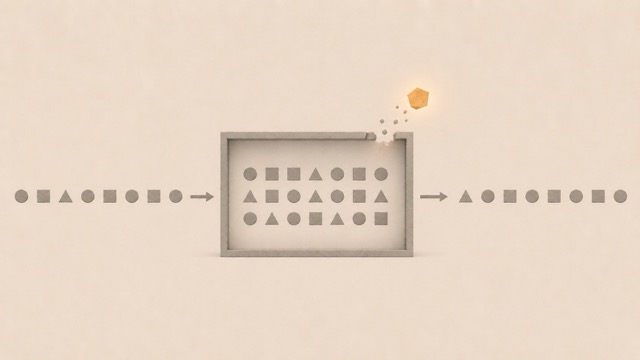
This is where I have been working in a different direction for years. What defines the artistic event is not who originates it—human or machine—nor its efficacy in influencing others. It is something I have termed structural surplus: a relational difference that persists and reorganises the field of a system's possible configurations, without allowing itself to be absorbed by that system's primary function.
Translated to the context of AI: the primary function of a generative system is to produce an optimal output that responds to the prompt. That is the purpose for which the system exists. The artistic event—if there is one—does not lie in the fulfilment of that function, however well it may be performed. It lies in the surplus: in what remains, in the difference that the system produces which its own function fails to reabsorb. Art is not the successful output. It is the remainder that overflows the task.
Esto cambia la pregunta entera. Deja de importar quién es el autor —la pregunta de los dos primeros polos—. Deja de importar si la obra «actúa» como una trampa —la pregunta de Gell—. La pregunta pasa a ser: ¿produce este encuentro un excedente que reorganiza algo y no se deja reducir a la función que lo originó? Y esa pregunta se puede hacer igual de un cuadro al óleo, de una obra generativa, o incluso de una interacción entre dos máquinas, sin necesidad de buscar un sujeto detrás ni de fingir que el objeto tiene voluntad.
The advantage is not merely rhetorical. Gell explains one part well: how AI functions as an infrastructure of capture that redistributes prior human agencies—those of the engineers, those of the millions of artists whose work is in the data. That is true and useful. But Gell cannot conceive of what we do need: the possibility of an artistic event that does not refer back to any human agent, not even in a deferred manner. Structural surplus can, because it does not locate art in the agent that originates the action, but in the persistence of a difference that no agent controls entirely.
The question of art in the age of AI is not whose work it is, nor whom it captures. It is what, in that encounter, overflows the function and reorganises the field.
This is what I have been calling structural surplus, the framework from which I will continue to work on this issue. Not as another variant of the relational turn, but as its consequence: if art was always relational, AI inaugurates nothing new. It only renders undeniable that the artistic event was never in the author, but in what remains.
Sources
Gell, A. (1998). Art and Agency: An Anthropological Theory. Oxford: Clarendon Press.
Layton, R. (2003). Art and Agency: A Reassessment. Journal of the Royal Anthropological Institute, 9(3), 447–464. https://doi.org/10.1111/1467-9655.00158
Morphy, H. (2009). Art as a Mode of Action: Some Problems with Gell’s Art and Agency. Journal of Material Culture, 14(1), 5–27. https://doi.org/10.1177/1359183508100009
Van Eck, C. (2010). Living Statues: Alfred Gell’s Art and Agency, Living Presence Response and the Sublime. Art History, 33(4), 642–659. https://doi.org/10.1111/j.1467-8365.2010.00767.x
Esteban Ruiz, J. A. (2026). Art as Structural Surplus: Toward a Relational Ontology Beyond Human Authorship (V2.3). PhilArchive and Zenodo.
Esteban Ruiz, J. A. Procesos sin significado. Public Notebook at juanesteban.art, 2026.